

66
2 Energy Sector Progression in India
Alternative Fuels
1. Development of alternative fuels such as coalbed methane, ethanol blending, gas
hydrates, and fuel cells.
Coalbed Methane
It was estimated that India had around 1000 billion cubic meters of coalbed
methane which was likely to emerge as a new source of commercial energy.
Blending of Petrol and Diesel with Ethanol
A decision was taken to blend petrol and diesel with 5% ethanol to be obtained
from sugar industry.
Gas Hydrates
Undertake drilling operations to produce gas from gas hydrates.
Alongside hydrocarbon vision, the focus on nuclear energy was also reinforced
and a three-stage approach was envisioned:
Stage 1: Setting up 10,000-megawatt plant based on pressurized heavy water
reactor using indigenous natural uranium resources.
Stage 2: Introduce fast breeder reactor technology using plutonium extracted from
reprocessing of spent fuel from stage 1.
Stage 3: Utilize indigenous and natural thorium resources for power generation.
Since India is poorly endowed with natural uranium, the three-stage program was
aimed at converting thorium to fissile material. The available uranium resources
support only 10,000-megawatt power generation. Nonetheless, the potential of
natural uranium could be enhanced to 30,000 megawatt through fast breeder reactors
that use plutonium obtained from recycled spent fuel of stage 1.
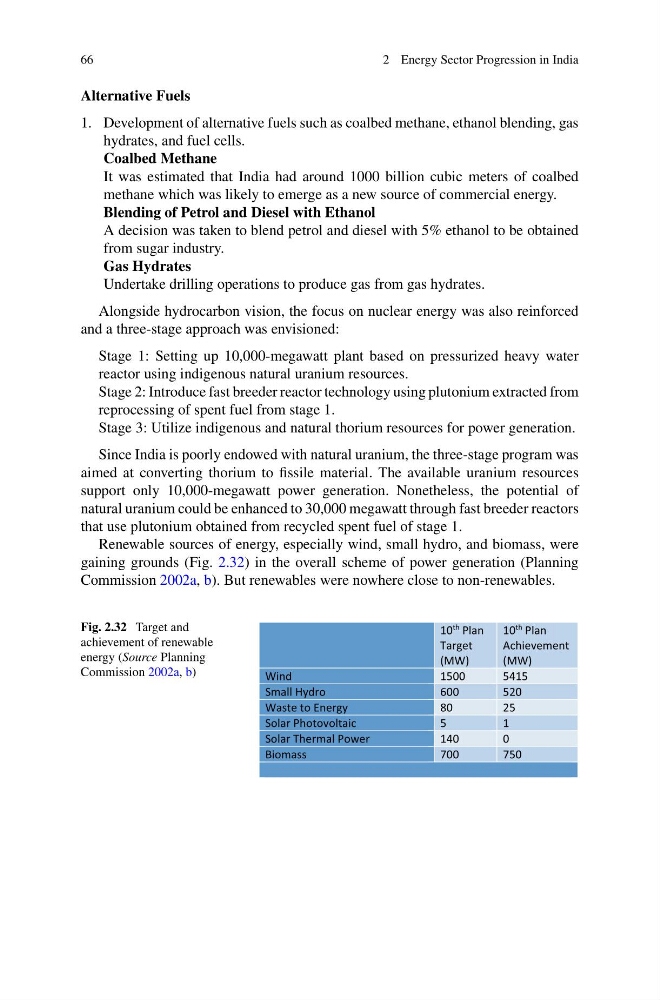
Renewable sources of energy, especially wind, small hydro, and biomass, were
gaining grounds (Fig. 2.32) in the overall scheme of power generation (Planning
Commission 2002a, b). But renewables were nowhere close to non-renewables.
Fig. 2.32 Target and
achievement of renewable
energy (Source Planning
Commission 2002a, b)
10
th Plan
Target
(MW)
10
th Plan
Achievement
(MW)
Wind
1500
5415
Small Hydro
600
520
Waste to Energy
80
25
Solar Photovoltaic
5
1
Solar Thermal Power
140
0
Biomass
700
750
2 Energy Sector Progression in India
Alternative Fuels
1. Development of alternative fuels such as coalbed methane, ethanol blending, gas
hydrates, and fuel cells.
Coalbed Methane
It was estimated that India had around 1000 billion cubic meters of coalbed
methane which was likely to emerge as a new source of commercial energy.
Blending of Petrol and Diesel with Ethanol
A decision was taken to blend petrol and diesel with 5% ethanol to be obtained
from sugar industry.
Gas Hydrates
Undertake drilling operations to produce gas from gas hydrates.
Alongside hydrocarbon vision, the focus on nuclear energy was also reinforced
and a three-stage approach was envisioned:
Stage 1: Setting up 10,000-megawatt plant based on pressurized heavy water
reactor using indigenous natural uranium resources.
Stage 2: Introduce fast breeder reactor technology using plutonium extracted from
reprocessing of spent fuel from stage 1.
Stage 3: Utilize indigenous and natural thorium resources for power generation.
Since India is poorly endowed with natural uranium, the three-stage program was
aimed at converting thorium to fissile material. The available uranium resources
support only 10,000-megawatt power generation. Nonetheless, the potential of
natural uranium could be enhanced to 30,000 megawatt through fast breeder reactors
that use plutonium obtained from recycled spent fuel of stage 1.
Renewable sources of energy, especially wind, small hydro, and biomass, were
gaining grounds (Fig. 2.32) in the overall scheme of power generation (Planning
Commission 2002a, b). But renewables were nowhere close to non-renewables.
Fig. 2.32 Target and
achievement of renewable
energy (Source Planning
Commission 2002a, b)
10
th Plan
Target
(MW)
10
th Plan
Achievement
(MW)
Wind
1500
5415
Small Hydro
600
520
Waste to Energy
80
25
Solar Photovoltaic
5
1
Solar Thermal Power
140
0
Biomass
700
750