

5.4 Renewable Energy Assessment—India
167
Small Hydro Power
Wind Power
Cogeneraon
Waste to Energy
Solar Power
4146.82
24376.26
4418.55
127.08
4346.818
4608.807
36750.42
9806.31
139.8
30708.85
Grid Interacve Renewable Power (MW) as on 30.09.2015
Grid Interacve Renewable Power (MW) as on 31.08.2019
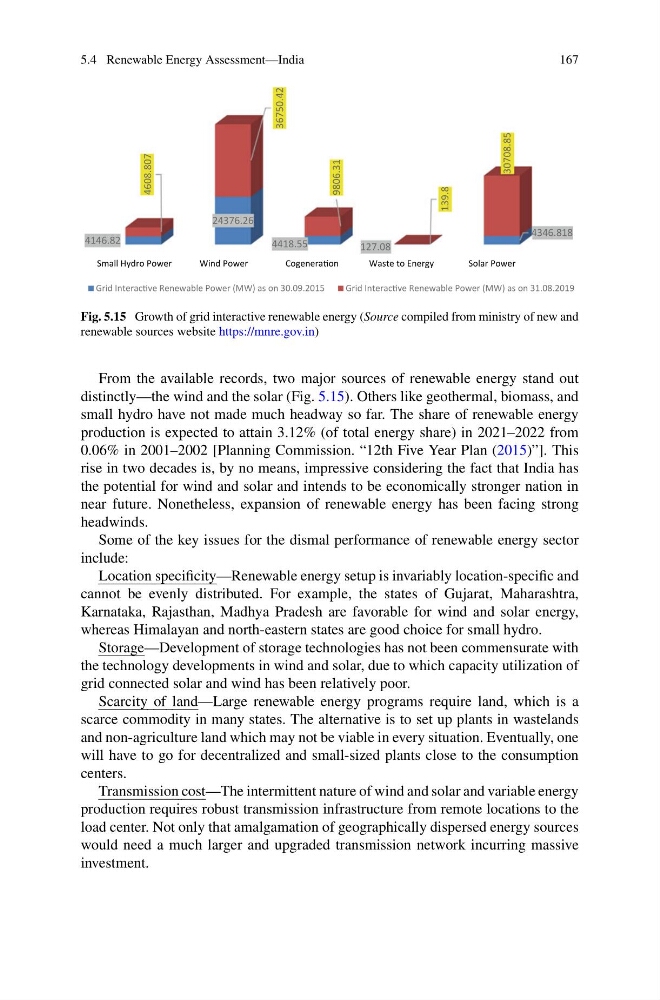
Fig. 5.15 Growth of grid interactive renewable energy (Source compiled from ministry of new and
renewable sources website https://mnre.gov.in)
From the available records, two major sources of renewable energy stand out
distinctly—the wind and the solar (Fig. 5.15). Others like geothermal, biomass, and
small hydro have not made much headway so far. The share of renewable energy
production is expected to attain 3.12% (of total energy share) in 2021–2022 from
0.06% in 2001–2002 [Planning Commission. “12th Five Year Plan (2015)”]. This
rise in two decades is, by no means, impressive considering the fact that India has
the potential for wind and solar and intends to be economically stronger nation in
near future. Nonetheless, expansion of renewable energy has been facing strong
headwinds.
Some of the key issues for the dismal performance of renewable energy sector
include:
Location specificity—Renewable energy setup is invariably location-specific and
cannot be evenly distributed. For example, the states of Gujarat, Maharashtra,
Karnataka, Rajasthan, Madhya Pradesh are favorable for wind and solar energy,
whereas Himalayan and north-eastern states are good choice for small hydro.
Storage—Development of storage technologies has not been commensurate with
the technology developments in wind and solar, due to which capacity utilization of
grid connected solar and wind has been relatively poor.
Scarcity of land—Large renewable energy programs require land, which is a
scarce commodity in many states. The alternative is to set up plants in wastelands
and non-agriculture land which may not be viable in every situation. Eventually, one
will have to go for decentralized and small-sized plants close to the consumption
centers.
Transmission cost—The intermittent nature of wind and solar and variable energy
production requires robust transmission infrastructure from remote locations to the
load center. Not only that amalgamation of geographically dispersed energy sources
would need a much larger and upgraded transmission network incurring massive
investment.
167
Small Hydro Power
Wind Power
Cogeneraon
Waste to Energy
Solar Power
4146.82
24376.26
4418.55
127.08
4346.818
4608.807
36750.42
9806.31
139.8
30708.85
Grid Interacve Renewable Power (MW) as on 30.09.2015
Grid Interacve Renewable Power (MW) as on 31.08.2019
Fig. 5.15 Growth of grid interactive renewable energy (Source compiled from ministry of new and
renewable sources website https://mnre.gov.in)
From the available records, two major sources of renewable energy stand out
distinctly—the wind and the solar (Fig. 5.15). Others like geothermal, biomass, and
small hydro have not made much headway so far. The share of renewable energy
production is expected to attain 3.12% (of total energy share) in 2021–2022 from
0.06% in 2001–2002 [Planning Commission. “12th Five Year Plan (2015)”]. This
rise in two decades is, by no means, impressive considering the fact that India has
the potential for wind and solar and intends to be economically stronger nation in
near future. Nonetheless, expansion of renewable energy has been facing strong
headwinds.
Some of the key issues for the dismal performance of renewable energy sector
include:
Location specificity—Renewable energy setup is invariably location-specific and
cannot be evenly distributed. For example, the states of Gujarat, Maharashtra,
Karnataka, Rajasthan, Madhya Pradesh are favorable for wind and solar energy,
whereas Himalayan and north-eastern states are good choice for small hydro.
Storage—Development of storage technologies has not been commensurate with
the technology developments in wind and solar, due to which capacity utilization of
grid connected solar and wind has been relatively poor.
Scarcity of land—Large renewable energy programs require land, which is a
scarce commodity in many states. The alternative is to set up plants in wastelands
and non-agriculture land which may not be viable in every situation. Eventually, one
will have to go for decentralized and small-sized plants close to the consumption
centers.
Transmission cost—The intermittent nature of wind and solar and variable energy
production requires robust transmission infrastructure from remote locations to the
load center. Not only that amalgamation of geographically dispersed energy sources
would need a much larger and upgraded transmission network incurring massive
investment.