

166
5 Fourth Industrial Revolution and India
0
2000
4000
6000
8000
10000
12000
14000
Karnataka
Tamil Nadu
Maharashtra
Gujarat
Rajasthan
Andhra Pradesh
Madhya Pradesh
Telangana
Uar Pradesh
Punjab
Himachal Pradesh
Uarakhand
Chha
West Bengal
Kerala
Haryana
Bihar
Odisha
Jammu & Kashmir
Delhi
Arunachal Pradesh
Sikkim
Assam
Mizoram
Jharkhand
Nagaland
Meghalaya
Chandigarh
Tripura
Daman & Diu
Andaman- Nicobar
Manipur
D.N.Haveli
Puducherry
Lakshadweep
Goa
Installed Capacity (MW) as on 31.01.2011 [Source Ministry of Power. "Annual report 2010–2011." (2011).]
Installed Capacity (MW) as on 30-November, 2018 [Source -Sabha, Lok. “Lok Sabha Question 337 (Archive)” (2019)]
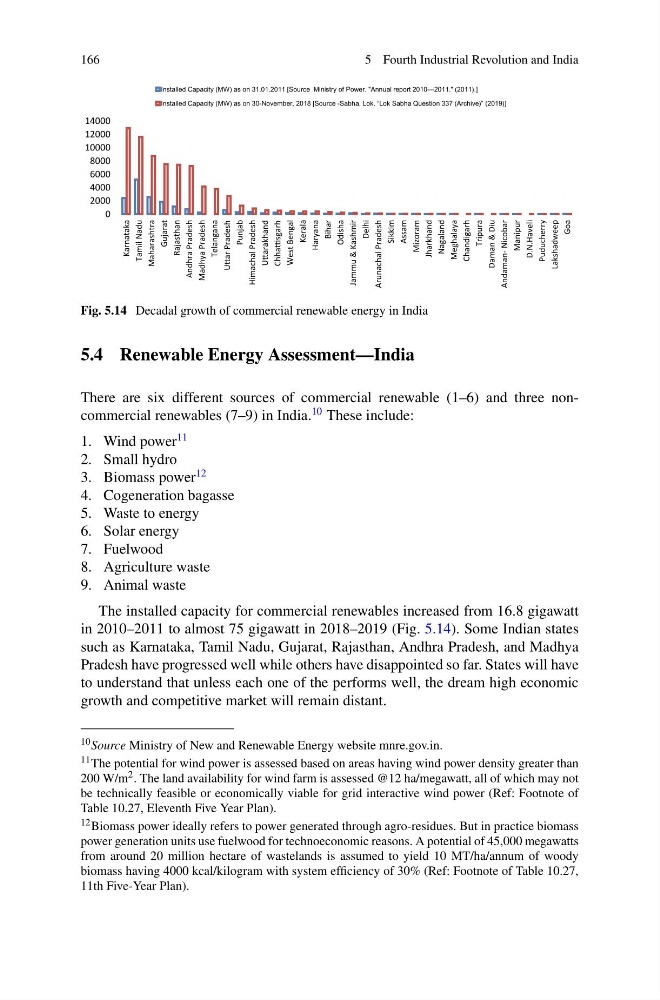
Fig. 5.14 Decadal growth of commercial renewable energy in India
5.4 Renewable Energy Assessment—India
There are six different sources of commercial renewable (1–6) and three noncommercial renewables (7–9) in India.
10 These include:
1. Wind power
11
2. Small hydro
3. Biomass power
12
4. Cogeneration bagasse
5. Waste to energy
6. Solar energy
7. Fuelwood
8. Agriculture waste
9. Animal waste
The installed capacity for commercial renewables increased from 16.8 gigawatt
in 2010–2011 to almost 75 gigawatt in 2018–2019 (Fig. 5.14). Some Indian states
such as Karnataka, Tamil Nadu, Gujarat, Rajasthan, Andhra Pradesh, and Madhya
Pradesh have progressed well while others have disappointed so far. States will have
to understand that unless each one of the performs well, the dream high economic
growth and competitive market will remain distant.
10 Source Ministry of New and Renewable Energy website mnre.gov.in.
11 The potential for wind power is assessed based on areas having wind power density greater than
200 W/m 2 . The land availability for wind farm is assessed @12 ha/megawatt, all of which may not
be technically feasible or economically viable for grid interactive wind power (Ref: Footnote of
Table 10.27, Eleventh Five Year Plan).
12 Biomass power ideally refers to power generated through agro-residues. But in practice biomass
power generation units use fuelwood for technoeconomic reasons. A potential of 45,000 megawatts
from around 20 million hectare of wastelands is assumed to yield 10 MT/ha/annum of woody
biomass having 4000 kcal/kilogram with system efficiency of 30% (Ref: Footnote of Table 10.27,
11th Five-Year Plan).
5 Fourth Industrial Revolution and India
0
2000
4000
6000
8000
10000
12000
14000
Karnataka
Tamil Nadu
Maharashtra
Gujarat
Rajasthan
Andhra Pradesh
Madhya Pradesh
Telangana
Uar Pradesh
Punjab
Himachal Pradesh
Uarakhand
Chha
West Bengal
Kerala
Haryana
Bihar
Odisha
Jammu & Kashmir
Delhi
Arunachal Pradesh
Sikkim
Assam
Mizoram
Jharkhand
Nagaland
Meghalaya
Chandigarh
Tripura
Daman & Diu
Andaman- Nicobar
Manipur
D.N.Haveli
Puducherry
Lakshadweep
Goa
Installed Capacity (MW) as on 31.01.2011 [Source Ministry of Power. "Annual report 2010–2011." (2011).]
Installed Capacity (MW) as on 30-November, 2018 [Source -Sabha, Lok. “Lok Sabha Question 337 (Archive)” (2019)]
Fig. 5.14 Decadal growth of commercial renewable energy in India
5.4 Renewable Energy Assessment—India
There are six different sources of commercial renewable (1–6) and three noncommercial renewables (7–9) in India.
10 These include:
1. Wind power
11
2. Small hydro
3. Biomass power
12
4. Cogeneration bagasse
5. Waste to energy
6. Solar energy
7. Fuelwood
8. Agriculture waste
9. Animal waste
The installed capacity for commercial renewables increased from 16.8 gigawatt
in 2010–2011 to almost 75 gigawatt in 2018–2019 (Fig. 5.14). Some Indian states
such as Karnataka, Tamil Nadu, Gujarat, Rajasthan, Andhra Pradesh, and Madhya
Pradesh have progressed well while others have disappointed so far. States will have
to understand that unless each one of the performs well, the dream high economic
growth and competitive market will remain distant.
10 Source Ministry of New and Renewable Energy website mnre.gov.in.
11 The potential for wind power is assessed based on areas having wind power density greater than
200 W/m 2 . The land availability for wind farm is assessed @12 ha/megawatt, all of which may not
be technically feasible or economically viable for grid interactive wind power (Ref: Footnote of
Table 10.27, Eleventh Five Year Plan).
12 Biomass power ideally refers to power generated through agro-residues. But in practice biomass
power generation units use fuelwood for technoeconomic reasons. A potential of 45,000 megawatts
from around 20 million hectare of wastelands is assumed to yield 10 MT/ha/annum of woody
biomass having 4000 kcal/kilogram with system efficiency of 30% (Ref: Footnote of Table 10.27,
11th Five-Year Plan).