

4.3 Land Use, Land-Use Change, and Forestry
131
BOX 3 - Details of Methane CH4 emissions in 1994
[Source- India, MoE. 2004]
Rice cultivation
Anaerobic decomposition of organic material in
flooded rice fields produces methane, which
escapes into the atmosphere primarily by
diffusive transport through the rice plants during
the growing season. There are large spatial and
temporal variations of methane fluxes which
occur due to different soil types, soil organic
carbon and various agricultural practices such
as choice of water management and cultivar,
the application of organic amendments, the
mineral fertilizer, and soil organic carbon.
Burning of Agricultural crop residue
Burning of crop residue is a significant net
source of methane. The amount of agricultural
waste produced by a country depends on its
crop management system. In India, the primary
end-uses of crop residue are as animal fodder,
industrial and domestic fuel, thatching,
packaging,
bedding,
construction
of
walls/fences, and as green-manure and
compost. The leftover is available for field
burning and even this varies with local and
regional climate, season, livestock distribution,
availability of fuelwood, availability of fodder,
weed infestation etc.
Manure management
The decomposition of organic animal waste in
an anaerobic environment produces methane.
The waste produced by non-ruminant animals in
India is not collected. However, that of cattle and
buffalo are used for a variety of purposes
including sun dried dung cakes for cooking or
for biogas.
Municipal Solid waste management
Solid waste disposal in India takes place in two
distinct ways. In rural areas and small towns,
there is no systematic collection of waste and it
is haphazard. As anaerobic conditions do not
develop, no methane is generated in these
areas. However, in urban towns, solid waste is
disposed by land filling in low-lying areas
located in and around the urban centers. Due to
stacking of waste over the years, anaerobic
conditions develop, and hence these dumping
sites generate large quantities of biogas
containing a sizeable proportion of methane.
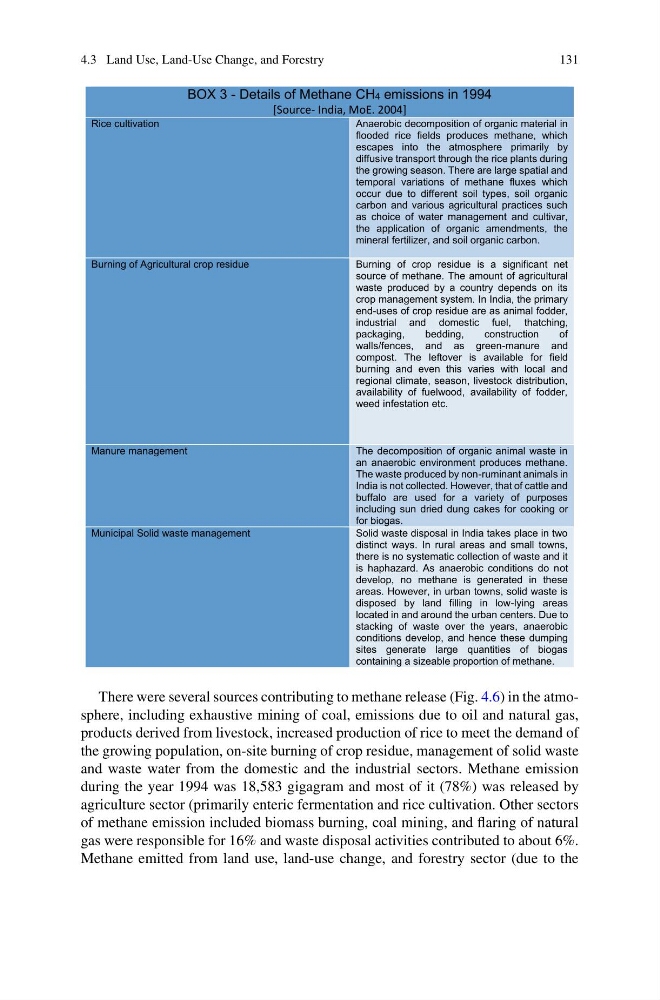
There were several sources contributing to methane release (Fig. 4.6) in the atmosphere, including exhaustive mining of coal, emissions due to oil and natural gas,
products derived from livestock, increased production of rice to meet the demand of
the growing population, on-site burning of crop residue, management of solid waste
and waste water from the domestic and the industrial sectors. Methane emission
during the year 1994 was 18,583 gigagram and most of it (78%) was released by
agriculture sector (primarily enteric fermentation and rice cultivation. Other sectors
of methane emission included biomass burning, coal mining, and flaring of natural
gas were responsible for 16% and waste disposal activities contributed to about 6%.
Methane emitted from land use, land-use change, and forestry sector (due to the
131
BOX 3 - Details of Methane CH4 emissions in 1994
[Source- India, MoE. 2004]
Rice cultivation
Anaerobic decomposition of organic material in
flooded rice fields produces methane, which
escapes into the atmosphere primarily by
diffusive transport through the rice plants during
the growing season. There are large spatial and
temporal variations of methane fluxes which
occur due to different soil types, soil organic
carbon and various agricultural practices such
as choice of water management and cultivar,
the application of organic amendments, the
mineral fertilizer, and soil organic carbon.
Burning of Agricultural crop residue
Burning of crop residue is a significant net
source of methane. The amount of agricultural
waste produced by a country depends on its
crop management system. In India, the primary
end-uses of crop residue are as animal fodder,
industrial and domestic fuel, thatching,
packaging,
bedding,
construction
of
walls/fences, and as green-manure and
compost. The leftover is available for field
burning and even this varies with local and
regional climate, season, livestock distribution,
availability of fuelwood, availability of fodder,
weed infestation etc.
Manure management
The decomposition of organic animal waste in
an anaerobic environment produces methane.
The waste produced by non-ruminant animals in
India is not collected. However, that of cattle and
buffalo are used for a variety of purposes
including sun dried dung cakes for cooking or
for biogas.
Municipal Solid waste management
Solid waste disposal in India takes place in two
distinct ways. In rural areas and small towns,
there is no systematic collection of waste and it
is haphazard. As anaerobic conditions do not
develop, no methane is generated in these
areas. However, in urban towns, solid waste is
disposed by land filling in low-lying areas
located in and around the urban centers. Due to
stacking of waste over the years, anaerobic
conditions develop, and hence these dumping
sites generate large quantities of biogas
containing a sizeable proportion of methane.
There were several sources contributing to methane release (Fig. 4.6) in the atmosphere, including exhaustive mining of coal, emissions due to oil and natural gas,
products derived from livestock, increased production of rice to meet the demand of
the growing population, on-site burning of crop residue, management of solid waste
and waste water from the domestic and the industrial sectors. Methane emission
during the year 1994 was 18,583 gigagram and most of it (78%) was released by
agriculture sector (primarily enteric fermentation and rice cultivation. Other sectors
of methane emission included biomass burning, coal mining, and flaring of natural
gas were responsible for 16% and waste disposal activities contributed to about 6%.
Methane emitted from land use, land-use change, and forestry sector (due to the