

126
4 Climate Mitigation and India’s Commitment to Global Community
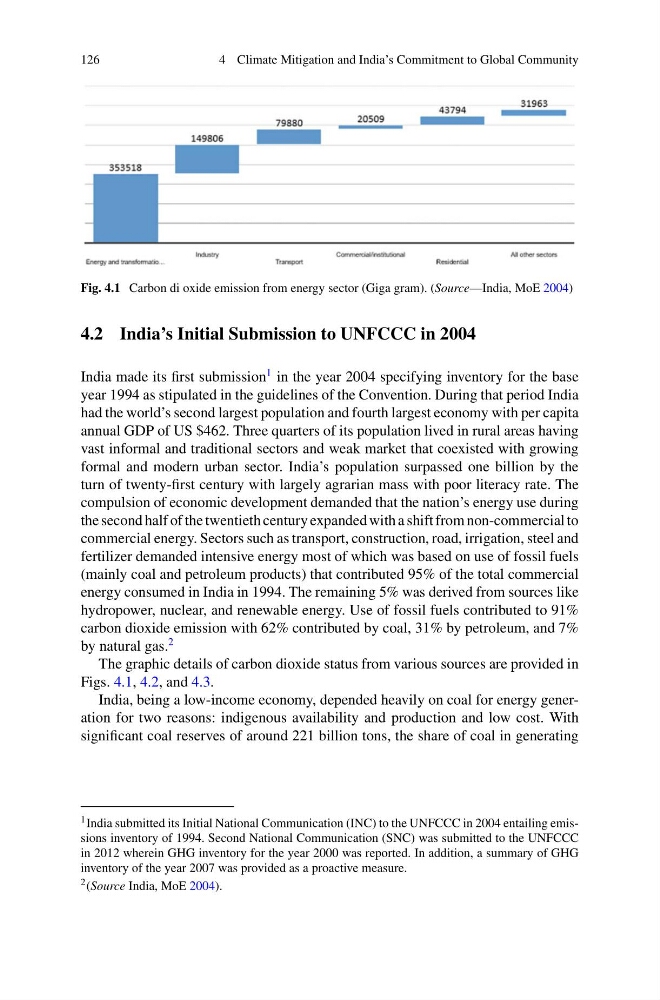
Fig. 4.1 Carbon di oxide emission from energy sector (Giga gram). (Source—India, MoE 2004)
4.2 India’s Initial Submission to UNFCCC in 2004
India made its first submission
1 in the year 2004 specifying inventory for the base
year 1994 as stipulated in the guidelines of the Convention. During that period India
had the world’s second largest population and fourth largest economy with per capita
annual GDP of US $462. Three quarters of its population lived in rural areas having
vast informal and traditional sectors and weak market that coexisted with growing
formal and modern urban sector. India’s population surpassed one billion by the
turn of twenty-first century with largely agrarian mass with poor literacy rate. The
compulsion of economic development demanded that the nation’s energy use during
the second half of the twentieth century expanded with a shift from non-commercial to
commercial energy. Sectors such as transport, construction, road, irrigation, steel and
fertilizer demanded intensive energy most of which was based on use of fossil fuels
(mainly coal and petroleum products) that contributed 95% of the total commercial
energy consumed in India in 1994. The remaining 5% was derived from sources like
hydropower, nuclear, and renewable energy. Use of fossil fuels contributed to 91%
carbon dioxide emission with 62% contributed by coal, 31% by petroleum, and 7%
by natural gas.
2
The graphic details of carbon dioxide status from various sources are provided in
Figs. 4.1, 4.2, and 4.3.
India, being a low-income economy, depended heavily on coal for energy generation for two reasons: indigenous availability and production and low cost. With
significant coal reserves of around 221 billion tons, the share of coal in generating
1 India submitted its Initial National Communication (INC) to the UNFCCC in 2004 entailing emissions inventory of 1994. Second National Communication (SNC) was submitted to the UNFCCC
in 2012 wherein GHG inventory for the year 2000 was reported. In addition, a summary of GHG
inventory of the year 2007 was provided as a proactive measure.
2 (Source India, MoE 2004).
4 Climate Mitigation and India’s Commitment to Global Community
Fig. 4.1 Carbon di oxide emission from energy sector (Giga gram). (Source—India, MoE 2004)
4.2 India’s Initial Submission to UNFCCC in 2004
India made its first submission
1 in the year 2004 specifying inventory for the base
year 1994 as stipulated in the guidelines of the Convention. During that period India
had the world’s second largest population and fourth largest economy with per capita
annual GDP of US $462. Three quarters of its population lived in rural areas having
vast informal and traditional sectors and weak market that coexisted with growing
formal and modern urban sector. India’s population surpassed one billion by the
turn of twenty-first century with largely agrarian mass with poor literacy rate. The
compulsion of economic development demanded that the nation’s energy use during
the second half of the twentieth century expanded with a shift from non-commercial to
commercial energy. Sectors such as transport, construction, road, irrigation, steel and
fertilizer demanded intensive energy most of which was based on use of fossil fuels
(mainly coal and petroleum products) that contributed 95% of the total commercial
energy consumed in India in 1994. The remaining 5% was derived from sources like
hydropower, nuclear, and renewable energy. Use of fossil fuels contributed to 91%
carbon dioxide emission with 62% contributed by coal, 31% by petroleum, and 7%
by natural gas.
2
The graphic details of carbon dioxide status from various sources are provided in
Figs. 4.1, 4.2, and 4.3.
India, being a low-income economy, depended heavily on coal for energy generation for two reasons: indigenous availability and production and low cost. With
significant coal reserves of around 221 billion tons, the share of coal in generating
1 India submitted its Initial National Communication (INC) to the UNFCCC in 2004 entailing emissions inventory of 1994. Second National Communication (SNC) was submitted to the UNFCCC
in 2012 wherein GHG inventory for the year 2000 was reported. In addition, a summary of GHG
inventory of the year 2007 was provided as a proactive measure.
2 (Source India, MoE 2004).