

4.1 Multilateral Environmental Affairs
125
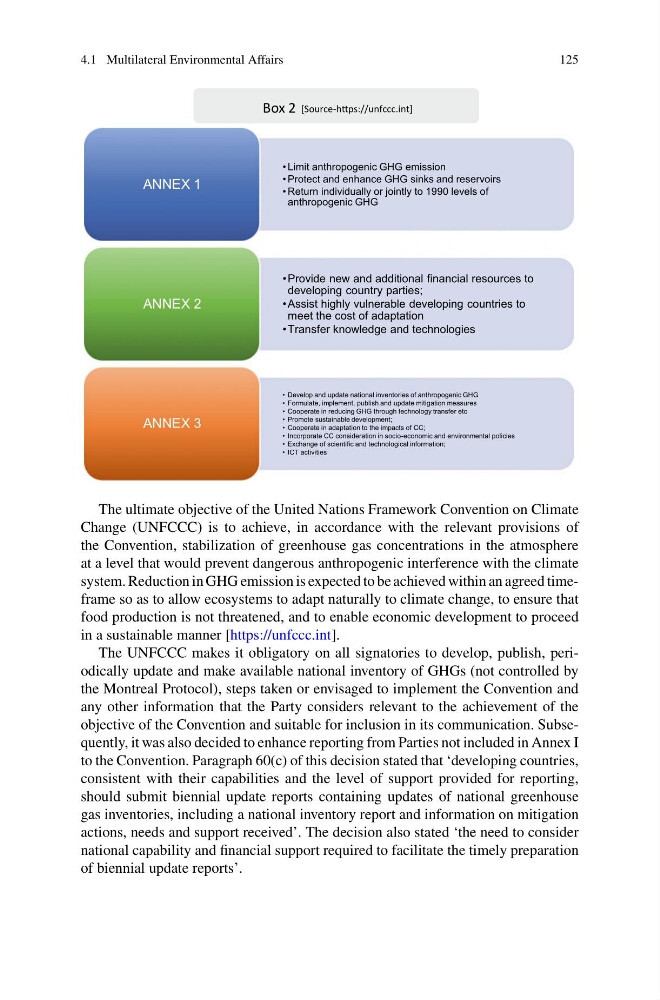
• Limit anthropogenic GHG emission
• Protect and enhance GHG sinks and reservoirs
• Return individually or jointly to 1990 levels of
anthropogenic GHG
ANNEX 1
• Provide new and additional financial resources to
developing country parties;
• Assist highly vulnerable developing countries to
meet the cost of adaptation
• Transfer knowledge and technologies
ANNEX 2
• Develop and update national inventories of anthropogenic GHG
• Formulate, implement, publish and update mitigation measures
• Cooperate in reducing GHG through technology transfer etc
• Promote sustainable development;
• Cooperate in adaptation to the impacts of CC;
• Incorporate CC consideration in socio-economic and environmental policies
• Exchange of scientific and technological information;
• ICT activities
ANNEX 3
Box 2 [Source-hƩps://unfccc.int]
The ultimate objective of the United Nations Framework Convention on Climate
Change (UNFCCC) is to achieve, in accordance with the relevant provisions of
the Convention, stabilization of greenhouse gas concentrations in the atmosphere
at a level that would prevent dangerous anthropogenic interference with the climate
system. Reduction in GHG emission is expected to be achieved within an agreed timeframe so as to allow ecosystems to adapt naturally to climate change, to ensure that
food production is not threatened, and to enable economic development to proceed
in a sustainable manner [https://unfccc.int].
The UNFCCC makes it obligatory on all signatories to develop, publish, periodically update and make available national inventory of GHGs (not controlled by
the Montreal Protocol), steps taken or envisaged to implement the Convention and
any other information that the Party considers relevant to the achievement of the
objective of the Convention and suitable for inclusion in its communication. Subsequently, it was also decided to enhance reporting from Parties not included in Annex I
to the Convention. Paragraph 60(c) of this decision stated that ‘developing countries,
consistent with their capabilities and the level of support provided for reporting,
should submit biennial update reports containing updates of national greenhouse
gas inventories, including a national inventory report and information on mitigation
actions, needs and support received’. The decision also stated ‘the need to consider
national capability and financial support required to facilitate the timely preparation
of biennial update reports’.
125
• Limit anthropogenic GHG emission
• Protect and enhance GHG sinks and reservoirs
• Return individually or jointly to 1990 levels of
anthropogenic GHG
ANNEX 1
• Provide new and additional financial resources to
developing country parties;
• Assist highly vulnerable developing countries to
meet the cost of adaptation
• Transfer knowledge and technologies
ANNEX 2
• Develop and update national inventories of anthropogenic GHG
• Formulate, implement, publish and update mitigation measures
• Cooperate in reducing GHG through technology transfer etc
• Promote sustainable development;
• Cooperate in adaptation to the impacts of CC;
• Incorporate CC consideration in socio-economic and environmental policies
• Exchange of scientific and technological information;
• ICT activities
ANNEX 3
Box 2 [Source-hƩps://unfccc.int]
The ultimate objective of the United Nations Framework Convention on Climate
Change (UNFCCC) is to achieve, in accordance with the relevant provisions of
the Convention, stabilization of greenhouse gas concentrations in the atmosphere
at a level that would prevent dangerous anthropogenic interference with the climate
system. Reduction in GHG emission is expected to be achieved within an agreed timeframe so as to allow ecosystems to adapt naturally to climate change, to ensure that
food production is not threatened, and to enable economic development to proceed
in a sustainable manner [https://unfccc.int].
The UNFCCC makes it obligatory on all signatories to develop, publish, periodically update and make available national inventory of GHGs (not controlled by
the Montreal Protocol), steps taken or envisaged to implement the Convention and
any other information that the Party considers relevant to the achievement of the
objective of the Convention and suitable for inclusion in its communication. Subsequently, it was also decided to enhance reporting from Parties not included in Annex I
to the Convention. Paragraph 60(c) of this decision stated that ‘developing countries,
consistent with their capabilities and the level of support provided for reporting,
should submit biennial update reports containing updates of national greenhouse
gas inventories, including a national inventory report and information on mitigation
actions, needs and support received’. The decision also stated ‘the need to consider
national capability and financial support required to facilitate the timely preparation
of biennial update reports’.