

3.5 Impediments to Electricity Generation
109
Box 4 - ELECTRICITY – SHOCK AND AWE
This story was published in The Hindu newspaper on August 27, 2016 under the title
ë The race to light up the last village. The report highlights massive efforts by the state
to ensure that villagers get the benefits of electricity under the flagship program of
rural electrification launched by the government in 2015.
Every village that has remained deprived of electricity has a painful narration
wrapped under the soul and mind of its inhabitants. This pain gets aggravated when
they travel/migrate to cities to get dazed by the electronic goods, sound systems,
mobiles phones and similar devices. And they are overwhelmed when their homes
are lit by LED bulb, fans, cooler and TV. Tanwarpura and Salam Singh Ki Basti are
two villages in Barmer, Rajasthan whose residents had remained devoid of electricity
connection for almost seven decades post-independence. While most of the cities
enjoyed the pleasures of electrical appliances, inhabitants of these two villages were
using kerosene lamps, manually operated flour mill and wood fuel. They had to
spend money for travelling 25 kms to the neighboring village to get their mobile
phones recharged. Electricity connectivity gave them opportunity to buy refrigerator,
electric flour mill and saved them from drudgery of mobile recharge. The realization
that their children will be saved from the obnoxious fumes of kerosene lamps gave
them immense pleasure.
Anandpur village in Hathras district of UP has a different story. women felt happy
that they were freed from swatting insects that would hover around kerosene lamps
while cooking food. Resident were earlier scared of venturing out after dusk due to
large number of snakes and presence of LED bulb boosted their confidence. This
story is an indicator of shock and awe that we as humans experience with
improvement in living condition.
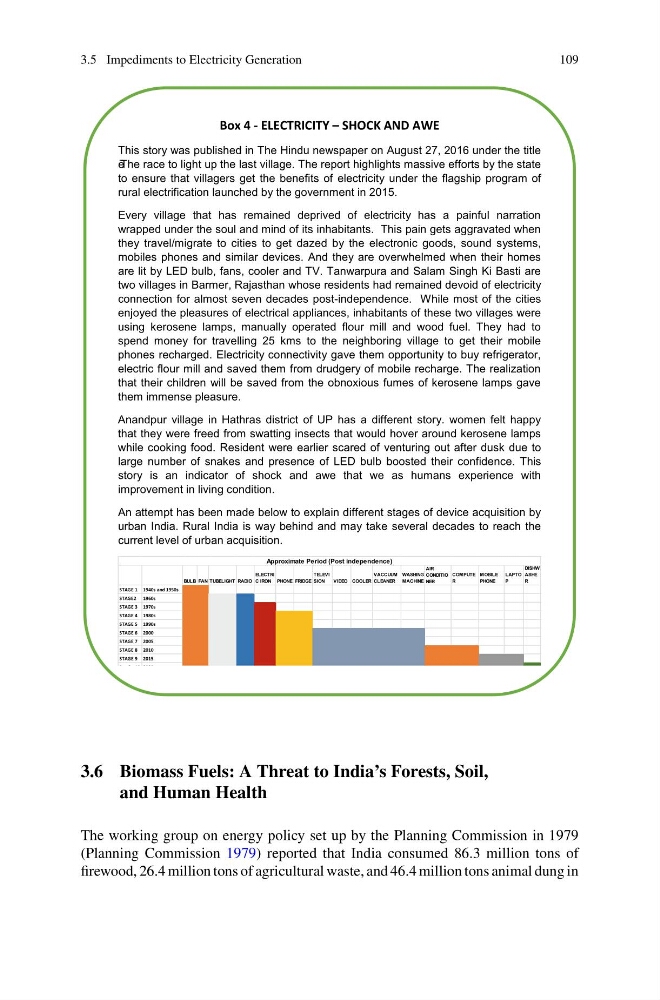
An attempt has been made below to explain different stages of device acquisition by
urban India. Rural India is way behind and may take several decades to reach the
current level of urban acquisition.
BULB FAN TUBELIGHT RADIO
ELECTRI
C IRON PHONE FRIDGE
TELEVI
SION
VIDEO COOLER
VACCUUM
CLEANER
WASHING
MACHINE
AIR
CONDITIO
NER
COMPUTE
R
MOBILE
PHONE
LAPTO
P
DISHW
ASHE
R
STAGE 1 1940s and 1950s
STAGE2 1960s
STAGE 3 1970s
STAGE 4 1980s
STAGE 5 1990s
STAGE 6 2000
STAGE 7 2005
STAGE 8 2010
STAGE 9 2015
S G 10 2020
Approximate Period (Post independence)
3.6 Biomass Fuels: A Threat to India’s Forests, Soil,
and Human Health
The working group on energy policy set up by the Planning Commission in 1979
(Planning Commission 1979) reported that India consumed 86.3 million tons of
firewood, 26.4 million tons of agricultural waste, and 46.4 million tons animal dung in
109
Box 4 - ELECTRICITY – SHOCK AND AWE
This story was published in The Hindu newspaper on August 27, 2016 under the title
ë The race to light up the last village. The report highlights massive efforts by the state
to ensure that villagers get the benefits of electricity under the flagship program of
rural electrification launched by the government in 2015.
Every village that has remained deprived of electricity has a painful narration
wrapped under the soul and mind of its inhabitants. This pain gets aggravated when
they travel/migrate to cities to get dazed by the electronic goods, sound systems,
mobiles phones and similar devices. And they are overwhelmed when their homes
are lit by LED bulb, fans, cooler and TV. Tanwarpura and Salam Singh Ki Basti are
two villages in Barmer, Rajasthan whose residents had remained devoid of electricity
connection for almost seven decades post-independence. While most of the cities
enjoyed the pleasures of electrical appliances, inhabitants of these two villages were
using kerosene lamps, manually operated flour mill and wood fuel. They had to
spend money for travelling 25 kms to the neighboring village to get their mobile
phones recharged. Electricity connectivity gave them opportunity to buy refrigerator,
electric flour mill and saved them from drudgery of mobile recharge. The realization
that their children will be saved from the obnoxious fumes of kerosene lamps gave
them immense pleasure.
Anandpur village in Hathras district of UP has a different story. women felt happy
that they were freed from swatting insects that would hover around kerosene lamps
while cooking food. Resident were earlier scared of venturing out after dusk due to
large number of snakes and presence of LED bulb boosted their confidence. This
story is an indicator of shock and awe that we as humans experience with
improvement in living condition.
An attempt has been made below to explain different stages of device acquisition by
urban India. Rural India is way behind and may take several decades to reach the
current level of urban acquisition.
BULB FAN TUBELIGHT RADIO
ELECTRI
C IRON PHONE FRIDGE
TELEVI
SION
VIDEO COOLER
VACCUUM
CLEANER
WASHING
MACHINE
AIR
CONDITIO
NER
COMPUTE
R
MOBILE
PHONE
LAPTO
P
DISHW
ASHE
R
STAGE 1 1940s and 1950s
STAGE2 1960s
STAGE 3 1970s
STAGE 4 1980s
STAGE 5 1990s
STAGE 6 2000
STAGE 7 2005
STAGE 8 2010
STAGE 9 2015
S G 10 2020
Approximate Period (Post independence)
3.6 Biomass Fuels: A Threat to India’s Forests, Soil,
and Human Health
The working group on energy policy set up by the Planning Commission in 1979
(Planning Commission 1979) reported that India consumed 86.3 million tons of
firewood, 26.4 million tons of agricultural waste, and 46.4 million tons animal dung in