

3.5 Impediments to Electricity Generation
103
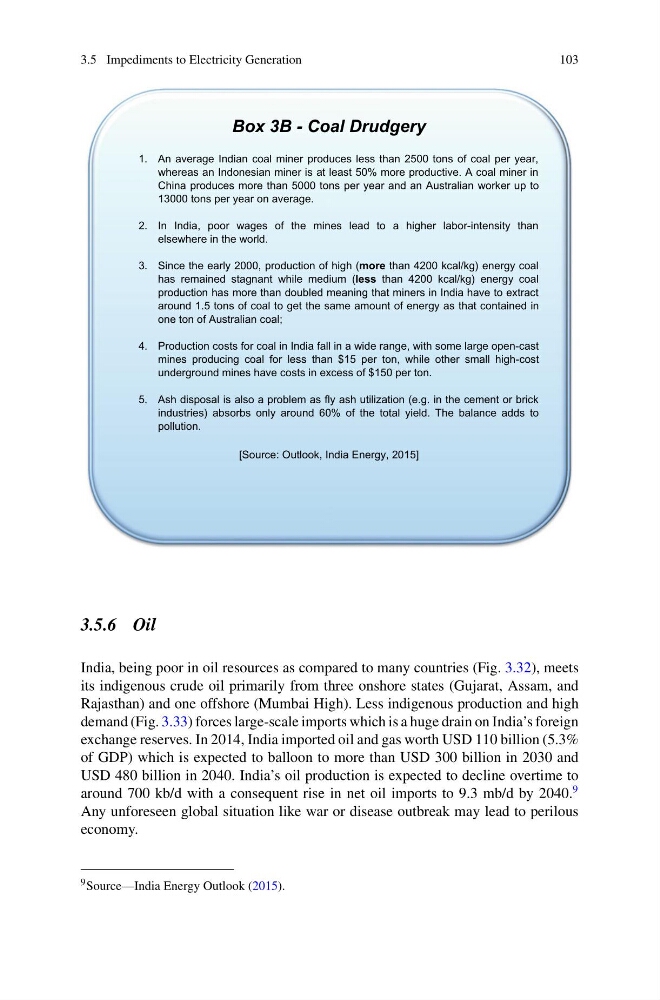
Box 3B - Coal Drudgery
1. An average Indian coal miner produces less than 2500 tons of coal per year,
whereas an Indonesian miner is at least 50% more productive. A coal miner in
China produces more than 5000 tons per year and an Australian worker up to
13000 tons per year on average.
2. In India, poor wages of the mines lead to a higher labor-intensity than
elsewhere in the world.
3. Since the early 2000, production of high (more than 4200 kcal/kg) energy coal
has remained stagnant while medium (less than 4200 kcal/kg) energy coal
production has more than doubled meaning that miners in India have to extract
around 1.5 tons of coal to get the same amount of energy as that contained in
one ton of Australian coal;
4. Production costs for coal in India fall in a wide range, with some large open-cast
mines producing coal for less than $15 per ton, while other small high-cost
underground mines have costs in excess of $150 per ton.
5. Ash disposal is also a problem as fly ash utilization (e.g. in the cement or brick
industries) absorbs only around 60% of the total yield. The balance adds to
pollution.
[Source: Outlook, India Energy, 2015]
3.5.6 Oil
India, being poor in oil resources as compared to many countries (Fig. 3.32), meets
its indigenous crude oil primarily from three onshore states (Gujarat, Assam, and
Rajasthan) and one offshore (Mumbai High). Less indigenous production and high
demand (Fig. 3.33) forces large-scale imports which is a huge drain on India’s foreign
exchange reserves. In 2014, India imported oil and gas worth USD 110 billion (5.3%
of GDP) which is expected to balloon to more than USD 300 billion in 2030 and
USD 480 billion in 2040. India’s oil production is expected to decline overtime to
around 700 kb/d with a consequent rise in net oil imports to 9.3 mb/d by 2040.
9
Any unforeseen global situation like war or disease outbreak may lead to perilous
economy.
9 Source—India Energy Outlook (2015).
103
Box 3B - Coal Drudgery
1. An average Indian coal miner produces less than 2500 tons of coal per year,
whereas an Indonesian miner is at least 50% more productive. A coal miner in
China produces more than 5000 tons per year and an Australian worker up to
13000 tons per year on average.
2. In India, poor wages of the mines lead to a higher labor-intensity than
elsewhere in the world.
3. Since the early 2000, production of high (more than 4200 kcal/kg) energy coal
has remained stagnant while medium (less than 4200 kcal/kg) energy coal
production has more than doubled meaning that miners in India have to extract
around 1.5 tons of coal to get the same amount of energy as that contained in
one ton of Australian coal;
4. Production costs for coal in India fall in a wide range, with some large open-cast
mines producing coal for less than $15 per ton, while other small high-cost
underground mines have costs in excess of $150 per ton.
5. Ash disposal is also a problem as fly ash utilization (e.g. in the cement or brick
industries) absorbs only around 60% of the total yield. The balance adds to
pollution.
[Source: Outlook, India Energy, 2015]
3.5.6 Oil
India, being poor in oil resources as compared to many countries (Fig. 3.32), meets
its indigenous crude oil primarily from three onshore states (Gujarat, Assam, and
Rajasthan) and one offshore (Mumbai High). Less indigenous production and high
demand (Fig. 3.33) forces large-scale imports which is a huge drain on India’s foreign
exchange reserves. In 2014, India imported oil and gas worth USD 110 billion (5.3%
of GDP) which is expected to balloon to more than USD 300 billion in 2030 and
USD 480 billion in 2040. India’s oil production is expected to decline overtime to
around 700 kb/d with a consequent rise in net oil imports to 9.3 mb/d by 2040.
9
Any unforeseen global situation like war or disease outbreak may lead to perilous
economy.
9 Source—India Energy Outlook (2015).