

102
3 The Challenges of Energy Supply
The National Electricity Plan 2018 provides a glimmer of hope for the climate
scientists (Box 3A and 3B). The plan mentions that by 2021–2022, the coal-based
generation in India will be around 63% (of the total energy generated from all
sources) and the same will gradually taper off to 55.7% by 2026–2027. Based on
the assessment of different sources of energy, it appears that India has the following
options:
i. A pathway for all energy supply sectors in which case the total energy-related
GHG emissions in 2047 are likely to be around 10,848 MT of CO 2 equivalent,
of which thermal power generation would contribute to about 3002 MT CO 2
equivalent or 27.6%; or
ii. A pathway with preference for thermal generation over renewables in which
case the total energy-related GHG emissions would be around 11,342 MT CO 2
equivalent of which thermal power generation would contribute to about 3495
MT CO 2 equivalent or 30.8%; or
iii. A pathway with preference for renewable energy generation over thermal in
which case the total energy-related GHG emissions would be around 9882 MT
CO 2 equivalent of which thermal power generation would contribute to about
20.6%.
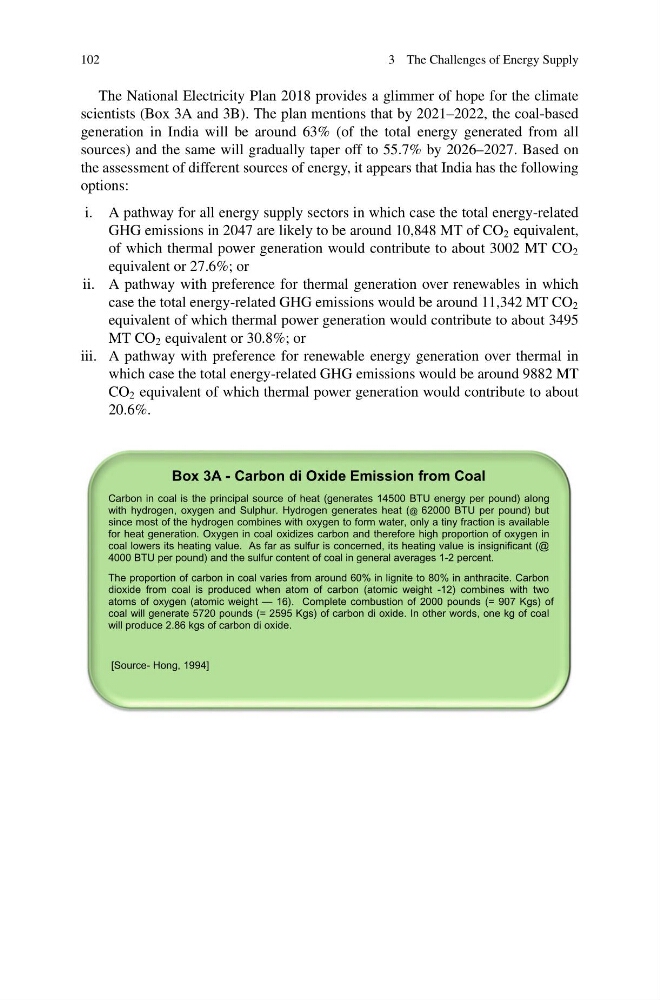
Box 3A - Carbon di Oxide Emission from Coal
Carbon in coal is the principal source of heat (generates 14500 BTU energy per pound) along
with hydrogen, oxygen and Sulphur. Hydrogen generates heat (@ 62000 BTU per pound) but
since most of the hydrogen combines with oxygen to form water, only a tiny fraction is available
for heat generation. Oxygen in coal oxidizes carbon and therefore high proportion of oxygen in
coal lowers its heating value. As far as sulfur is concerned, its heating value is insignificant (@
4000 BTU per pound) and the sulfur content of coal in general averages 1-2 percent.
The proportion of carbon in coal varies from around 60% in lignite to 80% in anthracite. Carbon
dioxide from coal is produced when atom of carbon (atomic weight -12) combines with two
atoms of oxygen (atomic weight – 16). Complete combustion of 2000 pounds (= 907 Kgs) of
coal will generate 5720 pounds (= 2595 Kgs) of carbon di oxide. In other words, one kg of coal
will produce 2.86 kgs of carbon di oxide.
[Source- Hong, 1994]
3 The Challenges of Energy Supply
The National Electricity Plan 2018 provides a glimmer of hope for the climate
scientists (Box 3A and 3B). The plan mentions that by 2021–2022, the coal-based
generation in India will be around 63% (of the total energy generated from all
sources) and the same will gradually taper off to 55.7% by 2026–2027. Based on
the assessment of different sources of energy, it appears that India has the following
options:
i. A pathway for all energy supply sectors in which case the total energy-related
GHG emissions in 2047 are likely to be around 10,848 MT of CO 2 equivalent,
of which thermal power generation would contribute to about 3002 MT CO 2
equivalent or 27.6%; or
ii. A pathway with preference for thermal generation over renewables in which
case the total energy-related GHG emissions would be around 11,342 MT CO 2
equivalent of which thermal power generation would contribute to about 3495
MT CO 2 equivalent or 30.8%; or
iii. A pathway with preference for renewable energy generation over thermal in
which case the total energy-related GHG emissions would be around 9882 MT
CO 2 equivalent of which thermal power generation would contribute to about
20.6%.
Box 3A - Carbon di Oxide Emission from Coal
Carbon in coal is the principal source of heat (generates 14500 BTU energy per pound) along
with hydrogen, oxygen and Sulphur. Hydrogen generates heat (@ 62000 BTU per pound) but
since most of the hydrogen combines with oxygen to form water, only a tiny fraction is available
for heat generation. Oxygen in coal oxidizes carbon and therefore high proportion of oxygen in
coal lowers its heating value. As far as sulfur is concerned, its heating value is insignificant (@
4000 BTU per pound) and the sulfur content of coal in general averages 1-2 percent.
The proportion of carbon in coal varies from around 60% in lignite to 80% in anthracite. Carbon
dioxide from coal is produced when atom of carbon (atomic weight -12) combines with two
atoms of oxygen (atomic weight – 16). Complete combustion of 2000 pounds (= 907 Kgs) of
coal will generate 5720 pounds (= 2595 Kgs) of carbon di oxide. In other words, one kg of coal
will produce 2.86 kgs of carbon di oxide.
[Source- Hong, 1994]