

3.5 Impediments to Electricity Generation
101
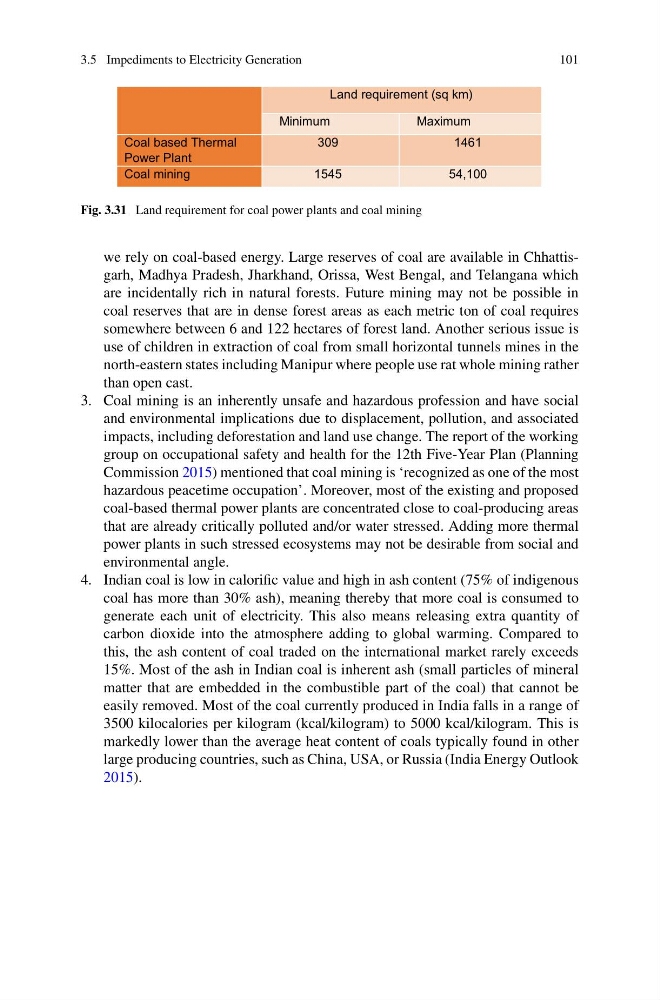
Land requirement (sq km)
Minimum
Maximum
Coal based Thermal
Power Plant
309
1461
Coal mining
1545
54,100
Fig. 3.31 Land requirement for coal power plants and coal mining
we rely on coal-based energy. Large reserves of coal are available in Chhattisgarh, Madhya Pradesh, Jharkhand, Orissa, West Bengal, and Telangana which
are incidentally rich in natural forests. Future mining may not be possible in
coal reserves that are in dense forest areas as each metric ton of coal requires
somewhere between 6 and 122 hectares of forest land. Another serious issue is
use of children in extraction of coal from small horizontal tunnels mines in the
north-eastern states including Manipur where people use rat whole mining rather
than open cast.
3. Coal mining is an inherently unsafe and hazardous profession and have social
and environmental implications due to displacement, pollution, and associated
impacts, including deforestation and land use change. The report of the working
group on occupational safety and health for the 12th Five-Year Plan (Planning
Commission 2015) mentioned that coal mining is ‘recognized as one of the most
hazardous peacetime occupation’. Moreover, most of the existing and proposed
coal-based thermal power plants are concentrated close to coal-producing areas
that are already critically polluted and/or water stressed. Adding more thermal
power plants in such stressed ecosystems may not be desirable from social and
environmental angle.
4. Indian coal is low in calorific value and high in ash content (75% of indigenous
coal has more than 30% ash), meaning thereby that more coal is consumed to
generate each unit of electricity. This also means releasing extra quantity of
carbon dioxide into the atmosphere adding to global warming. Compared to
this, the ash content of coal traded on the international market rarely exceeds
15%. Most of the ash in Indian coal is inherent ash (small particles of mineral
matter that are embedded in the combustible part of the coal) that cannot be
easily removed. Most of the coal currently produced in India falls in a range of
3500 kilocalories per kilogram (kcal/kilogram) to 5000 kcal/kilogram. This is
markedly lower than the average heat content of coals typically found in other
large producing countries, such as China, USA, or Russia (India Energy Outlook
2015).
101
Land requirement (sq km)
Minimum
Maximum
Coal based Thermal
Power Plant
309
1461
Coal mining
1545
54,100
Fig. 3.31 Land requirement for coal power plants and coal mining
we rely on coal-based energy. Large reserves of coal are available in Chhattisgarh, Madhya Pradesh, Jharkhand, Orissa, West Bengal, and Telangana which
are incidentally rich in natural forests. Future mining may not be possible in
coal reserves that are in dense forest areas as each metric ton of coal requires
somewhere between 6 and 122 hectares of forest land. Another serious issue is
use of children in extraction of coal from small horizontal tunnels mines in the
north-eastern states including Manipur where people use rat whole mining rather
than open cast.
3. Coal mining is an inherently unsafe and hazardous profession and have social
and environmental implications due to displacement, pollution, and associated
impacts, including deforestation and land use change. The report of the working
group on occupational safety and health for the 12th Five-Year Plan (Planning
Commission 2015) mentioned that coal mining is ‘recognized as one of the most
hazardous peacetime occupation’. Moreover, most of the existing and proposed
coal-based thermal power plants are concentrated close to coal-producing areas
that are already critically polluted and/or water stressed. Adding more thermal
power plants in such stressed ecosystems may not be desirable from social and
environmental angle.
4. Indian coal is low in calorific value and high in ash content (75% of indigenous
coal has more than 30% ash), meaning thereby that more coal is consumed to
generate each unit of electricity. This also means releasing extra quantity of
carbon dioxide into the atmosphere adding to global warming. Compared to
this, the ash content of coal traded on the international market rarely exceeds
15%. Most of the ash in Indian coal is inherent ash (small particles of mineral
matter that are embedded in the combustible part of the coal) that cannot be
easily removed. Most of the coal currently produced in India falls in a range of
3500 kilocalories per kilogram (kcal/kilogram) to 5000 kcal/kilogram. This is
markedly lower than the average heat content of coals typically found in other
large producing countries, such as China, USA, or Russia (India Energy Outlook
2015).