

86
4 Measurement of Work Function
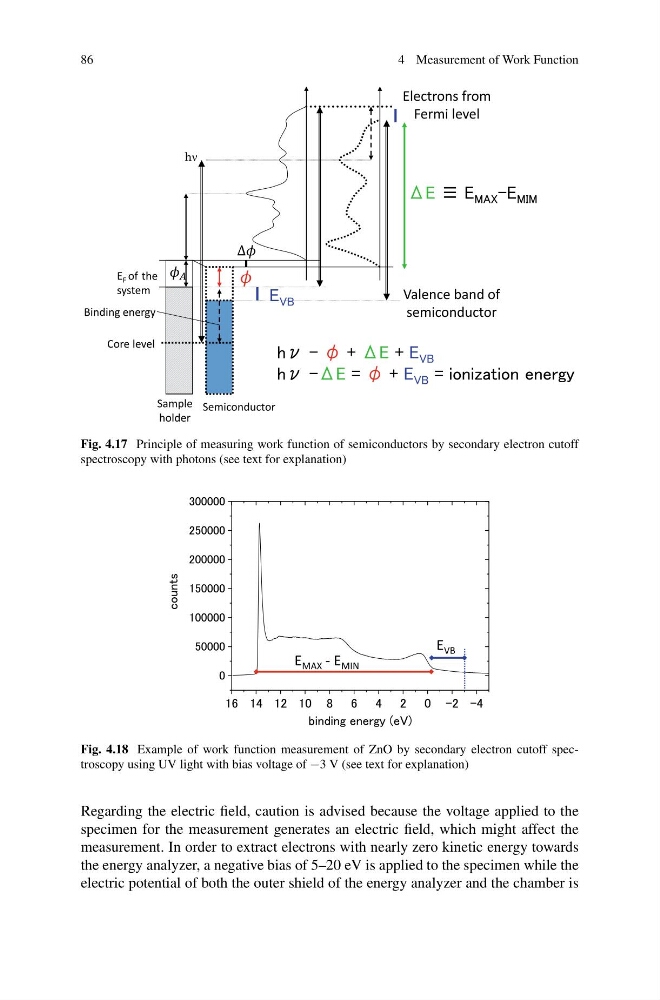
Fig. 4.17 Principle of measuring work function of semiconductors by secondary electron cutoff
spectroscopy with photons (see text for explanation)
Fig. 4.18 Example of work function measurement of ZnO by secondary electron cutoff spectroscopy using UV light with bias voltage of −3 V (see text for explanation)
Regarding the electric field, caution is advised because the voltage applied to the
specimen for the measurement generates an electric field, which might affect the
measurement. In order to extract electrons with nearly zero kinetic energy towards
the energy analyzer, a negative bias of 5–20 eV is applied to the specimen while the
electric potential of both the outer shield of the energy analyzer and the chamber is
4 Measurement of Work Function
Fig. 4.17 Principle of measuring work function of semiconductors by secondary electron cutoff
spectroscopy with photons (see text for explanation)
Fig. 4.18 Example of work function measurement of ZnO by secondary electron cutoff spectroscopy using UV light with bias voltage of −3 V (see text for explanation)
Regarding the electric field, caution is advised because the voltage applied to the
specimen for the measurement generates an electric field, which might affect the
measurement. In order to extract electrons with nearly zero kinetic energy towards
the energy analyzer, a negative bias of 5–20 eV is applied to the specimen while the
electric potential of both the outer shield of the energy analyzer and the chamber is