

82
4 Measurement of Work Function
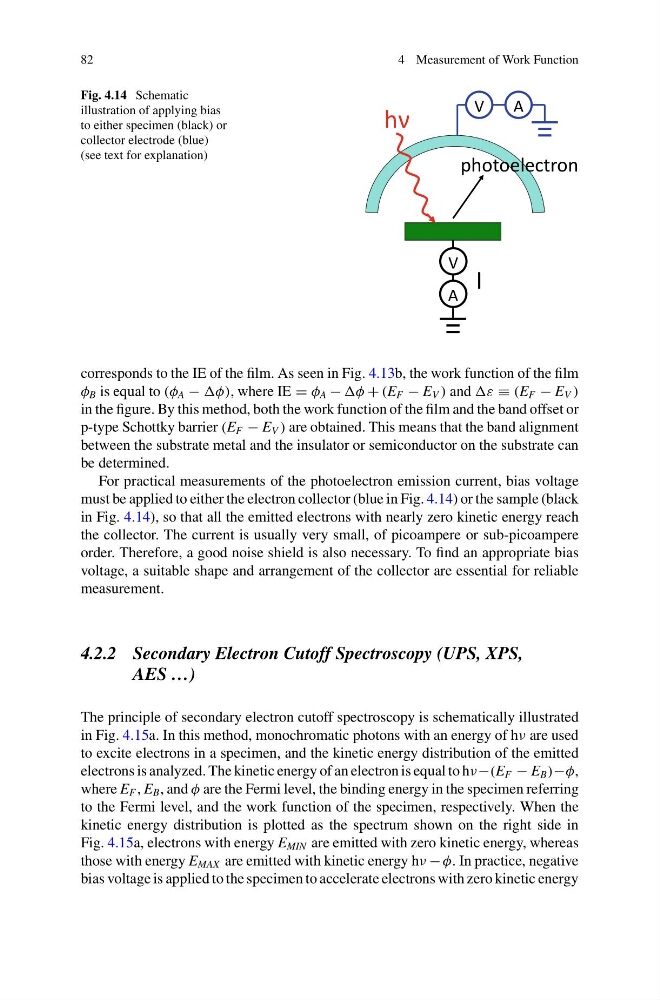
Fig. 4.14 Schematic
illustration of applying bias
to either specimen (black) or
collector electrode (blue)
(see text for explanation)
A
I
photoelectron
hν
A
V
V
corresponds to the IE of the film. As seen in Fig. 4.13b, the work function of the film
φ B is equal to (φ A − φ), where IE = φ A − + (E F − E V ) and ≡ (E F − E V )
in the figure. By this method, both the work function of the film and the band offset or
p-type Schottky barrier (E F − E V ) are obtained. This means that the band alignment
between the substrate metal and the insulator or semiconductor on the substrate can
be determined.
For practical measurements of the photoelectron emission current, bias voltage
must be applied to either the electron collector (blue in Fig. 4.14) or the sample (black
in Fig. 4.14), so that all the emitted electrons with nearly zero kinetic energy reach
the collector. The current is usually very small, of picoampere or sub-picoampere
order. Therefore, a good noise shield is also necessary. To find an appropriate bias
voltage, a suitable shape and arrangement of the collector are essential for reliable
measurement.
4.2.2 Secondary Electron Cutoff Spectroscopy (UPS, XPS,
AES …)
The principle of secondary electron cutoff spectroscopy is schematically illustrated
in Fig. 4.15a. In this method, monochromatic photons with an energy of hν are used
to excite electrons in a specimen, and the kinetic energy distribution of the emitted
electrons is analyzed. The kinetic energy of an electron is equal to hν−(E F − E B )−φ,
where E F , E B , and φ are the Fermi level, the binding energy in the specimen referring
to the Fermi level, and the work function of the specimen, respectively. When the
kinetic energy distribution is plotted as the spectrum shown on the right side in
Fig. 4.15a, electrons with energy E MIN are emitted with zero kinetic energy, whereas
those with energy E MAX are emitted with kinetic energy hν − φ. In practice, negative
bias voltage is applied to the specimen to accelerate electrons with zero kinetic energy
4 Measurement of Work Function
Fig. 4.14 Schematic
illustration of applying bias
to either specimen (black) or
collector electrode (blue)
(see text for explanation)
A
I
photoelectron
hν
A
V
V
corresponds to the IE of the film. As seen in Fig. 4.13b, the work function of the film
φ B is equal to (φ A − φ), where IE = φ A − + (E F − E V ) and ≡ (E F − E V )
in the figure. By this method, both the work function of the film and the band offset or
p-type Schottky barrier (E F − E V ) are obtained. This means that the band alignment
between the substrate metal and the insulator or semiconductor on the substrate can
be determined.
For practical measurements of the photoelectron emission current, bias voltage
must be applied to either the electron collector (blue in Fig. 4.14) or the sample (black
in Fig. 4.14), so that all the emitted electrons with nearly zero kinetic energy reach
the collector. The current is usually very small, of picoampere or sub-picoampere
order. Therefore, a good noise shield is also necessary. To find an appropriate bias
voltage, a suitable shape and arrangement of the collector are essential for reliable
measurement.
4.2.2 Secondary Electron Cutoff Spectroscopy (UPS, XPS,
AES …)
The principle of secondary electron cutoff spectroscopy is schematically illustrated
in Fig. 4.15a. In this method, monochromatic photons with an energy of hν are used
to excite electrons in a specimen, and the kinetic energy distribution of the emitted
electrons is analyzed. The kinetic energy of an electron is equal to hν−(E F − E B )−φ,
where E F , E B , and φ are the Fermi level, the binding energy in the specimen referring
to the Fermi level, and the work function of the specimen, respectively. When the
kinetic energy distribution is plotted as the spectrum shown on the right side in
Fig. 4.15a, electrons with energy E MIN are emitted with zero kinetic energy, whereas
those with energy E MAX are emitted with kinetic energy hν − φ. In practice, negative
bias voltage is applied to the specimen to accelerate electrons with zero kinetic energy