

4.2 Utilizing Electron Emission Spectroscopy
83
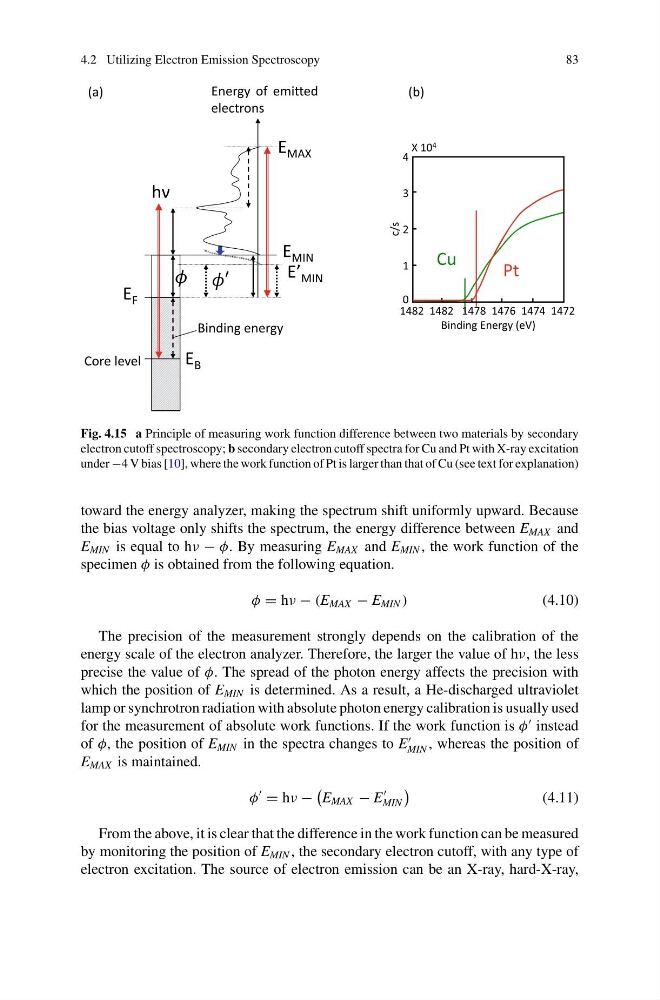
Fig. 4.15 a Principle of measuring work function difference between two materials by secondary
electron cutoff spectroscopy; b secondary electron cutoff spectra for Cu and Pt with X-ray excitation
under −4 V bias [10], where the work function of Pt is larger than that of Cu (see text for explanation)
toward the energy analyzer, making the spectrum shift uniformly upward. Because
the bias voltage only shifts the spectrum, the energy difference between E MAX and
E MIN is equal to hν − φ. By measuring E MAX and E MIN , the work function of the
specimen φ is obtained from the following equation.
φ = hν − (E MAX − E MIN )
(4.10)
The precision of the measurement strongly depends on the calibration of the
energy scale of the electron analyzer. Therefore, the larger the value of hν, the less
precise the value of φ. The spread of the photon energy affects the precision with
which the position of E MIN is determined. As a result, a He-discharged ultraviolet
lamp or synchrotron radiation with absolute photon energy calibration is usually used
for the measurement of absolute work functions. If the work function is φ
instead
of φ, the position of E MIN in the spectra changes to E
MIN , whereas the position of
E MAX is maintained.
φ
= hν −
E MAX − E
MIN
(4.11)
From the above, it is clear that the difference in the work function can be measured
by monitoring the position of E MIN , the secondary electron cutoff, with any type of
electron excitation. The source of electron emission can be an X-ray, hard-X-ray,
83
Fig. 4.15 a Principle of measuring work function difference between two materials by secondary
electron cutoff spectroscopy; b secondary electron cutoff spectra for Cu and Pt with X-ray excitation
under −4 V bias [10], where the work function of Pt is larger than that of Cu (see text for explanation)
toward the energy analyzer, making the spectrum shift uniformly upward. Because
the bias voltage only shifts the spectrum, the energy difference between E MAX and
E MIN is equal to hν − φ. By measuring E MAX and E MIN , the work function of the
specimen φ is obtained from the following equation.
φ = hν − (E MAX − E MIN )
(4.10)
The precision of the measurement strongly depends on the calibration of the
energy scale of the electron analyzer. Therefore, the larger the value of hν, the less
precise the value of φ. The spread of the photon energy affects the precision with
which the position of E MIN is determined. As a result, a He-discharged ultraviolet
lamp or synchrotron radiation with absolute photon energy calibration is usually used
for the measurement of absolute work functions. If the work function is φ
instead
of φ, the position of E MIN in the spectra changes to E
MIN , whereas the position of
E MAX is maintained.
φ
= hν −
E MAX − E
MIN
(4.11)
From the above, it is clear that the difference in the work function can be measured
by monitoring the position of E MIN , the secondary electron cutoff, with any type of
electron excitation. The source of electron emission can be an X-ray, hard-X-ray,