

3.2 Surface Termination
59
5.17 eV, although an experimental value has not been obtained, whereas the calculated value for Ni(100) is 5.47 eV [22]. Because the experimentally reported work
functions of Ni(100) are 5.22 eV [23], 5.53 eV [24], and 5.20 eV [25], the expected
experimental work functions of the Ni-term NiAl(100) are 4.92, 5.23, and 4.90 eV,
respectively (0.3 eV lower than the values for Ni(100)). In any case, it appears that the
work function of the Ni-term NiAl(100) is higher than that of the Al-term NiAl(100).
Although a differently terminated surface is structurally possible, in most cases,
only one of the possible terminations or reconstructed surface structures is stable for
intermetallic compounds. Often, only the work function for the most stable surface
is experimentally available.
The situation is different for compound semiconductors. It is possible to obtain
a differently terminated surface for many compound semiconductors such as ZnO,
GaAs, and GaN. Figure 3.24b shows the schematic crystal structure of ZnO. In
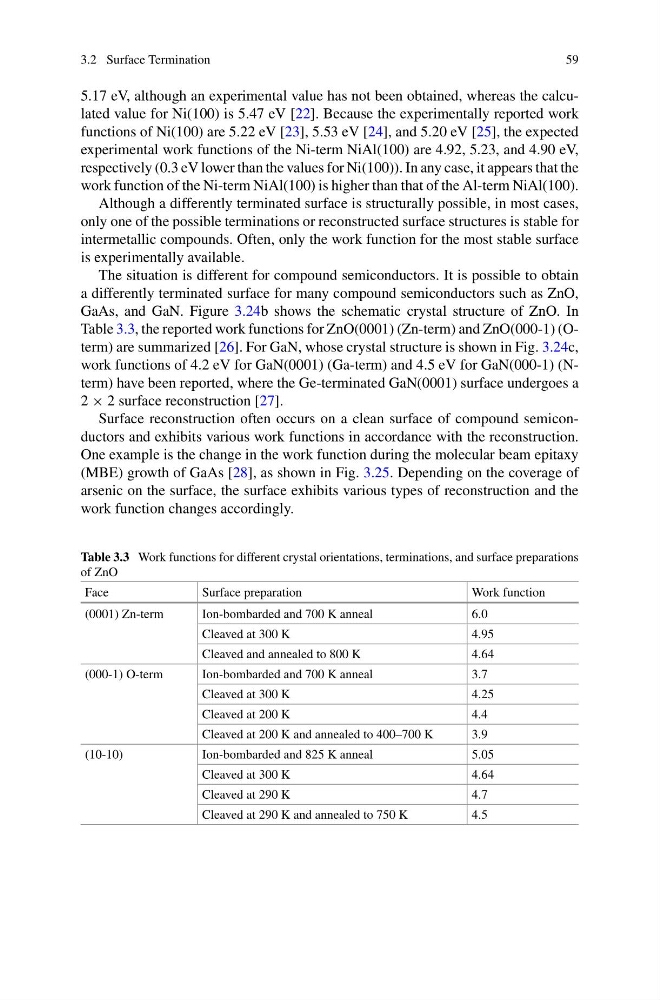
Table 3.3, the reported work functions for ZnO(0001) (Zn-term) and ZnO(000-1) (Oterm) are summarized [26]. For GaN, whose crystal structure is shown in Fig. 3.24c,
work functions of 4.2 eV for GaN(0001) (Ga-term) and 4.5 eV for GaN(000-1) (Nterm) have been reported, where the Ge-terminated GaN(0001) surface undergoes a
2 × 2 surface reconstruction [27].
Surface reconstruction often occurs on a clean surface of compound semiconductors and exhibits various work functions in accordance with the reconstruction.
One example is the change in the work function during the molecular beam epitaxy
(MBE) growth of GaAs [28], as shown in Fig. 3.25. Depending on the coverage of
arsenic on the surface, the surface exhibits various types of reconstruction and the
work function changes accordingly.
Table 3.3 Work functions for different crystal orientations, terminations, and surface preparations
of ZnO
Face
Surface preparation
Work function
(0001) Zn-term
Ion-bombarded and 700 K anneal
6.0
Cleaved at 300 K
4.95
Cleaved and annealed to 800 K
4.64
(000-1) O-term
Ion-bombarded and 700 K anneal
3.7
Cleaved at 300 K
4.25
Cleaved at 200 K
4.4
Cleaved at 200 K and annealed to 400–700 K
3.9
(10-10)
Ion-bombarded and 825 K anneal
5.05
Cleaved at 300 K
4.64
Cleaved at 290 K
4.7
Cleaved at 290 K and annealed to 750 K
4.5
59
5.17 eV, although an experimental value has not been obtained, whereas the calculated value for Ni(100) is 5.47 eV [22]. Because the experimentally reported work
functions of Ni(100) are 5.22 eV [23], 5.53 eV [24], and 5.20 eV [25], the expected
experimental work functions of the Ni-term NiAl(100) are 4.92, 5.23, and 4.90 eV,
respectively (0.3 eV lower than the values for Ni(100)). In any case, it appears that the
work function of the Ni-term NiAl(100) is higher than that of the Al-term NiAl(100).
Although a differently terminated surface is structurally possible, in most cases,
only one of the possible terminations or reconstructed surface structures is stable for
intermetallic compounds. Often, only the work function for the most stable surface
is experimentally available.
The situation is different for compound semiconductors. It is possible to obtain
a differently terminated surface for many compound semiconductors such as ZnO,
GaAs, and GaN. Figure 3.24b shows the schematic crystal structure of ZnO. In
Table 3.3, the reported work functions for ZnO(0001) (Zn-term) and ZnO(000-1) (Oterm) are summarized [26]. For GaN, whose crystal structure is shown in Fig. 3.24c,
work functions of 4.2 eV for GaN(0001) (Ga-term) and 4.5 eV for GaN(000-1) (Nterm) have been reported, where the Ge-terminated GaN(0001) surface undergoes a
2 × 2 surface reconstruction [27].
Surface reconstruction often occurs on a clean surface of compound semiconductors and exhibits various work functions in accordance with the reconstruction.
One example is the change in the work function during the molecular beam epitaxy
(MBE) growth of GaAs [28], as shown in Fig. 3.25. Depending on the coverage of
arsenic on the surface, the surface exhibits various types of reconstruction and the
work function changes accordingly.
Table 3.3 Work functions for different crystal orientations, terminations, and surface preparations
of ZnO
Face
Surface preparation
Work function
(0001) Zn-term
Ion-bombarded and 700 K anneal
6.0
Cleaved at 300 K
4.95
Cleaved and annealed to 800 K
4.64
(000-1) O-term
Ion-bombarded and 700 K anneal
3.7
Cleaved at 300 K
4.25
Cleaved at 200 K
4.4
Cleaved at 200 K and annealed to 400–700 K
3.9
(10-10)
Ion-bombarded and 825 K anneal
5.05
Cleaved at 300 K
4.64
Cleaved at 290 K
4.7
Cleaved at 290 K and annealed to 750 K
4.5