

58
3 Modification of the Work Function
forms an alloy in a wide composition range and undergoes phase separation only in
a very limited composition range (65–80% Ru), and the work function is similar on
both sides of the gap.
3.2 Surface Termination
Materials composed of more than one component, such as intermetallic compounds,
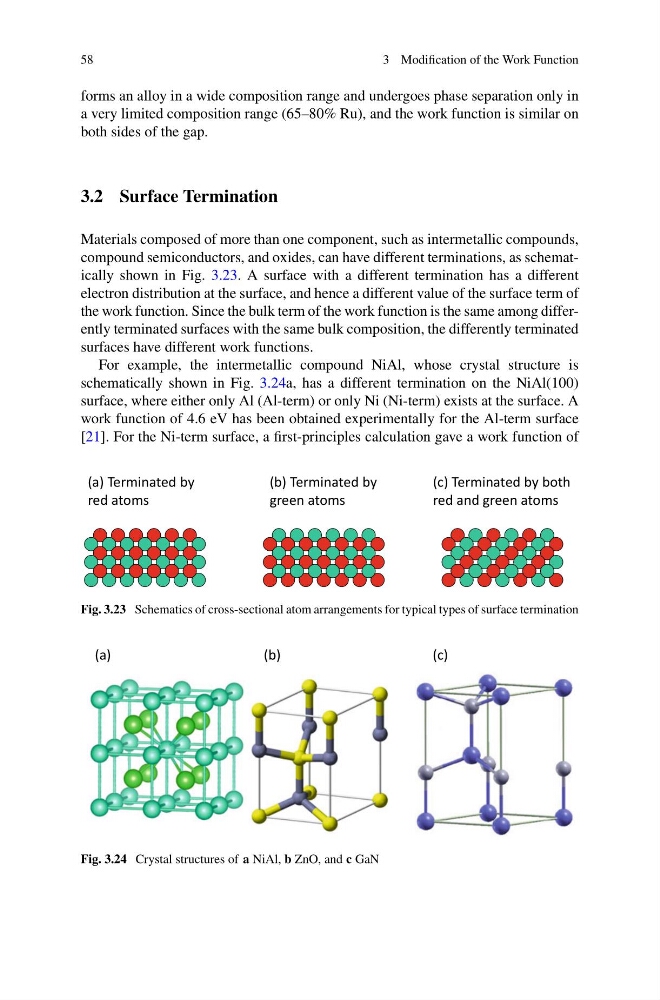
compound semiconductors, and oxides, can have different terminations, as schematically shown in Fig. 3.23. A surface with a different termination has a different
electron distribution at the surface, and hence a different value of the surface term of
the work function. Since the bulk term of the work function is the same among differently terminated surfaces with the same bulk composition, the differently terminated
surfaces have different work functions.
For example, the intermetallic compound NiAl, whose crystal structure is
schematically shown in Fig. 3.24a, has a different termination on the NiAl(100)
surface, where either only Al (Al-term) or only Ni (Ni-term) exists at the surface. A
work function of 4.6 eV has been obtained experimentally for the Al-term surface
[21]. For the Ni-term surface, a first-principles calculation gave a work function of
(a) Terminated by
red atoms
(b) Terminated by
green atoms
(c) Terminated by both
red and green atoms
Fig. 3.23 Schematics of cross-sectional atom arrangements for typical types of surface termination
(a)
(b)
(c)
Fig. 3.24 Crystal structures of a NiAl, b ZnO, and c GaN
3 Modification of the Work Function
forms an alloy in a wide composition range and undergoes phase separation only in
a very limited composition range (65–80% Ru), and the work function is similar on
both sides of the gap.
3.2 Surface Termination
Materials composed of more than one component, such as intermetallic compounds,
compound semiconductors, and oxides, can have different terminations, as schematically shown in Fig. 3.23. A surface with a different termination has a different
electron distribution at the surface, and hence a different value of the surface term of
the work function. Since the bulk term of the work function is the same among differently terminated surfaces with the same bulk composition, the differently terminated
surfaces have different work functions.
For example, the intermetallic compound NiAl, whose crystal structure is
schematically shown in Fig. 3.24a, has a different termination on the NiAl(100)
surface, where either only Al (Al-term) or only Ni (Ni-term) exists at the surface. A
work function of 4.6 eV has been obtained experimentally for the Al-term surface
[21]. For the Ni-term surface, a first-principles calculation gave a work function of
(a) Terminated by
red atoms
(b) Terminated by
green atoms
(c) Terminated by both
red and green atoms
Fig. 3.23 Schematics of cross-sectional atom arrangements for typical types of surface termination
(a)
(b)
(c)
Fig. 3.24 Crystal structures of a NiAl, b ZnO, and c GaN