

10
2 What is the Work Function?: Definition and Factors …
E VAC (∞)
V XC
2
2
2
F
k
m
ħ
E VAC
E F
0
∞
~ mm
~ km
≈
≈
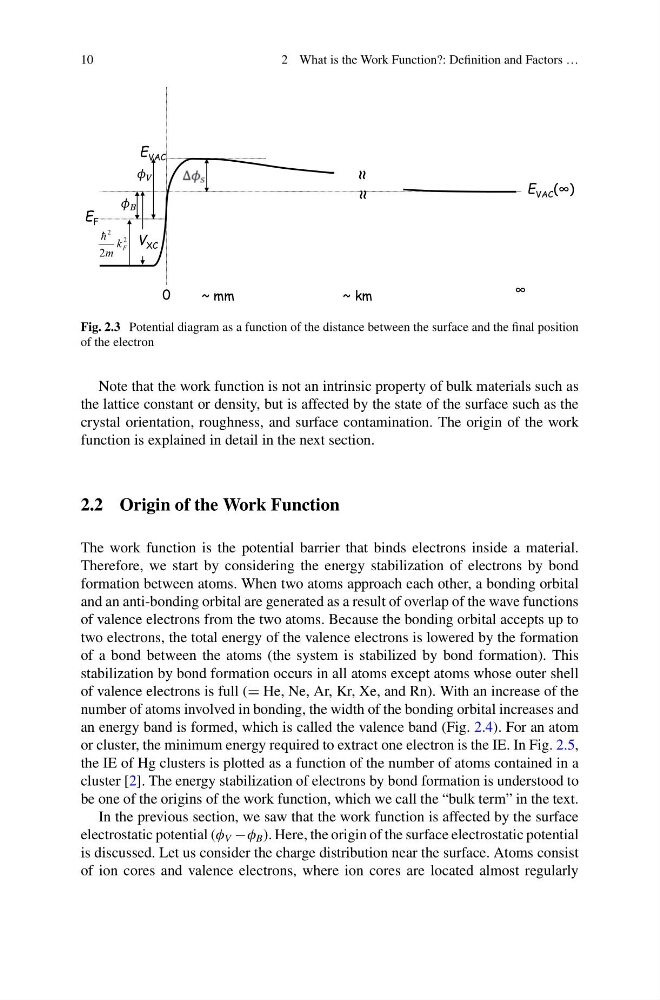
Fig. 2.3 Potential diagram as a function of the distance between the surface and the final position
of the electron
Note that the work function is not an intrinsic property of bulk materials such as
the lattice constant or density, but is affected by the state of the surface such as the
crystal orientation, roughness, and surface contamination. The origin of the work
function is explained in detail in the next section.
2.2 Origin of the Work Function
The work function is the potential barrier that binds electrons inside a material.
Therefore, we start by considering the energy stabilization of electrons by bond
formation between atoms. When two atoms approach each other, a bonding orbital
and an anti-bonding orbital are generated as a result of overlap of the wave functions
of valence electrons from the two atoms. Because the bonding orbital accepts up to
two electrons, the total energy of the valence electrons is lowered by the formation
of a bond between the atoms (the system is stabilized by bond formation). This
stabilization by bond formation occurs in all atoms except atoms whose outer shell
of valence electrons is full (= He, Ne, Ar, Kr, Xe, and Rn). With an increase of the
number of atoms involved in bonding, the width of the bonding orbital increases and
an energy band is formed, which is called the valence band (Fig. 2.4). For an atom
or cluster, the minimum energy required to extract one electron is the IE. In Fig. 2.5,
the IE of Hg clusters is plotted as a function of the number of atoms contained in a
cluster [2]. The energy stabilization of electrons by bond formation is understood to
be one of the origins of the work function, which we call the “bulk term” in the text.
In the previous section, we saw that the work function is affected by the surface
electrostatic potential (φ V −φ B ). Here, the origin of the surface electrostatic potential
is discussed. Let us consider the charge distribution near the surface. Atoms consist
of ion cores and valence electrons, where ion cores are located almost regularly
2 What is the Work Function?: Definition and Factors …
E VAC (∞)
V XC
2
2
2
F
k
m
ħ
E VAC
E F
0
∞
~ mm
~ km
≈
≈
Fig. 2.3 Potential diagram as a function of the distance between the surface and the final position
of the electron
Note that the work function is not an intrinsic property of bulk materials such as
the lattice constant or density, but is affected by the state of the surface such as the
crystal orientation, roughness, and surface contamination. The origin of the work
function is explained in detail in the next section.
2.2 Origin of the Work Function
The work function is the potential barrier that binds electrons inside a material.
Therefore, we start by considering the energy stabilization of electrons by bond
formation between atoms. When two atoms approach each other, a bonding orbital
and an anti-bonding orbital are generated as a result of overlap of the wave functions
of valence electrons from the two atoms. Because the bonding orbital accepts up to
two electrons, the total energy of the valence electrons is lowered by the formation
of a bond between the atoms (the system is stabilized by bond formation). This
stabilization by bond formation occurs in all atoms except atoms whose outer shell
of valence electrons is full (= He, Ne, Ar, Kr, Xe, and Rn). With an increase of the
number of atoms involved in bonding, the width of the bonding orbital increases and
an energy band is formed, which is called the valence band (Fig. 2.4). For an atom
or cluster, the minimum energy required to extract one electron is the IE. In Fig. 2.5,
the IE of Hg clusters is plotted as a function of the number of atoms contained in a
cluster [2]. The energy stabilization of electrons by bond formation is understood to
be one of the origins of the work function, which we call the “bulk term” in the text.
In the previous section, we saw that the work function is affected by the surface
electrostatic potential (φ V −φ B ). Here, the origin of the surface electrostatic potential
is discussed. Let us consider the charge distribution near the surface. Atoms consist
of ion cores and valence electrons, where ion cores are located almost regularly