

7.1 Control of Interface-Terminating Species
133
contact, enabling the tuning of the SBH by work function modification. Note that the
thermodynamic stability of interface termination must be considered in the control
of interface-terminating species for band alignment.
7.2 Insertion of a 1-ML-Thick Material
Another commonly used way of tuning the interface potential gap is to insert a
material as thin as 1 ML between a semiconductor and a metal. Here 1 ML means that
the thickness is near the lattice constant; at such thicknesses, many of the properties
of the material considerably differ from those of the bulk. In Sect. 6.5, the effect of
inserting a dielectric layer was discussed, where the thickness of the layer was 1 ML
or above and the dielectric constant of the inserted layer was treated as a parameter
that determines the S parameter.
The interface termination mentioned in the previous section can be referred to
as 1 ML insertion, where the dielectric constant is not known for such a system.
Inserting 1 ML of a dielectric resembles interface termination from the viewpoint of
the interface potential gap, except that other species that are not components of the
two materials in contact are involved.
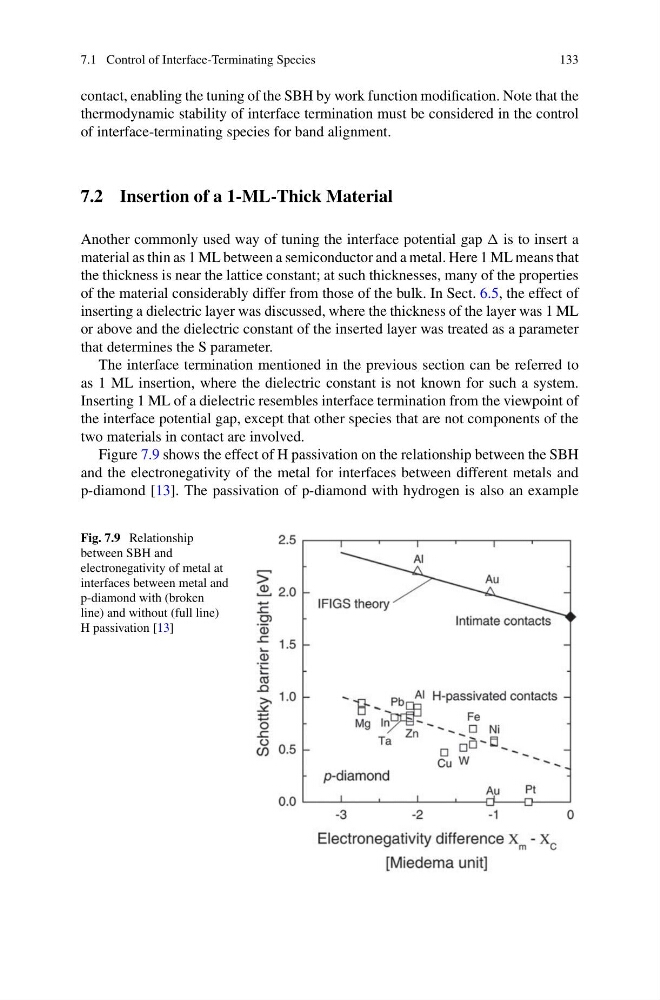
Figure 7.9 shows the effect of H passivation on the relationship between the SBH
and the electronegativity of the metal for interfaces between different metals and
p-diamond [13]. The passivation of p-diamond with hydrogen is also an example
Fig. 7.9 Relationship
between SBH and
electronegativity of metal at
interfaces between metal and
p-diamond with (broken
line) and without (full line)
H passivation [13]
133
contact, enabling the tuning of the SBH by work function modification. Note that the
thermodynamic stability of interface termination must be considered in the control
of interface-terminating species for band alignment.
7.2 Insertion of a 1-ML-Thick Material
Another commonly used way of tuning the interface potential gap is to insert a
material as thin as 1 ML between a semiconductor and a metal. Here 1 ML means that
the thickness is near the lattice constant; at such thicknesses, many of the properties
of the material considerably differ from those of the bulk. In Sect. 6.5, the effect of
inserting a dielectric layer was discussed, where the thickness of the layer was 1 ML
or above and the dielectric constant of the inserted layer was treated as a parameter
that determines the S parameter.
The interface termination mentioned in the previous section can be referred to
as 1 ML insertion, where the dielectric constant is not known for such a system.
Inserting 1 ML of a dielectric resembles interface termination from the viewpoint of
the interface potential gap, except that other species that are not components of the
two materials in contact are involved.
Figure 7.9 shows the effect of H passivation on the relationship between the SBH
and the electronegativity of the metal for interfaces between different metals and
p-diamond [13]. The passivation of p-diamond with hydrogen is also an example
Fig. 7.9 Relationship
between SBH and
electronegativity of metal at
interfaces between metal and
p-diamond with (broken
line) and without (full line)
H passivation [13]