

132
7 Utilization of Interface Potential
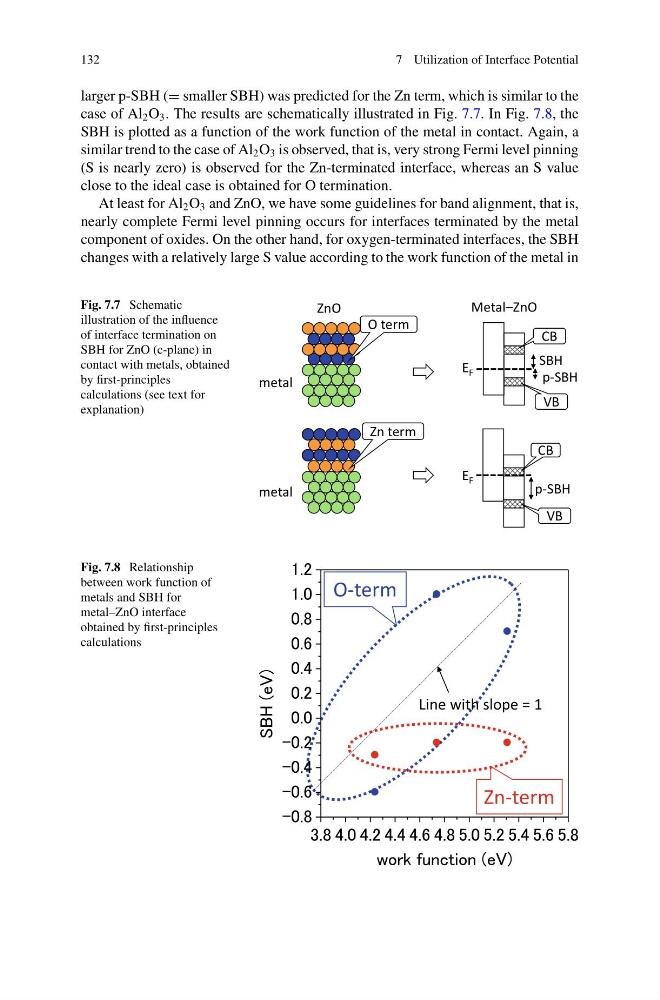
larger p-SBH (= smaller SBH) was predicted for the Zn term, which is similar to the
case of Al 2 O 3 . The results are schematically illustrated in Fig. 7.7. In Fig. 7.8, the
SBH is plotted as a function of the work function of the metal in contact. Again, a
similar trend to the case of Al 2 O 3 is observed, that is, very strong Fermi level pinning
(S is nearly zero) is observed for the Zn-terminated interface, whereas an S value
close to the ideal case is obtained for O termination.
At least for Al 2 O 3 and ZnO, we have some guidelines for band alignment, that is,
nearly complete Fermi level pinning occurs for interfaces terminated by the metal
component of oxides. On the other hand, for oxygen-terminated interfaces, the SBH
changes with a relatively large S value according to the work function of the metal in
Fig. 7.7 Schematic
illustration of the influence
of interface termination on
SBH for ZnO (c-plane) in
contact with metals, obtained
by first-principles
calculations (see text for
explanation)
O term
Zn term
ZnO
metal
metal
Metal–ZnO
E F
E F
CB
CB
VB
VB
SBH
p-SBH
p-SBH
Fig. 7.8 Relationship
between work function of
metals and SBH for
metal–ZnO interface
obtained by first-principles
calculations
7 Utilization of Interface Potential
larger p-SBH (= smaller SBH) was predicted for the Zn term, which is similar to the
case of Al 2 O 3 . The results are schematically illustrated in Fig. 7.7. In Fig. 7.8, the
SBH is plotted as a function of the work function of the metal in contact. Again, a
similar trend to the case of Al 2 O 3 is observed, that is, very strong Fermi level pinning
(S is nearly zero) is observed for the Zn-terminated interface, whereas an S value
close to the ideal case is obtained for O termination.
At least for Al 2 O 3 and ZnO, we have some guidelines for band alignment, that is,
nearly complete Fermi level pinning occurs for interfaces terminated by the metal
component of oxides. On the other hand, for oxygen-terminated interfaces, the SBH
changes with a relatively large S value according to the work function of the metal in
Fig. 7.7 Schematic
illustration of the influence
of interface termination on
SBH for ZnO (c-plane) in
contact with metals, obtained
by first-principles
calculations (see text for
explanation)
O term
Zn term
ZnO
metal
metal
Metal–ZnO
E F
E F
CB
CB
VB
VB
SBH
p-SBH
p-SBH
Fig. 7.8 Relationship
between work function of
metals and SBH for
metal–ZnO interface
obtained by first-principles
calculations