

7.1 Control of Interface-Terminating Species
131
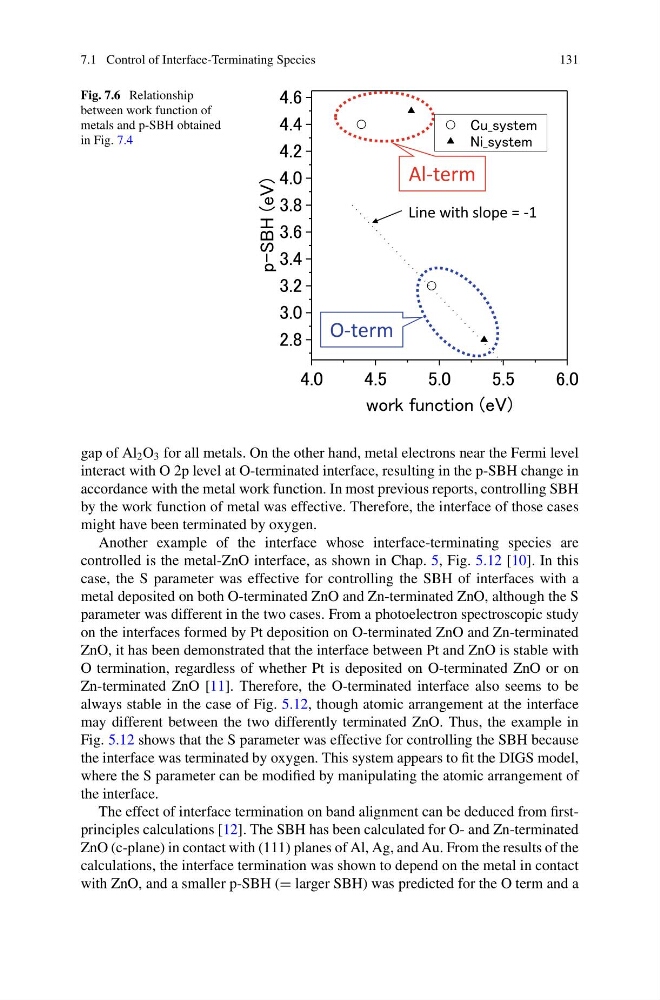
Fig. 7.6 Relationship
between work function of
metals and p-SBH obtained
in Fig. 7.4
gap of Al 2 O 3 for all metals. On the other hand, metal electrons near the Fermi level
interact with O 2p level at O-terminated interface, resulting in the p-SBH change in
accordance with the metal work function. In most previous reports, controlling SBH
by the work function of metal was effective. Therefore, the interface of those cases
might have been terminated by oxygen.
Another example of the interface whose interface-terminating species are
controlled is the metal-ZnO interface, as shown in Chap. 5, Fig. 5.12 [10]. In this
case, the S parameter was effective for controlling the SBH of interfaces with a
metal deposited on both O-terminated ZnO and Zn-terminated ZnO, although the S
parameter was different in the two cases. From a photoelectron spectroscopic study
on the interfaces formed by Pt deposition on O-terminated ZnO and Zn-terminated
ZnO, it has been demonstrated that the interface between Pt and ZnO is stable with
O termination, regardless of whether Pt is deposited on O-terminated ZnO or on
Zn-terminated ZnO [11]. Therefore, the O-terminated interface also seems to be
always stable in the case of Fig. 5.12, though atomic arrangement at the interface
may different between the two differently terminated ZnO. Thus, the example in
Fig. 5.12 shows that the S parameter was effective for controlling the SBH because
the interface was terminated by oxygen. This system appears to fit the DIGS model,
where the S parameter can be modified by manipulating the atomic arrangement of
the interface.
The effect of interface termination on band alignment can be deduced from firstprinciples calculations [12]. The SBH has been calculated for O- and Zn-terminated
ZnO (c-plane) in contact with (111) planes of Al, Ag, and Au. From the results of the
calculations, the interface termination was shown to depend on the metal in contact
with ZnO, and a smaller p-SBH (= larger SBH) was predicted for the O term and a
131
Fig. 7.6 Relationship
between work function of
metals and p-SBH obtained
in Fig. 7.4
gap of Al 2 O 3 for all metals. On the other hand, metal electrons near the Fermi level
interact with O 2p level at O-terminated interface, resulting in the p-SBH change in
accordance with the metal work function. In most previous reports, controlling SBH
by the work function of metal was effective. Therefore, the interface of those cases
might have been terminated by oxygen.
Another example of the interface whose interface-terminating species are
controlled is the metal-ZnO interface, as shown in Chap. 5, Fig. 5.12 [10]. In this
case, the S parameter was effective for controlling the SBH of interfaces with a
metal deposited on both O-terminated ZnO and Zn-terminated ZnO, although the S
parameter was different in the two cases. From a photoelectron spectroscopic study
on the interfaces formed by Pt deposition on O-terminated ZnO and Zn-terminated
ZnO, it has been demonstrated that the interface between Pt and ZnO is stable with
O termination, regardless of whether Pt is deposited on O-terminated ZnO or on
Zn-terminated ZnO [11]. Therefore, the O-terminated interface also seems to be
always stable in the case of Fig. 5.12, though atomic arrangement at the interface
may different between the two differently terminated ZnO. Thus, the example in
Fig. 5.12 shows that the S parameter was effective for controlling the SBH because
the interface was terminated by oxygen. This system appears to fit the DIGS model,
where the S parameter can be modified by manipulating the atomic arrangement of
the interface.
The effect of interface termination on band alignment can be deduced from firstprinciples calculations [12]. The SBH has been calculated for O- and Zn-terminated
ZnO (c-plane) in contact with (111) planes of Al, Ag, and Au. From the results of the
calculations, the interface termination was shown to depend on the metal in contact
with ZnO, and a smaller p-SBH (= larger SBH) was predicted for the O term and a