

130
7 Utilization of Interface Potential
Summary of p-type
SchoƩky barrier height
Δ: calc./ exp.
Ni:
O term: 1.5 / 2.8 eV
Al term: 3.8 / 4.5 eV
Cu
O term: 2.1 / 3.2 eV
Al term: 3.6 / 4.4 eV
NiAl
Cu(Al)
Pure Ni
Pure Cu
alumina
O term
Al term
E F
E F
VB
VB
CB
CB
Metal–alumina
Δ:small
Δ:large
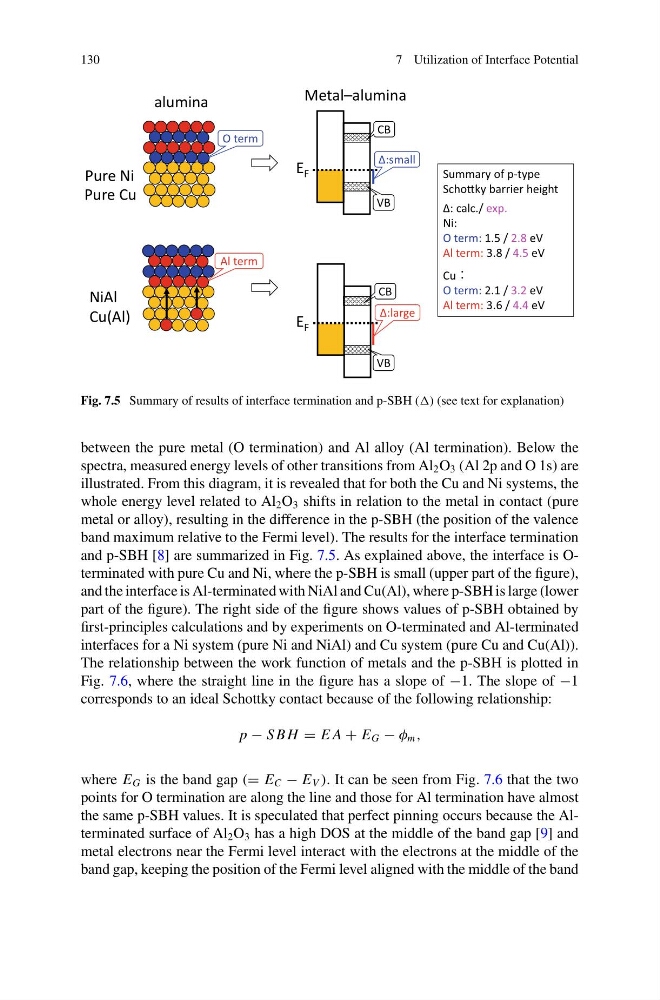
Fig. 7.5 Summary of results of interface termination and p-SBH () (see text for explanation)
between the pure metal (O termination) and Al alloy (Al termination). Below the
spectra, measured energy levels of other transitions from Al 2 O 3 (Al 2p and O 1s) are
illustrated. From this diagram, it is revealed that for both the Cu and Ni systems, the
whole energy level related to Al 2 O 3 shifts in relation to the metal in contact (pure
metal or alloy), resulting in the difference in the p-SBH (the position of the valence
band maximum relative to the Fermi level). The results for the interface termination
and p-SBH [8] are summarized in Fig. 7.5. As explained above, the interface is Oterminated with pure Cu and Ni, where the p-SBH is small (upper part of the figure),
and the interface is Al-terminated with NiAl and Cu(Al), where p-SBH is large (lower
part of the figure). The right side of the figure shows values of p-SBH obtained by
first-principles calculations and by experiments on O-terminated and Al-terminated
interfaces for a Ni system (pure Ni and NiAl) and Cu system (pure Cu and Cu(Al)).
The relationship between the work function of metals and the p-SBH is plotted in
Fig. 7.6, where the straight line in the figure has a slope of −1. The slope of −1
corresponds to an ideal Schottky contact because of the following relationship:
p − S B H = E A + E G − φ m ,
where E G is the band gap (= E C − E V ). It can be seen from Fig. 7.6 that the two
points for O termination are along the line and those for Al termination have almost
the same p-SBH values. It is speculated that perfect pinning occurs because the Alterminated surface of Al 2 O 3 has a high DOS at the middle of the band gap [9] and
metal electrons near the Fermi level interact with the electrons at the middle of the
band gap, keeping the position of the Fermi level aligned with the middle of the band
7 Utilization of Interface Potential
Summary of p-type
SchoƩky barrier height
Δ: calc./ exp.
Ni:
O term: 1.5 / 2.8 eV
Al term: 3.8 / 4.5 eV
Cu
O term: 2.1 / 3.2 eV
Al term: 3.6 / 4.4 eV
NiAl
Cu(Al)
Pure Ni
Pure Cu
alumina
O term
Al term
E F
E F
VB
VB
CB
CB
Metal–alumina
Δ:small
Δ:large
Fig. 7.5 Summary of results of interface termination and p-SBH () (see text for explanation)
between the pure metal (O termination) and Al alloy (Al termination). Below the
spectra, measured energy levels of other transitions from Al 2 O 3 (Al 2p and O 1s) are
illustrated. From this diagram, it is revealed that for both the Cu and Ni systems, the
whole energy level related to Al 2 O 3 shifts in relation to the metal in contact (pure
metal or alloy), resulting in the difference in the p-SBH (the position of the valence
band maximum relative to the Fermi level). The results for the interface termination
and p-SBH [8] are summarized in Fig. 7.5. As explained above, the interface is Oterminated with pure Cu and Ni, where the p-SBH is small (upper part of the figure),
and the interface is Al-terminated with NiAl and Cu(Al), where p-SBH is large (lower
part of the figure). The right side of the figure shows values of p-SBH obtained by
first-principles calculations and by experiments on O-terminated and Al-terminated
interfaces for a Ni system (pure Ni and NiAl) and Cu system (pure Cu and Cu(Al)).
The relationship between the work function of metals and the p-SBH is plotted in
Fig. 7.6, where the straight line in the figure has a slope of −1. The slope of −1
corresponds to an ideal Schottky contact because of the following relationship:
p − S B H = E A + E G − φ m ,
where E G is the band gap (= E C − E V ). It can be seen from Fig. 7.6 that the two
points for O termination are along the line and those for Al termination have almost
the same p-SBH values. It is speculated that perfect pinning occurs because the Alterminated surface of Al 2 O 3 has a high DOS at the middle of the band gap [9] and
metal electrons near the Fermi level interact with the electrons at the middle of the
band gap, keeping the position of the Fermi level aligned with the middle of the band