

124
6 Advanced Models for Practical Devices
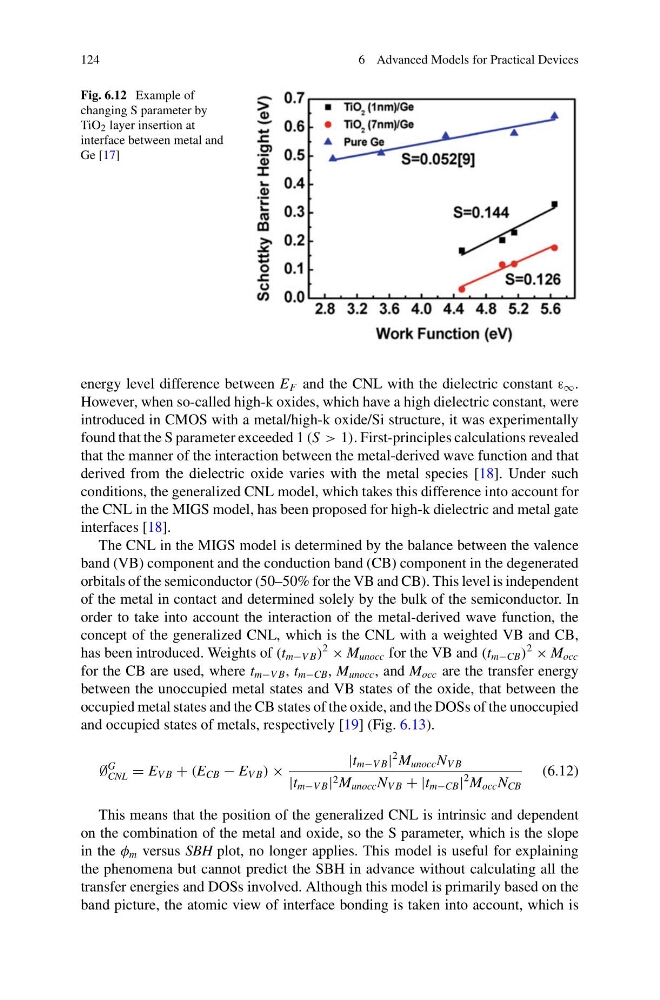
Fig. 6.12 Example of
changing S parameter by
TiO 2 layer insertion at
interface between metal and
Ge [17]
energy level difference between E F and the CNL with the dielectric constant ε ∞ .
However, when so-called high-k oxides, which have a high dielectric constant, were
introduced in CMOS with a metal/high-k oxide/Si structure, it was experimentally
found that the S parameter exceeded 1 (S > 1). First-principles calculations revealed
that the manner of the interaction between the metal-derived wave function and that
derived from the dielectric oxide varies with the metal species [18]. Under such
conditions, the generalized CNL model, which takes this difference into account for
the CNL in the MIGS model, has been proposed for high-k dielectric and metal gate
interfaces [18].
The CNL in the MIGS model is determined by the balance between the valence
band (VB) component and the conduction band (CB) component in the degenerated
orbitals of the semiconductor (50–50% for the VB and CB). This level is independent
of the metal in contact and determined solely by the bulk of the semiconductor. In
order to take into account the interaction of the metal-derived wave function, the
concept of the generalized CNL, which is the CNL with a weighted VB and CB,
has been introduced. Weights of (t m−V B )
2
× M unocc for the VB and (t m−CB )
2
× M occ
for the CB are used, where t m−V B , t m−CB , M unocc , and M occ are the transfer energy
between the unoccupied metal states and VB states of the oxide, that between the
occupied metal states and the CB states of the oxide, and the DOSs of the unoccupied
and occupied states of metals, respectively [19] (Fig. 6.13).
∅
G
CNL = E V B + (E CB − E V B ) ×
|t m−V B |
2 M unocc N V B
|t m−V B | 2 M unocc N V B + |t m−CB |
2 M occ N CB
(6.12)
This means that the position of the generalized CNL is intrinsic and dependent
on the combination of the metal and oxide, so the S parameter, which is the slope
in the φ m versus SBH plot, no longer applies. This model is useful for explaining
the phenomena but cannot predict the SBH in advance without calculating all the
transfer energies and DOSs involved. Although this model is primarily based on the
band picture, the atomic view of interface bonding is taken into account, which is
6 Advanced Models for Practical Devices
Fig. 6.12 Example of
changing S parameter by
TiO 2 layer insertion at
interface between metal and
Ge [17]
energy level difference between E F and the CNL with the dielectric constant ε ∞ .
However, when so-called high-k oxides, which have a high dielectric constant, were
introduced in CMOS with a metal/high-k oxide/Si structure, it was experimentally
found that the S parameter exceeded 1 (S > 1). First-principles calculations revealed
that the manner of the interaction between the metal-derived wave function and that
derived from the dielectric oxide varies with the metal species [18]. Under such
conditions, the generalized CNL model, which takes this difference into account for
the CNL in the MIGS model, has been proposed for high-k dielectric and metal gate
interfaces [18].
The CNL in the MIGS model is determined by the balance between the valence
band (VB) component and the conduction band (CB) component in the degenerated
orbitals of the semiconductor (50–50% for the VB and CB). This level is independent
of the metal in contact and determined solely by the bulk of the semiconductor. In
order to take into account the interaction of the metal-derived wave function, the
concept of the generalized CNL, which is the CNL with a weighted VB and CB,
has been introduced. Weights of (t m−V B )
2
× M unocc for the VB and (t m−CB )
2
× M occ
for the CB are used, where t m−V B , t m−CB , M unocc , and M occ are the transfer energy
between the unoccupied metal states and VB states of the oxide, that between the
occupied metal states and the CB states of the oxide, and the DOSs of the unoccupied
and occupied states of metals, respectively [19] (Fig. 6.13).
∅
G
CNL = E V B + (E CB − E V B ) ×
|t m−V B |
2 M unocc N V B
|t m−V B | 2 M unocc N V B + |t m−CB |
2 M occ N CB
(6.12)
This means that the position of the generalized CNL is intrinsic and dependent
on the combination of the metal and oxide, so the S parameter, which is the slope
in the φ m versus SBH plot, no longer applies. This model is useful for explaining
the phenomena but cannot predict the SBH in advance without calculating all the
transfer energies and DOSs involved. Although this model is primarily based on the
band picture, the atomic view of interface bonding is taken into account, which is