

104
5 Modification of Band Alignment via Work Function Control
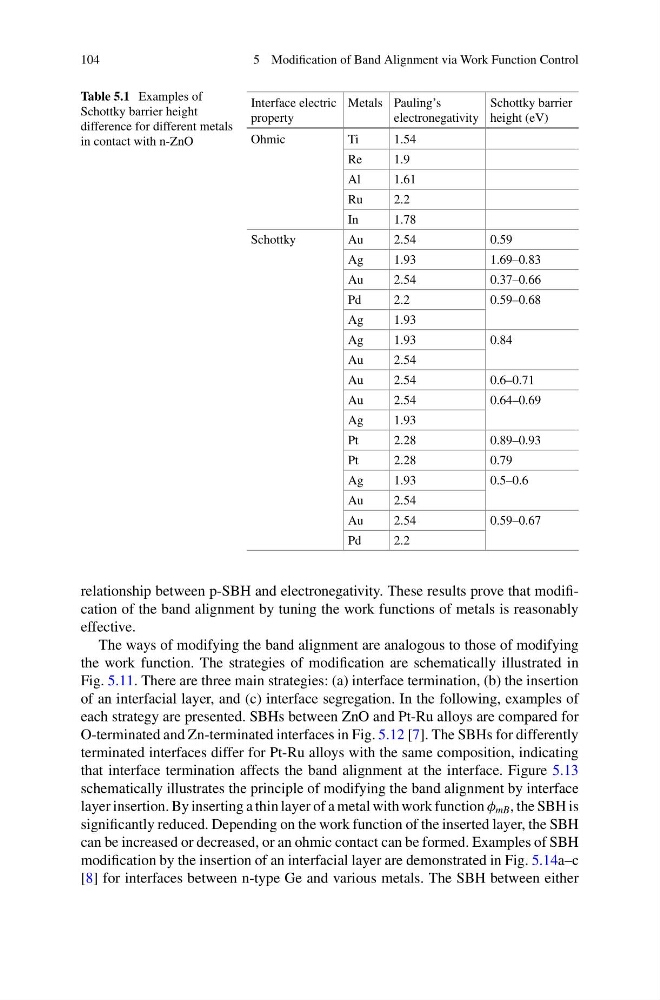
Table 5.1 Examples of
Schottky barrier height
difference for different metals
in contact with n-ZnO
Interface electric
property
Metals Pauling’s
electronegativity
Schottky barrier
height (eV)
Ohmic
Ti
1.54
Re
1.9
Al
1.61
Ru
2.2
In
1.78
Schottky
Au
2.54
0.59
Ag
1.93
1.69–0.83
Au
2.54
0.37–0.66
Pd
2.2
0.59–0.68
Ag
1.93
Ag
1.93
0.84
Au
2.54
Au
2.54
0.6–0.71
Au
2.54
0.64–0.69
Ag
1.93
Pt
2.28
0.89–0.93
Pt
2.28
0.79
Ag
1.93
0.5–0.6
Au
2.54
Au
2.54
0.59–0.67
Pd
2.2
relationship between p-SBH and electronegativity. These results prove that modification of the band alignment by tuning the work functions of metals is reasonably
effective.
The ways of modifying the band alignment are analogous to those of modifying
the work function. The strategies of modification are schematically illustrated in
Fig. 5.11. There are three main strategies: (a) interface termination, (b) the insertion
of an interfacial layer, and (c) interface segregation. In the following, examples of
each strategy are presented. SBHs between ZnO and Pt-Ru alloys are compared for
O-terminated and Zn-terminated interfaces in Fig. 5.12 [7]. The SBHs for differently
terminated interfaces differ for Pt-Ru alloys with the same composition, indicating
that interface termination affects the band alignment at the interface. Figure 5.13
schematically illustrates the principle of modifying the band alignment by interface
layer insertion. By inserting a thin layer of a metal with work function φ mB , the SBH is
significantly reduced. Depending on the work function of the inserted layer, the SBH
can be increased or decreased, or an ohmic contact can be formed. Examples of SBH
modification by the insertion of an interfacial layer are demonstrated in Fig. 5.14a–c
[8] for interfaces between n-type Ge and various metals. The SBH between either
5 Modification of Band Alignment via Work Function Control
Table 5.1 Examples of
Schottky barrier height
difference for different metals
in contact with n-ZnO
Interface electric
property
Metals Pauling’s
electronegativity
Schottky barrier
height (eV)
Ohmic
Ti
1.54
Re
1.9
Al
1.61
Ru
2.2
In
1.78
Schottky
Au
2.54
0.59
Ag
1.93
1.69–0.83
Au
2.54
0.37–0.66
Pd
2.2
0.59–0.68
Ag
1.93
Ag
1.93
0.84
Au
2.54
Au
2.54
0.6–0.71
Au
2.54
0.64–0.69
Ag
1.93
Pt
2.28
0.89–0.93
Pt
2.28
0.79
Ag
1.93
0.5–0.6
Au
2.54
Au
2.54
0.59–0.67
Pd
2.2
relationship between p-SBH and electronegativity. These results prove that modification of the band alignment by tuning the work functions of metals is reasonably
effective.
The ways of modifying the band alignment are analogous to those of modifying
the work function. The strategies of modification are schematically illustrated in
Fig. 5.11. There are three main strategies: (a) interface termination, (b) the insertion
of an interfacial layer, and (c) interface segregation. In the following, examples of
each strategy are presented. SBHs between ZnO and Pt-Ru alloys are compared for
O-terminated and Zn-terminated interfaces in Fig. 5.12 [7]. The SBHs for differently
terminated interfaces differ for Pt-Ru alloys with the same composition, indicating
that interface termination affects the band alignment at the interface. Figure 5.13
schematically illustrates the principle of modifying the band alignment by interface
layer insertion. By inserting a thin layer of a metal with work function φ mB , the SBH is
significantly reduced. Depending on the work function of the inserted layer, the SBH
can be increased or decreased, or an ohmic contact can be formed. Examples of SBH
modification by the insertion of an interfacial layer are demonstrated in Fig. 5.14a–c
[8] for interfaces between n-type Ge and various metals. The SBH between either