

5.2 Modification of Band Alignment
103
Specimen
(a)
(b)
Secondary electron
cutoff spectra
Work funccon
mapping
Pt
Cu
Pt
Cu
-4V
c/s
4
3
2
1
0
X 10 4
1482 1482 1478 1476 1474 1472
Binding Energy (eV)
intensity
for mapping
100 μm
100
μm
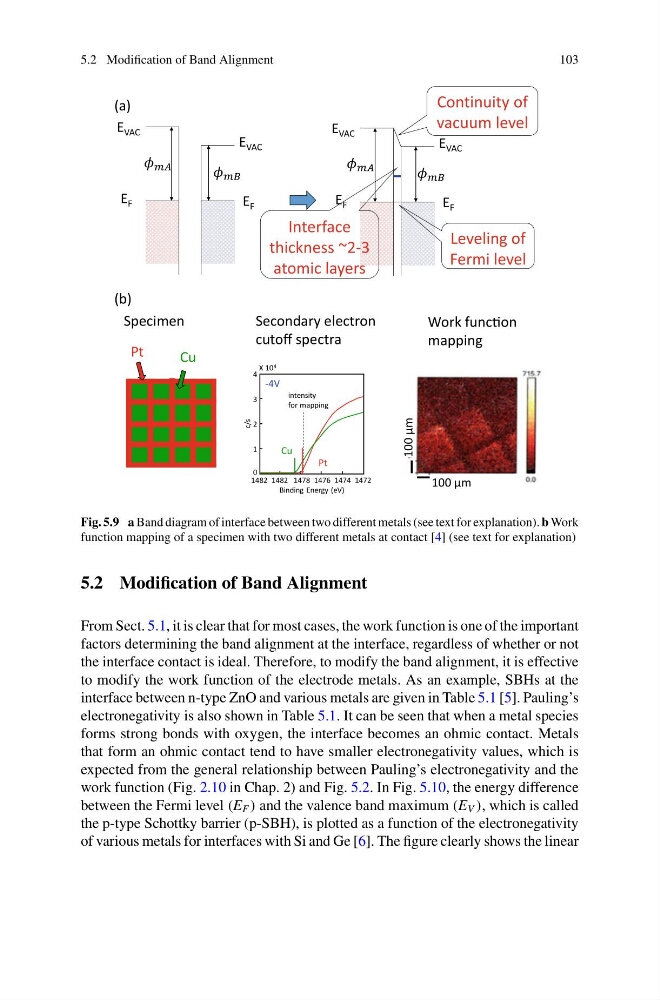
Fig. 5.9 a Band diagram of interface between two different metals (see text for explanation). b Work
function mapping of a specimen with two different metals at contact [4] (see text for explanation)
5.2 Modification of Band Alignment
From Sect. 5.1, it is clear that for most cases, the work function is one of the important
factors determining the band alignment at the interface, regardless of whether or not
the interface contact is ideal. Therefore, to modify the band alignment, it is effective
to modify the work function of the electrode metals. As an example, SBHs at the
interface between n-type ZnO and various metals are given in Table 5.1 [5]. Pauling’s
electronegativity is also shown in Table 5.1. It can be seen that when a metal species
forms strong bonds with oxygen, the interface becomes an ohmic contact. Metals
that form an ohmic contact tend to have smaller electronegativity values, which is
expected from the general relationship between Pauling’s electronegativity and the
work function (Fig. 2.10 in Chap. 2) and Fig. 5.2. In Fig. 5.10, the energy difference
between the Fermi level (E F ) and the valence band maximum (E V ), which is called
the p-type Schottky barrier (p-SBH), is plotted as a function of the electronegativity
of various metals for interfaces with Si and Ge [6]. The figure clearly shows the linear
103
Specimen
(a)
(b)
Secondary electron
cutoff spectra
Work funccon
mapping
Pt
Cu
Pt
Cu
-4V
c/s
4
3
2
1
0
X 10 4
1482 1482 1478 1476 1474 1472
Binding Energy (eV)
intensity
for mapping
100 μm
100
μm
Fig. 5.9 a Band diagram of interface between two different metals (see text for explanation). b Work
function mapping of a specimen with two different metals at contact [4] (see text for explanation)
5.2 Modification of Band Alignment
From Sect. 5.1, it is clear that for most cases, the work function is one of the important
factors determining the band alignment at the interface, regardless of whether or not
the interface contact is ideal. Therefore, to modify the band alignment, it is effective
to modify the work function of the electrode metals. As an example, SBHs at the
interface between n-type ZnO and various metals are given in Table 5.1 [5]. Pauling’s
electronegativity is also shown in Table 5.1. It can be seen that when a metal species
forms strong bonds with oxygen, the interface becomes an ohmic contact. Metals
that form an ohmic contact tend to have smaller electronegativity values, which is
expected from the general relationship between Pauling’s electronegativity and the
work function (Fig. 2.10 in Chap. 2) and Fig. 5.2. In Fig. 5.10, the energy difference
between the Fermi level (E F ) and the valence band maximum (E V ), which is called
the p-type Schottky barrier (p-SBH), is plotted as a function of the electronegativity
of various metals for interfaces with Si and Ge [6]. The figure clearly shows the linear