

5.1 Ideal Band Alignment
99
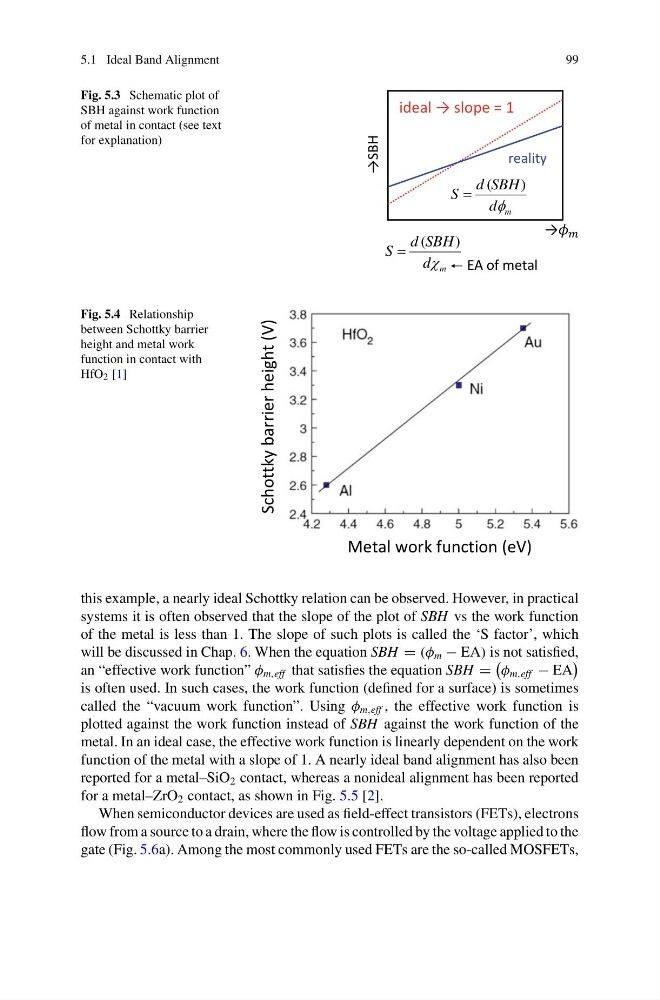
Fig. 5.3 Schematic plot of
SBH against work function
of metal in contact (see text
for explanation)
→
→SBH
ideal → slope = 1
reality
m
d
d
H
B
S
S
I
)
(
m
d
d
H
B
S
S
F
)
(
EA of metal
Fig. 5.4 Relationship
between Schottky barrier
height and metal work
function in contact with
HfO 2 [1]
Metal work function (eV)
Schottky barrier height (V)
this example, a nearly ideal Schottky relation can be observed. However, in practical
systems it is often observed that the slope of the plot of SBH vs the work function
of the metal is less than 1. The slope of such plots is called the ‘S factor’, which
will be discussed in Chap. 6. When the equation SBH = (φ m − EA) is not satisfied,
an “effective work function” φ m,eff that satisfies the equation SBH =
φ m,eff − EA
is often used. In such cases, the work function (defined for a surface) is sometimes
called the “vacuum work function”. Using φ m,eff , the effective work function is
plotted against the work function instead of SBH against the work function of the
metal. In an ideal case, the effective work function is linearly dependent on the work
function of the metal with a slope of 1. A nearly ideal band alignment has also been
reported for a metal–SiO 2 contact, whereas a nonideal alignment has been reported
for a metal–ZrO 2 contact, as shown in Fig. 5.5 [2].
When semiconductor devices are used as field-effect transistors (FETs), electrons
flow from a source to a drain, where the flow is controlled by the voltage applied to the
gate (Fig. 5.6a). Among the most commonly used FETs are the so-called MOSFETs,
99
Fig. 5.3 Schematic plot of
SBH against work function
of metal in contact (see text
for explanation)
→
→SBH
ideal → slope = 1
reality
m
d
d
H
B
S
S
I
)
(
m
d
d
H
B
S
S
F
)
(
EA of metal
Fig. 5.4 Relationship
between Schottky barrier
height and metal work
function in contact with
HfO 2 [1]
Metal work function (eV)
Schottky barrier height (V)
this example, a nearly ideal Schottky relation can be observed. However, in practical
systems it is often observed that the slope of the plot of SBH vs the work function
of the metal is less than 1. The slope of such plots is called the ‘S factor’, which
will be discussed in Chap. 6. When the equation SBH = (φ m − EA) is not satisfied,
an “effective work function” φ m,eff that satisfies the equation SBH =
φ m,eff − EA
is often used. In such cases, the work function (defined for a surface) is sometimes
called the “vacuum work function”. Using φ m,eff , the effective work function is
plotted against the work function instead of SBH against the work function of the
metal. In an ideal case, the effective work function is linearly dependent on the work
function of the metal with a slope of 1. A nearly ideal band alignment has also been
reported for a metal–SiO 2 contact, whereas a nonideal alignment has been reported
for a metal–ZrO 2 contact, as shown in Fig. 5.5 [2].
When semiconductor devices are used as field-effect transistors (FETs), electrons
flow from a source to a drain, where the flow is controlled by the voltage applied to the
gate (Fig. 5.6a). Among the most commonly used FETs are the so-called MOSFETs,