

SOLUTIONS
19
Solutions
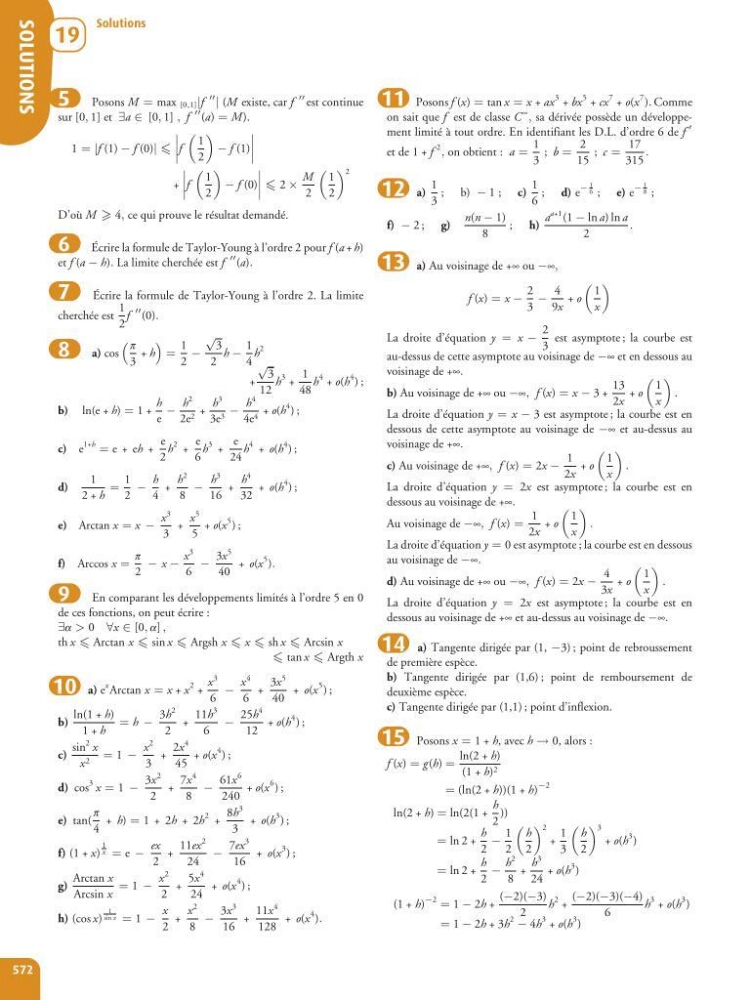
5 Posons M = max [0,1] |f
| (M existe, car f
est continue
sur [0, 1] et ∃a ∈ [0, 1] , f
(a) = M ).
1 = |f (1) − f (0)|
f
1
2
− f (1)
+
f
1
2
− f (0)
2 ×
M
2
1
2
2
D’où M 4, ce qui prouve le résultat demandé.
6 Écrire la formule de Taylor-Young àl’ordre 2pour f (a + h)
et f (a − h). La limite cherchée est f
(a).
7 Écrire la formule de Taylor-Young àl ’ordre 2. La limite
cherchée est
1
2
f
(0).
8 a) cos
π
3
+ h
=
1
2
−
√ 3
2
h −
1
4
h
2
+
√ 3
12
h
3 +
1
48
h
4 + o(h
4 );
b) ln(e + h) = 1+
h
e
−
h
2
2e 2 +
h
3
3e 3 −
h
4
4e 4 + o(h
4 );
c) e
1+h = e+e h+
e
2
h
2 +
e
6
h
3 +
e
24
h
4 + o(h
4 );
d)
1
2+h
=
1
2
−
h
4
+
h
2
8
−
h
3
16
+
h
4
32
+ o(h
4 );
e) Arctan x = x −
x
3
3
+
x
5
5
+ o(x
5 );
f) Arccos x =
π
2
− x −
x
3
6
−
3x
5
40
+ o(x
5 ).
9 En comparant les développements limités àl’ordre 5en0
de ces fonctions, on peut écrire :
∃α > 0 ∀x ∈ [0, α] ,
th x Arctan x sin x Argsh x x sh x Arcsin x
tan x Argth x
10 a) e
x Arctan x = x + x
2 +
x
3
6
−
x
4
6
+
3x
5
40
+ o(x
5 );
b)
ln(1 + h)
1+h
=h −
3h
2
2
+
11h
3
6
−
25h
4
12
+ o(h
4 );
c)
sin
2 x
x 2 = 1 −
x
2
3
+
2x
4
45
+ o(x
4 );
d) cos
3 x = 1 −
3x
2
2
+
7x
4
8
−
61x
6
240
+ o(x
6 );
e) tan(
π
4
+ h) = 1+2 h+2 h
2 +
8 h
3
3
+o ( h
3 );
f) (1 + x)
1
x = e −
ex
2
+
11ex
2
24
−
7ex
3
16
+ o(x
3 );
g)
Arctan x
Arcsin x
= 1 −
x
2
2
+
5x
4
24
+ o(x
4 );
h) (cos x)
1
sin x = 1 −
x
2
+
x
2
8
−
3x
3
16
+
11x
4
128
+ o(x
4 ).
11 Posons f (x) = tan x = x + ax
3 + bx
5 + cx
7 + o(x
7 ). Comme
on sait que f est de classe C
∞ , sa dérivéep ossède un développement limité àtout ordre. En identifiant les D.L. d’ordre 6def
et de 1+f
2 ,on obtient : a =
1
3
; b =
2
15
; c =
17
315
.
12 a)
1
3
;b ) − 1; c)
1
6
; d) e
− 1
6 ; e) e
− 1
8 ;
f) − 2; g)
n(n − 1)
8
; h)
a
a+1 (1 − ln a)lna
2
.
13 a) Au voisinage de +∞ ou −∞,
f (x) = x −
2
3
−
4
9x
+ o
1
x
La droite d’équation y = x −
2
3
est asymptote ;l ac ourbe est
au-dessus de cette asymptote au voisinage de −∞ et en dessousau
voisinage de +∞.
b) Au voisinage de +∞ ou −∞, f (x) = x − 3+
13
2x
+ o
1
x
.
La droite d’équation y = x − 3e st asymptote ;l ac ourbe est en
dessous de cette asymptote au voisinage de −∞ et au-dessus au
voisinage de +∞.
c) Au voisinagede+∞, f(x)=2x−
1
2x
+o
1
x
.
La droite d’équation y = 2x est asymptote ;l ac ourbe este n
dessous au voisinage de +∞.
Au voisinage de −∞, f (x) =
1
2x
+ o
1
x
.
La droite d’équation y = 0est asymptote ;lacourbe est en dessous
au voisinage de −∞.
d) Au voisinage de +∞ ou −∞, f (x) = 2x −
4
3x
+ o
1
x
.
La droite d’équation y = 2x est asymptote ;l ac ourbe este n
dessous au voisinage de +∞ et au-dessus au voisinage de −∞.
14 a) Tangente dirigée par( 1, −3) ;p oint de rebroussement
de première espèce.
b) Tangente dirigéep ar (1,6) ;p oint de remboursement de
deuxième espèce.
c) Tangente dirigéepar (1,1) ;point d’inflexion.
15 Posons x = 1+h,avec h → 0, alors :
f (x) = g(h) =
ln(2+h)
(1 + h) 2
= (ln(2 + h))(1 + h)
−2
ln(2+h)=ln(2(1 +
h
2
))
= ln 2+
h
2
−
1
2
h
2
2
+
1
3
h
2
3
+o(h
3 )
=ln 2+
h
2
−
h
2
8
+
h
3
24
+ o(h
3 )
(1 + h)
−2 = 1 − 2h +
(−2)(−3)
2
h
2 +
(−2)(−3)(−4)
6
h
3 + o(h
3 )
= 1 − 2h +3h
2 −4h
3 +o(h
3 )
572