

5 Polymer Solar Cells: Development of π-Conjugated Polymers …
93
q xy (Å – 1 )
q z (Å –
1
)
0
0.5
1.0
1.5
2.0
0
0.2
0.4
0.6
0.8
1.0
1.2
1.4
1.6
1.8
2.0
0
0.5
1.0
1.5
2.0
q z (Å – 1
)
q xy (Å – 1 )
0
.
2
5
.
1
5
.
0
0
.
1
0
0
0.5
1.0
1.5
2.0
q z (Å – 1
)
q xy (Å – 1 )
0
.
2
5
.
1
5
.
0
0
.
1
0
PTzQT
PTzBT-14HD
a
PTzBT-14HD/PC 61 BM
lamella
(h00)
π–π
stacking
(010)
PC 61 BM
π–π stacking
b
c
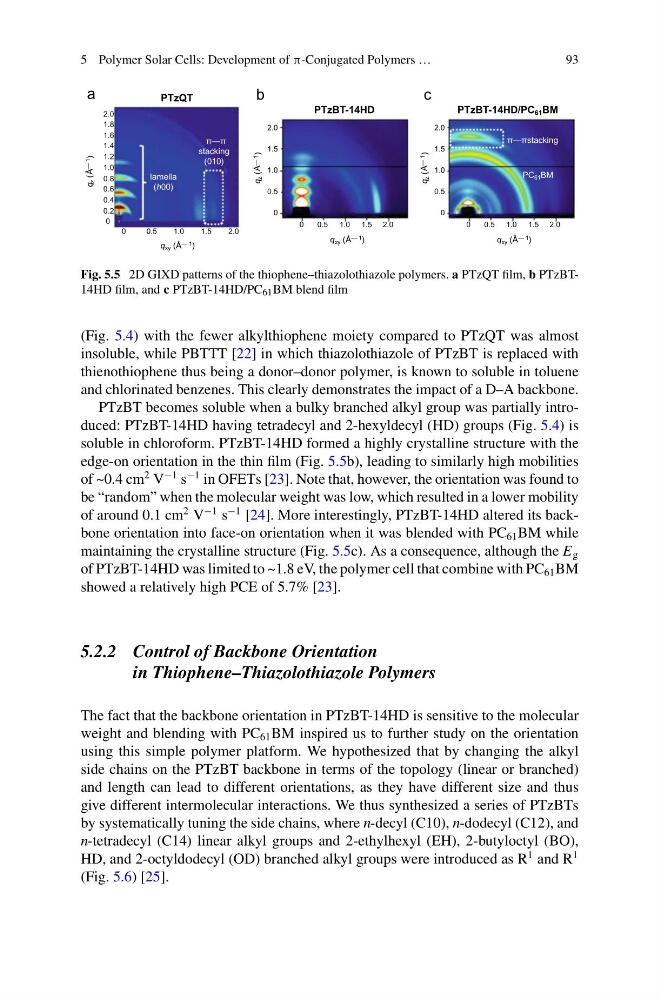
Fig. 5.5 2D GIXD patterns of the thiophene–thiazolothiazole polymers. a PTzQT film, b PTzBT14HD film, and c PTzBT-14HD/PC 61 BM blend film
(Fig. 5.4) with the fewer alkylthiophene moiety compared to PTzQT was almost
insoluble, while PBTTT [22] in which thiazolothiazole of PTzBT is replaced with
thienothiophene thus being a donor–donor polymer, is known to soluble in toluene
and chlorinated benzenes. This clearly demonstrates the impact of a D–A backbone.
PTzBT becomes soluble when a bulky branched alkyl group was partially introduced: PTzBT-14HD having tetradecyl and 2-hexyldecyl (HD) groups (Fig. 5.4) is
soluble in chloroform. PTzBT-14HD formed a highly crystalline structure with the
edge-on orientation in the thin film (Fig. 5.5b), leading to similarly high mobilities
of ~0.4 cm
2 V
−1 s
−1 in OFETs [23]. Note that, however, the orientation was found to
be “random” when the molecular weight was low, which resulted in a lower mobility
of around 0.1 cm
2 V
−1 s
−1 [24]. More interestingly, PTzBT-14HD altered its backbone orientation into face-on orientation when it was blended with PC 61 BM while
maintaining the crystalline structure (Fig. 5.5c). As a consequence, although the E g
of PTzBT-14HD was limited to ~1.8 eV, the polymer cell that combine with PC 61 BM
showed a relatively high PCE of 5.7% [23].
5.2.2 Control of Backbone Orientation
in Thiophene–Thiazolothiazole Polymers
The fact that the backbone orientation in PTzBT-14HD is sensitive to the molecular
weight and blending with PC 61 BM inspired us to further study on the orientation
using this simple polymer platform. We hypothesized that by changing the alkyl
side chains on the PTzBT backbone in terms of the topology (linear or branched)
and length can lead to different orientations, as they have different size and thus
give different intermolecular interactions. We thus synthesized a series of PTzBTs
by systematically tuning the side chains, where n-decyl (C10), n-dodecyl (C12), and
n-tetradecyl (C14) linear alkyl groups and 2-ethylhexyl (EH), 2-butyloctyl (BO),
HD, and 2-octyldodecyl (OD) branched alkyl groups were introduced as R
1 and R
1
(Fig. 5.6) [25].
93
q xy (Å – 1 )
q z (Å –
1
)
0
0.5
1.0
1.5
2.0
0
0.2
0.4
0.6
0.8
1.0
1.2
1.4
1.6
1.8
2.0
0
0.5
1.0
1.5
2.0
q z (Å – 1
)
q xy (Å – 1 )
0
.
2
5
.
1
5
.
0
0
.
1
0
0
0.5
1.0
1.5
2.0
q z (Å – 1
)
q xy (Å – 1 )
0
.
2
5
.
1
5
.
0
0
.
1
0
PTzQT
PTzBT-14HD
a
PTzBT-14HD/PC 61 BM
lamella
(h00)
π–π
stacking
(010)
PC 61 BM
π–π stacking
b
c
Fig. 5.5 2D GIXD patterns of the thiophene–thiazolothiazole polymers. a PTzQT film, b PTzBT14HD film, and c PTzBT-14HD/PC 61 BM blend film
(Fig. 5.4) with the fewer alkylthiophene moiety compared to PTzQT was almost
insoluble, while PBTTT [22] in which thiazolothiazole of PTzBT is replaced with
thienothiophene thus being a donor–donor polymer, is known to soluble in toluene
and chlorinated benzenes. This clearly demonstrates the impact of a D–A backbone.
PTzBT becomes soluble when a bulky branched alkyl group was partially introduced: PTzBT-14HD having tetradecyl and 2-hexyldecyl (HD) groups (Fig. 5.4) is
soluble in chloroform. PTzBT-14HD formed a highly crystalline structure with the
edge-on orientation in the thin film (Fig. 5.5b), leading to similarly high mobilities
of ~0.4 cm
2 V
−1 s
−1 in OFETs [23]. Note that, however, the orientation was found to
be “random” when the molecular weight was low, which resulted in a lower mobility
of around 0.1 cm
2 V
−1 s
−1 [24]. More interestingly, PTzBT-14HD altered its backbone orientation into face-on orientation when it was blended with PC 61 BM while
maintaining the crystalline structure (Fig. 5.5c). As a consequence, although the E g
of PTzBT-14HD was limited to ~1.8 eV, the polymer cell that combine with PC 61 BM
showed a relatively high PCE of 5.7% [23].
5.2.2 Control of Backbone Orientation
in Thiophene–Thiazolothiazole Polymers
The fact that the backbone orientation in PTzBT-14HD is sensitive to the molecular
weight and blending with PC 61 BM inspired us to further study on the orientation
using this simple polymer platform. We hypothesized that by changing the alkyl
side chains on the PTzBT backbone in terms of the topology (linear or branched)
and length can lead to different orientations, as they have different size and thus
give different intermolecular interactions. We thus synthesized a series of PTzBTs
by systematically tuning the side chains, where n-decyl (C10), n-dodecyl (C12), and
n-tetradecyl (C14) linear alkyl groups and 2-ethylhexyl (EH), 2-butyloctyl (BO),
HD, and 2-octyldodecyl (OD) branched alkyl groups were introduced as R
1 and R
1
(Fig. 5.6) [25].