

92
I. Osaka
5.2 Thiazolothiazole-Based Polymers
5.2.1 Crystallinity of Thiophene–Thiazolothiazole
Donor–Acceptor Polymers
Thiazolothiazole was first introduced into organic semiconductors by Yamashita
and co-workers [16–18]. They synthesized a series of small-molecular compounds,
which nicely functioned as p-type and n-type semiconductors in organic field-effect
transistors (OFETs). On the other hand, thiazolothiazole-based π-conjugated polymers were first reported as luminescent materials [19]. We have then developed a
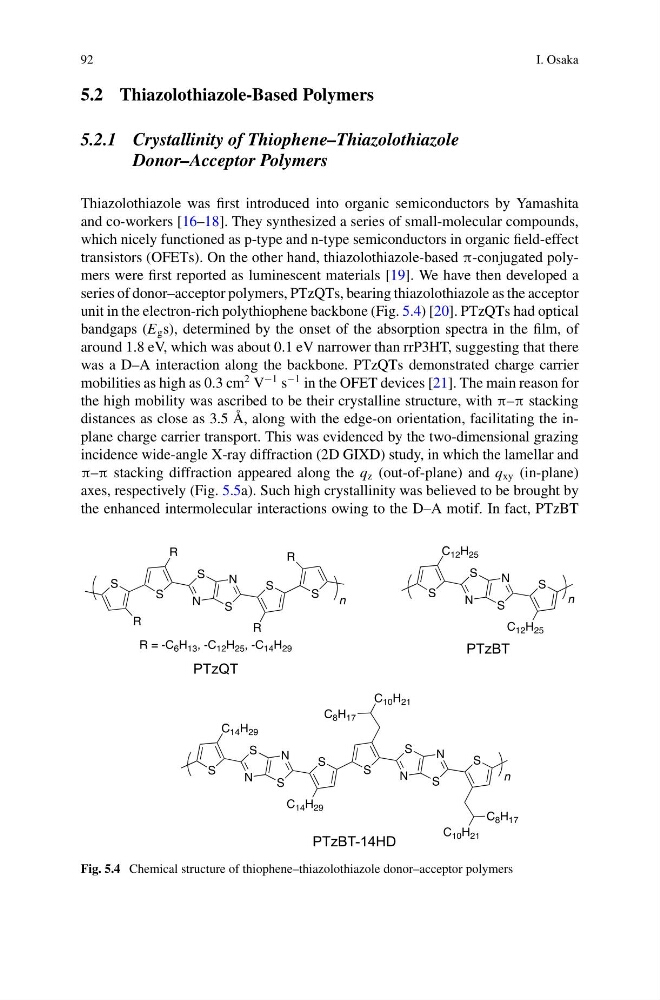
series of donor–acceptor polymers, PTzQTs, bearing thiazolothiazole as the acceptor
unit in the electron-rich polythiophene backbone (Fig. 5.4) [20]. PTzQTs had optical
bandgaps (E g s), determined by the onset of the absorption spectra in the film, of
around 1.8 eV, which was about 0.1 eV narrower than rrP3HT, suggesting that there
was a D–A interaction along the backbone. PTzQTs demonstrated charge carrier
mobilities as high as 0.3 cm
2 V
−1 s
−1 in the OFET devices [21]. The main reason for
the high mobility was ascribed to be their crystalline structure, with π–π stacking
distances as close as 3.5 Å, along with the edge-on orientation, facilitating the inplane charge carrier transport. This was evidenced by the two-dimensional grazing
incidence wide-angle X-ray diffraction (2D GIXD) study, in which the lamellar and
π–π stacking diffraction appeared along the q z (out-of-plane) and q xy (in-plane)
axes, respectively (Fig. 5.5a). Such high crystallinity was believed to be brought by
the enhanced intermolecular interactions owing to the D–A motif. In fact, PTzBT
Fig. 5.4 Chemical structure of thiophene–thiazolothiazole donor–acceptor polymers
I. Osaka
5.2 Thiazolothiazole-Based Polymers
5.2.1 Crystallinity of Thiophene–Thiazolothiazole
Donor–Acceptor Polymers
Thiazolothiazole was first introduced into organic semiconductors by Yamashita
and co-workers [16–18]. They synthesized a series of small-molecular compounds,
which nicely functioned as p-type and n-type semiconductors in organic field-effect
transistors (OFETs). On the other hand, thiazolothiazole-based π-conjugated polymers were first reported as luminescent materials [19]. We have then developed a
series of donor–acceptor polymers, PTzQTs, bearing thiazolothiazole as the acceptor
unit in the electron-rich polythiophene backbone (Fig. 5.4) [20]. PTzQTs had optical
bandgaps (E g s), determined by the onset of the absorption spectra in the film, of
around 1.8 eV, which was about 0.1 eV narrower than rrP3HT, suggesting that there
was a D–A interaction along the backbone. PTzQTs demonstrated charge carrier
mobilities as high as 0.3 cm
2 V
−1 s
−1 in the OFET devices [21]. The main reason for
the high mobility was ascribed to be their crystalline structure, with π–π stacking
distances as close as 3.5 Å, along with the edge-on orientation, facilitating the inplane charge carrier transport. This was evidenced by the two-dimensional grazing
incidence wide-angle X-ray diffraction (2D GIXD) study, in which the lamellar and
π–π stacking diffraction appeared along the q z (out-of-plane) and q xy (in-plane)
axes, respectively (Fig. 5.5a). Such high crystallinity was believed to be brought by
the enhanced intermolecular interactions owing to the D–A motif. In fact, PTzBT
Fig. 5.4 Chemical structure of thiophene–thiazolothiazole donor–acceptor polymers