

5 Polymer Solar Cells: Development of π-Conjugated Polymers …
91
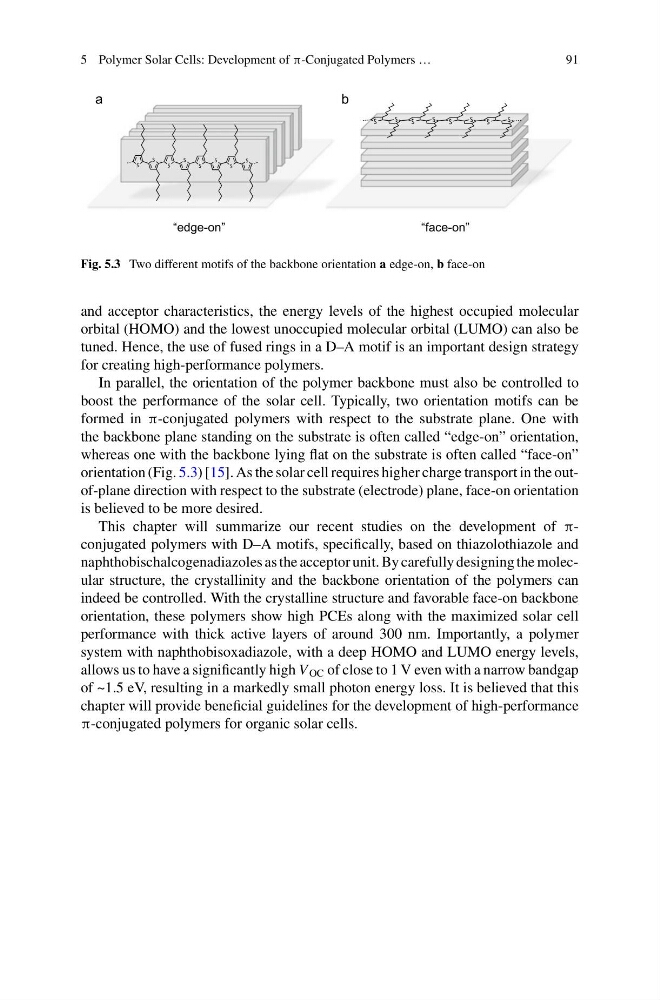
Fig. 5.3 Two different motifs of the backbone orientation a edge-on, b face-on
and acceptor characteristics, the energy levels of the highest occupied molecular
orbital (HOMO) and the lowest unoccupied molecular orbital (LUMO) can also be
tuned. Hence, the use of fused rings in a D–A motif is an important design strategy
for creating high-performance polymers.
In parallel, the orientation of the polymer backbone must also be controlled to
boost the performance of the solar cell. Typically, two orientation motifs can be
formed in π-conjugated polymers with respect to the substrate plane. One with
the backbone plane standing on the substrate is often called “edge-on” orientation,
whereas one with the backbone lying flat on the substrate is often called “face-on”
orientation (Fig. 5.3) [15]. As the solar cell requires higher charge transport in the outof-plane direction with respect to the substrate (electrode) plane, face-on orientation
is believed to be more desired.
This chapter will summarize our recent studies on the development of πconjugated polymers with D–A motifs, specifically, based on thiazolothiazole and
naphthobischalcogenadiazoles as the acceptor unit. By carefully designing the molecular structure, the crystallinity and the backbone orientation of the polymers can
indeed be controlled. With the crystalline structure and favorable face-on backbone
orientation, these polymers show high PCEs along with the maximized solar cell
performance with thick active layers of around 300 nm. Importantly, a polymer
system with naphthobisoxadiazole, with a deep HOMO and LUMO energy levels,
allows us to have a significantly high V OC of close to 1 V even with a narrow bandgap
of ~1.5 eV, resulting in a markedly small photon energy loss. It is believed that this
chapter will provide beneficial guidelines for the development of high-performance
π-conjugated polymers for organic solar cells.
91
Fig. 5.3 Two different motifs of the backbone orientation a edge-on, b face-on
and acceptor characteristics, the energy levels of the highest occupied molecular
orbital (HOMO) and the lowest unoccupied molecular orbital (LUMO) can also be
tuned. Hence, the use of fused rings in a D–A motif is an important design strategy
for creating high-performance polymers.
In parallel, the orientation of the polymer backbone must also be controlled to
boost the performance of the solar cell. Typically, two orientation motifs can be
formed in π-conjugated polymers with respect to the substrate plane. One with
the backbone plane standing on the substrate is often called “edge-on” orientation,
whereas one with the backbone lying flat on the substrate is often called “face-on”
orientation (Fig. 5.3) [15]. As the solar cell requires higher charge transport in the outof-plane direction with respect to the substrate (electrode) plane, face-on orientation
is believed to be more desired.
This chapter will summarize our recent studies on the development of πconjugated polymers with D–A motifs, specifically, based on thiazolothiazole and
naphthobischalcogenadiazoles as the acceptor unit. By carefully designing the molecular structure, the crystallinity and the backbone orientation of the polymers can
indeed be controlled. With the crystalline structure and favorable face-on backbone
orientation, these polymers show high PCEs along with the maximized solar cell
performance with thick active layers of around 300 nm. Importantly, a polymer
system with naphthobisoxadiazole, with a deep HOMO and LUMO energy levels,
allows us to have a significantly high V OC of close to 1 V even with a narrow bandgap
of ~1.5 eV, resulting in a markedly small photon energy loss. It is believed that this
chapter will provide beneficial guidelines for the development of high-performance
π-conjugated polymers for organic solar cells.