

90
I. Osaka
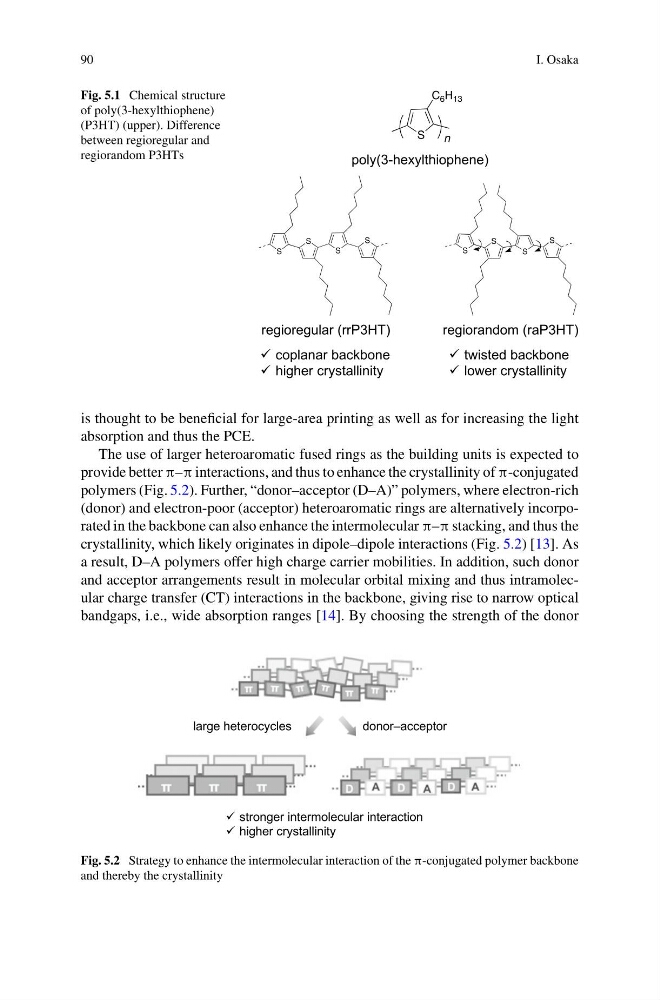
Fig. 5.1 Chemical structure
of poly(3-hexylthiophene)
(P3HT) (upper). Difference
between regioregular and
regiorandom P3HTs
is thought to be beneficial for large-area printing as well as for increasing the light
absorption and thus the PCE.
The use of larger heteroaromatic fused rings as the building units is expected to
provide better π–π interactions, and thus to enhance the crystallinity of π-conjugated
polymers (Fig. 5.2). Further, “donor–acceptor (D–A)” polymers, where electron-rich
(donor) and electron-poor (acceptor) heteroaromatic rings are alternatively incorporated in the backbone can also enhance the intermolecular π–π stacking, and thus the
crystallinity, which likely originates in dipole–dipole interactions (Fig. 5.2) [13]. As
a result, D–A polymers offer high charge carrier mobilities. In addition, such donor
and acceptor arrangements result in molecular orbital mixing and thus intramolecular charge transfer (CT) interactions in the backbone, giving rise to narrow optical
bandgaps, i.e., wide absorption ranges [14]. By choosing the strength of the donor
Fig. 5.2 Strategy to enhance the intermolecular interaction of the π-conjugated polymer backbone
and thereby the crystallinity
I. Osaka
Fig. 5.1 Chemical structure
of poly(3-hexylthiophene)
(P3HT) (upper). Difference
between regioregular and
regiorandom P3HTs
is thought to be beneficial for large-area printing as well as for increasing the light
absorption and thus the PCE.
The use of larger heteroaromatic fused rings as the building units is expected to
provide better π–π interactions, and thus to enhance the crystallinity of π-conjugated
polymers (Fig. 5.2). Further, “donor–acceptor (D–A)” polymers, where electron-rich
(donor) and electron-poor (acceptor) heteroaromatic rings are alternatively incorporated in the backbone can also enhance the intermolecular π–π stacking, and thus the
crystallinity, which likely originates in dipole–dipole interactions (Fig. 5.2) [13]. As
a result, D–A polymers offer high charge carrier mobilities. In addition, such donor
and acceptor arrangements result in molecular orbital mixing and thus intramolecular charge transfer (CT) interactions in the backbone, giving rise to narrow optical
bandgaps, i.e., wide absorption ranges [14]. By choosing the strength of the donor
Fig. 5.2 Strategy to enhance the intermolecular interaction of the π-conjugated polymer backbone
and thereby the crystallinity