

50
M. Hiramoto
of the incident light absorbed by the organic film (solid curve). The quantum efficiency is calculated as the ratio of the number of carriers collected under short-circuit
conditions to the number of photons absorbed by the organic layers. The maximum
and averaged internal quantum efficiencies (400–800 nm) were 84% and 59.3%,
respectively.
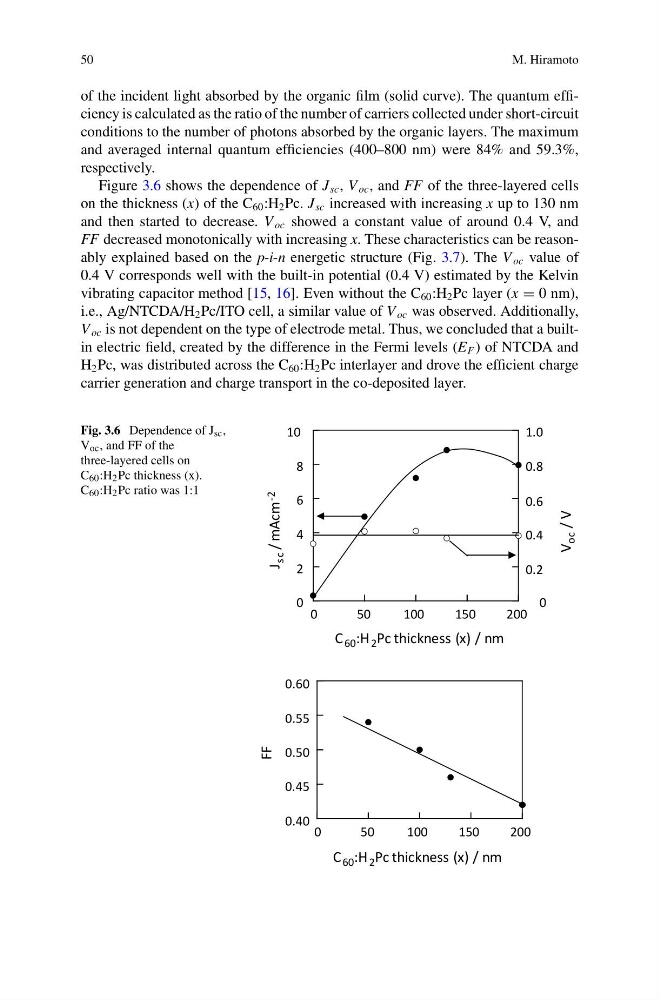
Figure 3.6 shows the dependence of J sc , V oc , and FF of the three-layered cells
on the thickness (x) of the C 60 :H 2 Pc. J sc increased with increasing x up to 130 nm
and then started to decrease. V oc showed a constant value of around 0.4 V, and
FF decreased monotonically with increasing x. These characteristics can be reasonably explained based on the p-i-n energetic structure (Fig. 3.7). The V oc value of
0.4 V corresponds well with the built-in potential (0.4 V) estimated by the Kelvin
vibrating capacitor method [15, 16]. Even without the C 60 :H 2 Pc layer (x = 0 nm),
i.e., Ag/NTCDA/H 2 Pc/ITO cell, a similar value of V oc was observed. Additionally,
V oc is not dependent on the type of electrode metal. Thus, we concluded that a builtin electric field, created by the difference in the Fermi levels (E F ) of NTCDA and
H 2 Pc, was distributed across the C 60 :H 2 Pc interlayer and drove the efficient charge
carrier generation and charge transport in the co-deposited layer.
Fig. 3.6 Dependence of J sc ,
V oc , and FF of the
three-layered cells on
C 60 :H 2 Pc thickness (x).
C 60 :H 2 Pc ratio was 1:1
0
50
100
150
200
C 60 :H 2 Pc thickness (x) / nm
FF
0.40
0.45
0.50
0.55
0.60
0
50
100
150
200
0
2
4
6
8
10
C 60 :H 2 Pc thickness (x) / nm
J
sc / mAcm -2
V
oc / V
0
0.2
0.4
0.6
0.8
1.0
M. Hiramoto
of the incident light absorbed by the organic film (solid curve). The quantum efficiency is calculated as the ratio of the number of carriers collected under short-circuit
conditions to the number of photons absorbed by the organic layers. The maximum
and averaged internal quantum efficiencies (400–800 nm) were 84% and 59.3%,
respectively.
Figure 3.6 shows the dependence of J sc , V oc , and FF of the three-layered cells
on the thickness (x) of the C 60 :H 2 Pc. J sc increased with increasing x up to 130 nm
and then started to decrease. V oc showed a constant value of around 0.4 V, and
FF decreased monotonically with increasing x. These characteristics can be reasonably explained based on the p-i-n energetic structure (Fig. 3.7). The V oc value of
0.4 V corresponds well with the built-in potential (0.4 V) estimated by the Kelvin
vibrating capacitor method [15, 16]. Even without the C 60 :H 2 Pc layer (x = 0 nm),
i.e., Ag/NTCDA/H 2 Pc/ITO cell, a similar value of V oc was observed. Additionally,
V oc is not dependent on the type of electrode metal. Thus, we concluded that a builtin electric field, created by the difference in the Fermi levels (E F ) of NTCDA and
H 2 Pc, was distributed across the C 60 :H 2 Pc interlayer and drove the efficient charge
carrier generation and charge transport in the co-deposited layer.
Fig. 3.6 Dependence of J sc ,
V oc , and FF of the
three-layered cells on
C 60 :H 2 Pc thickness (x).
C 60 :H 2 Pc ratio was 1:1
0
50
100
150
200
C 60 :H 2 Pc thickness (x) / nm
FF
0.40
0.45
0.50
0.55
0.60
0
50
100
150
200
0
2
4
6
8
10
C 60 :H 2 Pc thickness (x) / nm
J
sc / mAcm -2
V
oc / V
0
0.2
0.4
0.6
0.8
1.0