

40
M. Hiramoto
with a diameter of several tens of nm. However, the distribution of Me-PTC and
H 2 Pc could not be clarified by the elemental analysis based on the energy analysis
of secondary electrons.
From the beginning, the concept of the co-deposited junction, i.e., the blended
junction, inevitably raised the issue of percolation, i.e., nanoscale route formation,
and the author was continuously forced to consider how to solve this issue. The
possible solutions for this issue are summarized in Chap. 3.
2.3.7 Carrier Generation Model
2.3.7.1 Clues
The photocurrent enhancement by the blending of PTC and Pc means that there
should be some type of interaction between these two organic semiconductors that
accelerates the photocarrier generation. Several clues were available for elucidating
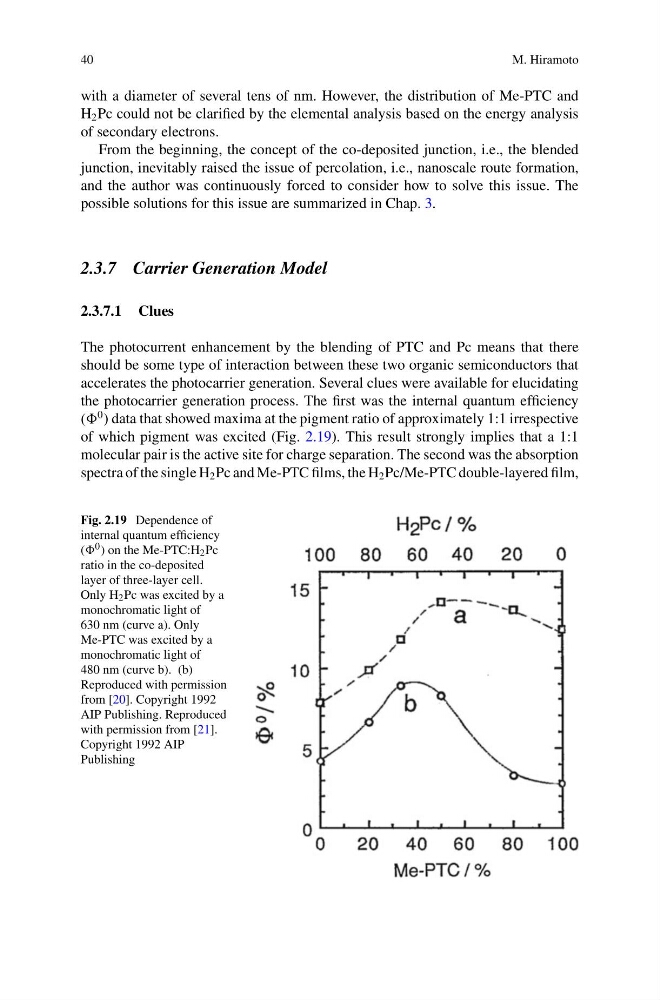
the photocarrier generation process. The first was the internal quantum efficiency
(
0 ) data that showed maxima at the pigment ratio of approximately 1:1 irrespective
of which pigment was excited (Fig. 2.19). This result strongly implies that a 1:1
molecular pair is the active site for charge separation. The second was the absorption
spectra of the single H 2 Pc and Me-PTC films, the H 2 Pc/Me-PTC double-layered film,
Fig. 2.19 Dependence of
internal quantum efficiency
( 0 ) on the Me-PTC:H 2 Pc
ratio in the co-deposited
layer of three-layer cell.
Only H 2 Pc was excited by a
monochromatic light of
630 nm (curve a). Only
Me-PTC was excited by a
monochromatic light of
480 nm (curve b). (b)
Reproduced with permission
from [20]. Copyright 1992
AIP Publishing. Reproduced
with permission from [21].
Copyright 1992 AIP
Publishing
M. Hiramoto
with a diameter of several tens of nm. However, the distribution of Me-PTC and
H 2 Pc could not be clarified by the elemental analysis based on the energy analysis
of secondary electrons.
From the beginning, the concept of the co-deposited junction, i.e., the blended
junction, inevitably raised the issue of percolation, i.e., nanoscale route formation,
and the author was continuously forced to consider how to solve this issue. The
possible solutions for this issue are summarized in Chap. 3.
2.3.7 Carrier Generation Model
2.3.7.1 Clues
The photocurrent enhancement by the blending of PTC and Pc means that there
should be some type of interaction between these two organic semiconductors that
accelerates the photocarrier generation. Several clues were available for elucidating
the photocarrier generation process. The first was the internal quantum efficiency
(
0 ) data that showed maxima at the pigment ratio of approximately 1:1 irrespective
of which pigment was excited (Fig. 2.19). This result strongly implies that a 1:1
molecular pair is the active site for charge separation. The second was the absorption
spectra of the single H 2 Pc and Me-PTC films, the H 2 Pc/Me-PTC double-layered film,
Fig. 2.19 Dependence of
internal quantum efficiency
( 0 ) on the Me-PTC:H 2 Pc
ratio in the co-deposited
layer of three-layer cell.
Only H 2 Pc was excited by a
monochromatic light of
630 nm (curve a). Only
Me-PTC was excited by a
monochromatic light of
480 nm (curve b). (b)
Reproduced with permission
from [20]. Copyright 1992
AIP Publishing. Reproduced
with permission from [21].
Copyright 1992 AIP
Publishing