

2 A Path to the Blended Junction
41
and H 2 Pc:Me-PTC co-deposited film. No differences were observed between the
calculated sum of the absorption spectra of the extremely thin (2.5 nm) single films of
Me-PTC and H 2 Pc, and the absorption spectrum of extreme thin two-layer film of MePTC (2.5 nm)/H 2 Pc (2.5 nm). Moreover, the H 2 Pc:Me-PTC co-deposited film showed
no specific absorption that could be attributed to the charge–transfer interaction. This
means that a strong interaction between H 2 Pc and Me-PTC hardly occur under dark,
i.e., in the ground state. Logically, we should consider the interaction between MePTC and H 2 Pc in the excited states, and therefore, we discussed the exciplex model
and the donor–acceptor model at that time [11].
2.3.7.2 Exciplex
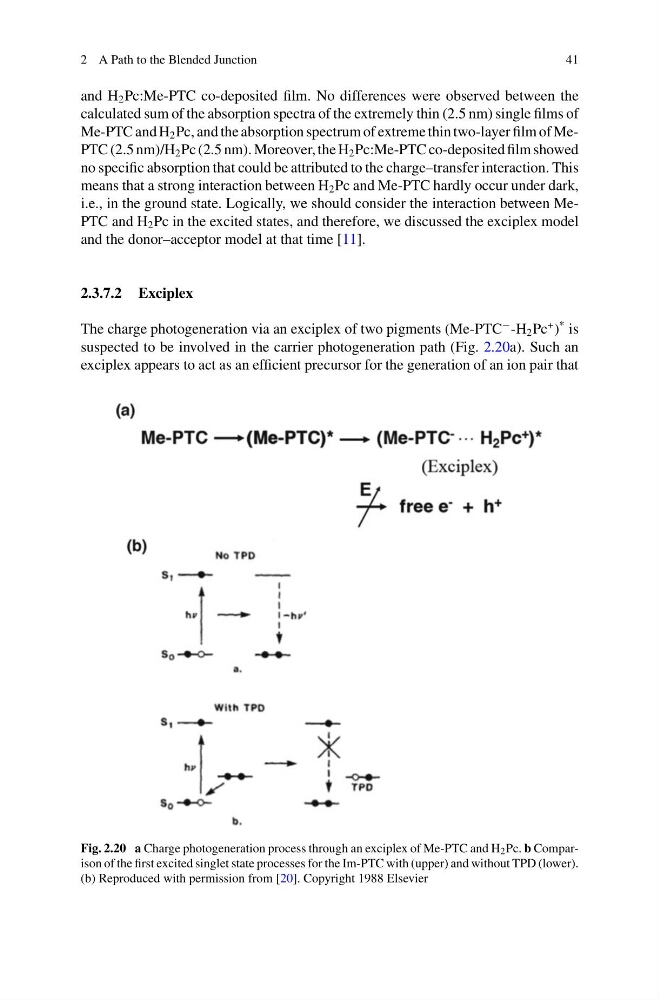
The charge photogeneration via an exciplex of two pigments (Me-PTC
− -H 2 Pc
+ )
* is
suspected to be involved in the carrier photogeneration path (Fig. 2.20a). Such an
exciplex appears to act as an efficient precursor for the generation of an ion pair that
Fig. 2.20 a Charge photogeneration process through an exciplex of Me-PTC and H 2 Pc. b Comparison of the first excited singlet state processes for the Im-PTC with (upper) and without TPD (lower).
(b) Reproduced with permission from [20]. Copyright 1988 Elsevier
41
and H 2 Pc:Me-PTC co-deposited film. No differences were observed between the
calculated sum of the absorption spectra of the extremely thin (2.5 nm) single films of
Me-PTC and H 2 Pc, and the absorption spectrum of extreme thin two-layer film of MePTC (2.5 nm)/H 2 Pc (2.5 nm). Moreover, the H 2 Pc:Me-PTC co-deposited film showed
no specific absorption that could be attributed to the charge–transfer interaction. This
means that a strong interaction between H 2 Pc and Me-PTC hardly occur under dark,
i.e., in the ground state. Logically, we should consider the interaction between MePTC and H 2 Pc in the excited states, and therefore, we discussed the exciplex model
and the donor–acceptor model at that time [11].
2.3.7.2 Exciplex
The charge photogeneration via an exciplex of two pigments (Me-PTC
− -H 2 Pc
+ )
* is
suspected to be involved in the carrier photogeneration path (Fig. 2.20a). Such an
exciplex appears to act as an efficient precursor for the generation of an ion pair that
Fig. 2.20 a Charge photogeneration process through an exciplex of Me-PTC and H 2 Pc. b Comparison of the first excited singlet state processes for the Im-PTC with (upper) and without TPD (lower).
(b) Reproduced with permission from [20]. Copyright 1988 Elsevier