

38
M. Hiramoto
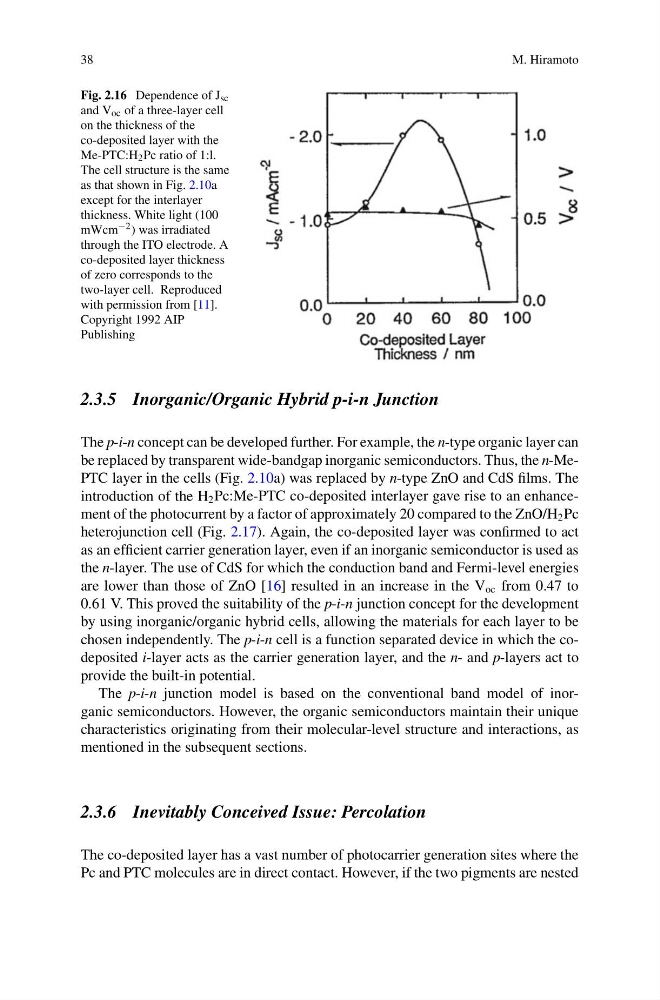
Fig. 2.16 Dependence of J sc
and V oc of a three-layer cell
on the thickness of the
co-deposited layer with the
Me-PTC:H 2 Pc ratio of 1:l.
The cell structure is the same
as that shown in Fig. 2.10a
except for the interlayer
thickness. White light (100
mWcm −2 ) was irradiated
through the ITO electrode. A
co-deposited layer thickness
of zero corresponds to the
two-layer cell. Reproduced
with permission from [11].
Copyright 1992 AIP
Publishing
2.3.5 Inorganic/Organic Hybrid p-i-n Junction
The p-i-n concept can be developed further. For example, the n-type organic layer can
be replaced by transparent wide-bandgap inorganic semiconductors. Thus, the n-MePTC layer in the cells (Fig. 2.10a) was replaced by n-type ZnO and CdS films. The
introduction of the H 2 Pc:Me-PTC co-deposited interlayer gave rise to an enhancement of the photocurrent by a factor of approximately 20 compared to the ZnO/H 2 Pc
heterojunction cell (Fig. 2.17). Again, the co-deposited layer was confirmed to act
as an efficient carrier generation layer, even if an inorganic semiconductor is used as
the n-layer. The use of CdS for which the conduction band and Fermi-level energies
are lower than those of ZnO [16] resulted in an increase in the V oc from 0.47 to
0.61 V. This proved the suitability of the p-i-n junction concept for the development
by using inorganic/organic hybrid cells, allowing the materials for each layer to be
chosen independently. The p-i-n cell is a function separated device in which the codeposited i-layer acts as the carrier generation layer, and the n- and p-layers act to
provide the built-in potential.
The p-i-n junction model is based on the conventional band model of inorganic semiconductors. However, the organic semiconductors maintain their unique
characteristics originating from their molecular-level structure and interactions, as
mentioned in the subsequent sections.
2.3.6 Inevitably Conceived Issue: Percolation
The co-deposited layer has a vast number of photocarrier generation sites where the
Pc and PTC molecules are in direct contact. However, if the two pigments are nested
M. Hiramoto
Fig. 2.16 Dependence of J sc
and V oc of a three-layer cell
on the thickness of the
co-deposited layer with the
Me-PTC:H 2 Pc ratio of 1:l.
The cell structure is the same
as that shown in Fig. 2.10a
except for the interlayer
thickness. White light (100
mWcm −2 ) was irradiated
through the ITO electrode. A
co-deposited layer thickness
of zero corresponds to the
two-layer cell. Reproduced
with permission from [11].
Copyright 1992 AIP
Publishing
2.3.5 Inorganic/Organic Hybrid p-i-n Junction
The p-i-n concept can be developed further. For example, the n-type organic layer can
be replaced by transparent wide-bandgap inorganic semiconductors. Thus, the n-MePTC layer in the cells (Fig. 2.10a) was replaced by n-type ZnO and CdS films. The
introduction of the H 2 Pc:Me-PTC co-deposited interlayer gave rise to an enhancement of the photocurrent by a factor of approximately 20 compared to the ZnO/H 2 Pc
heterojunction cell (Fig. 2.17). Again, the co-deposited layer was confirmed to act
as an efficient carrier generation layer, even if an inorganic semiconductor is used as
the n-layer. The use of CdS for which the conduction band and Fermi-level energies
are lower than those of ZnO [16] resulted in an increase in the V oc from 0.47 to
0.61 V. This proved the suitability of the p-i-n junction concept for the development
by using inorganic/organic hybrid cells, allowing the materials for each layer to be
chosen independently. The p-i-n cell is a function separated device in which the codeposited i-layer acts as the carrier generation layer, and the n- and p-layers act to
provide the built-in potential.
The p-i-n junction model is based on the conventional band model of inorganic semiconductors. However, the organic semiconductors maintain their unique
characteristics originating from their molecular-level structure and interactions, as
mentioned in the subsequent sections.
2.3.6 Inevitably Conceived Issue: Percolation
The co-deposited layer has a vast number of photocarrier generation sites where the
Pc and PTC molecules are in direct contact. However, if the two pigments are nested