

28
M. Hiramoto
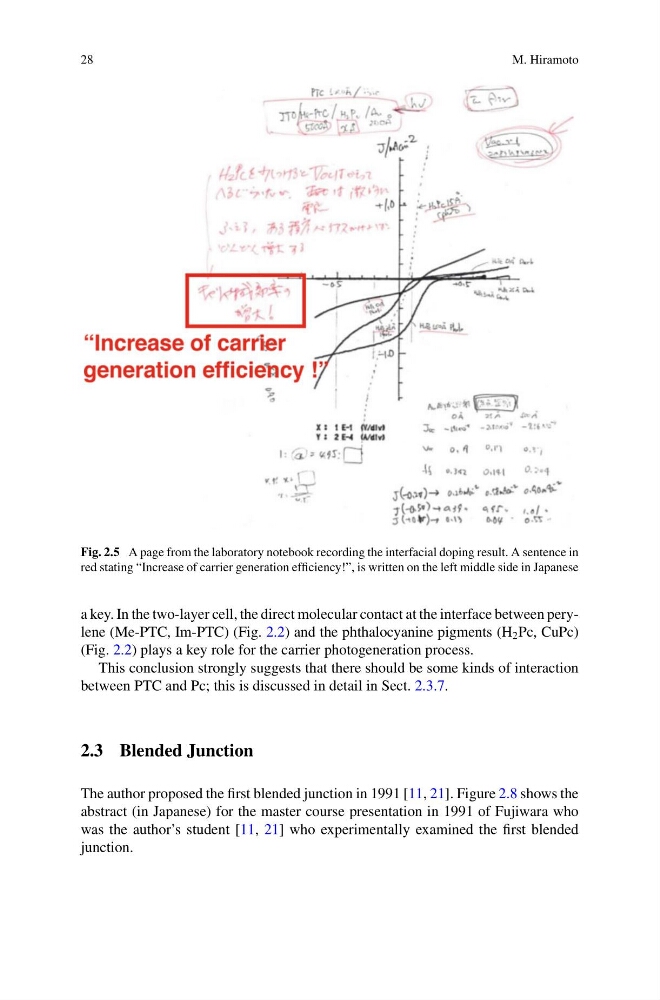
Fig. 2.5 A page from the laboratory notebook recording the interfacial doping result. A sentence in
red stating “Increase of carrier generation efficiency!”, is written on the left middle side in Japanese
a key. In the two-layer cell, the direct molecular contact at the interface between perylene (Me-PTC, Im-PTC) (Fig. 2.2) and the phthalocyanine pigments (H 2 Pc, CuPc)
(Fig. 2.2) plays a key role for the carrier photogeneration process.
This conclusion strongly suggests that there should be some kinds of interaction
between PTC and Pc; this is discussed in detail in Sect. 2.3.7.
2.3 Blended Junction
The author proposed the first blended junction in 1991 [11, 21]. Figure 2.8 shows the
abstract (in Japanese) for the master course presentation in 1991 of Fujiwara who
was the author’s student [11, 21] who experimentally examined the first blended
junction.
M. Hiramoto
Fig. 2.5 A page from the laboratory notebook recording the interfacial doping result. A sentence in
red stating “Increase of carrier generation efficiency!”, is written on the left middle side in Japanese
a key. In the two-layer cell, the direct molecular contact at the interface between perylene (Me-PTC, Im-PTC) (Fig. 2.2) and the phthalocyanine pigments (H 2 Pc, CuPc)
(Fig. 2.2) plays a key role for the carrier photogeneration process.
This conclusion strongly suggests that there should be some kinds of interaction
between PTC and Pc; this is discussed in detail in Sect. 2.3.7.
2.3 Blended Junction
The author proposed the first blended junction in 1991 [11, 21]. Figure 2.8 shows the
abstract (in Japanese) for the master course presentation in 1991 of Fujiwara who
was the author’s student [11, 21] who experimentally examined the first blended
junction.