

266
M. Hiramoto
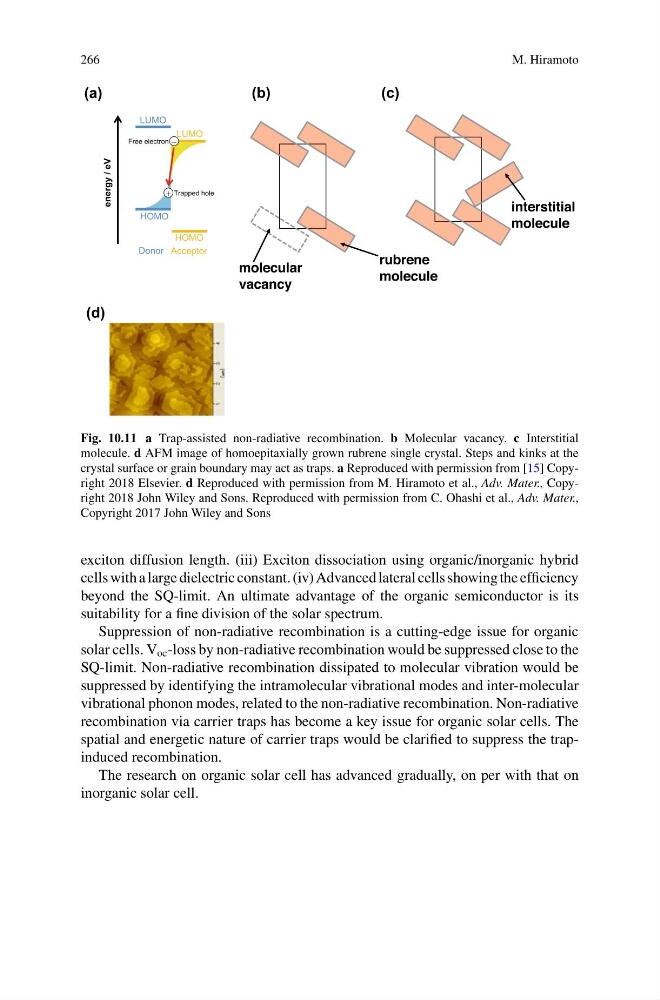
Fig. 10.11 a Trap-assisted non-radiative recombination. b Molecular vacancy. c Interstitial
molecule. d AFM image of homoepitaxially grown rubrene single crystal. Steps and kinks at the
crystal surface or grain boundary may act as traps. a Reproduced with permission from [15] Copyright 2018 Elsevier. d Reproduced with permission from M. Hiramoto et al., Adv. Mater., Copyright 2018 John Wiley and Sons. Reproduced with permission from C. Ohashi et al., Adv. Mater.,
Copyright 2017 John Wiley and Sons
exciton diffusion length. (iii) Exciton dissociation using organic/inorganic hybrid
cells with a large dielectric constant. (iv) Advanced lateral cells showing the efficiency
beyond the SQ-limit. An ultimate advantage of the organic semiconductor is its
suitability for a fine division of the solar spectrum.
Suppression of non-radiative recombination is a cutting-edge issue for organic
solar cells. V oc -loss by non-radiative recombination would be suppressed close to the
SQ-limit. Non-radiative recombination dissipated to molecular vibration would be
suppressed by identifying the intramolecular vibrational modes and inter-molecular
vibrational phonon modes, related to the non-radiative recombination. Non-radiative
recombination via carrier traps has become a key issue for organic solar cells. The
spatial and energetic nature of carrier traps would be clarified to suppress the trapinduced recombination.
The research on organic solar cell has advanced gradually, on per with that on
inorganic solar cell.
M. Hiramoto
Fig. 10.11 a Trap-assisted non-radiative recombination. b Molecular vacancy. c Interstitial
molecule. d AFM image of homoepitaxially grown rubrene single crystal. Steps and kinks at the
crystal surface or grain boundary may act as traps. a Reproduced with permission from [15] Copyright 2018 Elsevier. d Reproduced with permission from M. Hiramoto et al., Adv. Mater., Copyright 2018 John Wiley and Sons. Reproduced with permission from C. Ohashi et al., Adv. Mater.,
Copyright 2017 John Wiley and Sons
exciton diffusion length. (iii) Exciton dissociation using organic/inorganic hybrid
cells with a large dielectric constant. (iv) Advanced lateral cells showing the efficiency
beyond the SQ-limit. An ultimate advantage of the organic semiconductor is its
suitability for a fine division of the solar spectrum.
Suppression of non-radiative recombination is a cutting-edge issue for organic
solar cells. V oc -loss by non-radiative recombination would be suppressed close to the
SQ-limit. Non-radiative recombination dissipated to molecular vibration would be
suppressed by identifying the intramolecular vibrational modes and inter-molecular
vibrational phonon modes, related to the non-radiative recombination. Non-radiative
recombination via carrier traps has become a key issue for organic solar cells. The
spatial and energetic nature of carrier traps would be clarified to suppress the trapinduced recombination.
The research on organic solar cell has advanced gradually, on per with that on
inorganic solar cell.