

10 Proposal for Future Organic Solar Cells
265
surface states
surface recombination
bulk recombination
p-type semiconductors
grain boundary
interfacial states
n-type
heterojunction interface
p-type
interfacial states
(a)
(c)
(b)
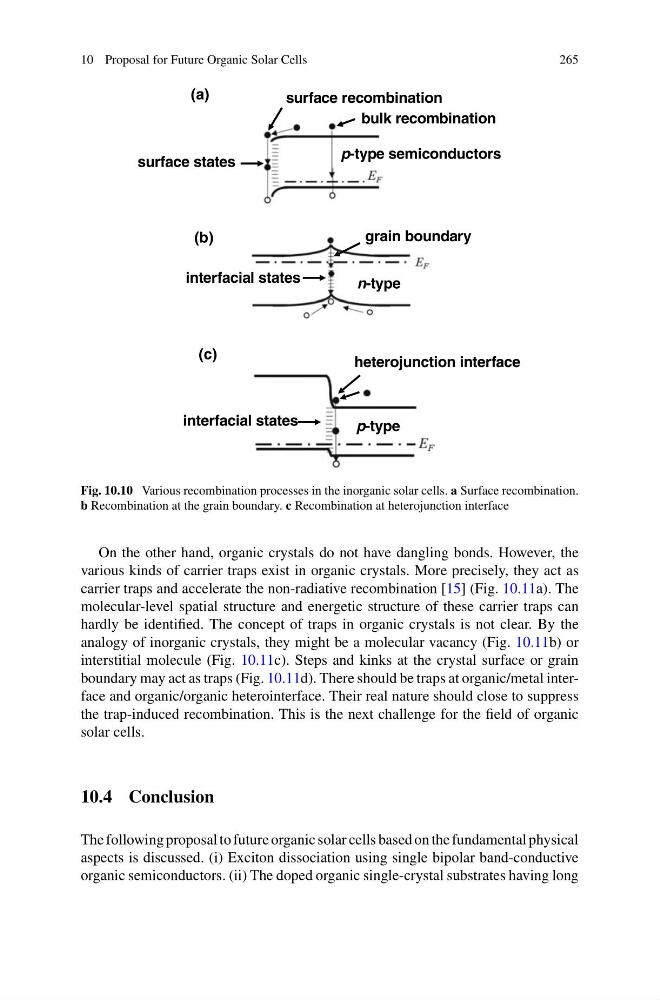
Fig. 10.10 Various recombination processes in the inorganic solar cells. a Surface recombination.
b Recombination at the grain boundary. c Recombination at heterojunction interface
On the other hand, organic crystals do not have dangling bonds. However, the
various kinds of carrier traps exist in organic crystals. More precisely, they act as
carrier traps and accelerate the non-radiative recombination [15] (Fig. 10.11a). The
molecular-level spatial structure and energetic structure of these carrier traps can
hardly be identified. The concept of traps in organic crystals is not clear. By the
analogy of inorganic crystals, they might be a molecular vacancy (Fig. 10.11b) or
interstitial molecule (Fig. 10.11c). Steps and kinks at the crystal surface or grain
boundary may act as traps (Fig. 10.11d). There should be traps at organic/metal interface and organic/organic heterointerface. Their real nature should close to suppress
the trap-induced recombination. This is the next challenge for the field of organic
solar cells.
10.4 Conclusion
The following proposal to future organic solar cells based on the fundamental physical
aspects is discussed. (i) Exciton dissociation using single bipolar band-conductive
organic semiconductors. (ii) The doped organic single-crystal substrates having long
265
surface states
surface recombination
bulk recombination
p-type semiconductors
grain boundary
interfacial states
n-type
heterojunction interface
p-type
interfacial states
(a)
(c)
(b)
Fig. 10.10 Various recombination processes in the inorganic solar cells. a Surface recombination.
b Recombination at the grain boundary. c Recombination at heterojunction interface
On the other hand, organic crystals do not have dangling bonds. However, the
various kinds of carrier traps exist in organic crystals. More precisely, they act as
carrier traps and accelerate the non-radiative recombination [15] (Fig. 10.11a). The
molecular-level spatial structure and energetic structure of these carrier traps can
hardly be identified. The concept of traps in organic crystals is not clear. By the
analogy of inorganic crystals, they might be a molecular vacancy (Fig. 10.11b) or
interstitial molecule (Fig. 10.11c). Steps and kinks at the crystal surface or grain
boundary may act as traps (Fig. 10.11d). There should be traps at organic/metal interface and organic/organic heterointerface. Their real nature should close to suppress
the trap-induced recombination. This is the next challenge for the field of organic
solar cells.
10.4 Conclusion
The following proposal to future organic solar cells based on the fundamental physical
aspects is discussed. (i) Exciton dissociation using single bipolar band-conductive
organic semiconductors. (ii) The doped organic single-crystal substrates having long