

264
M. Hiramoto
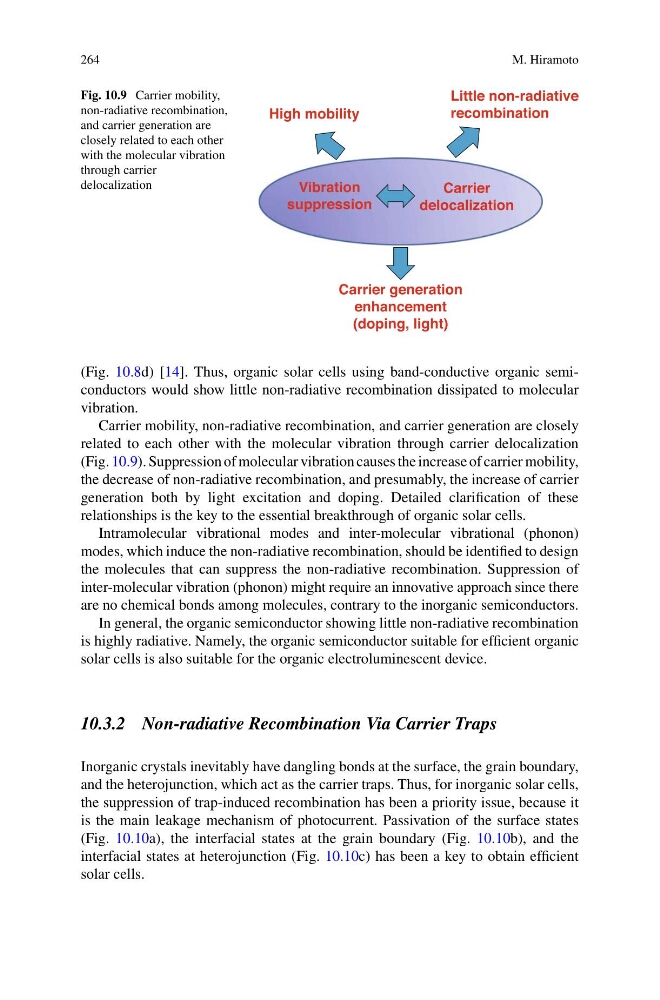
Fig. 10.9 Carrier mobility,
non-radiative recombination,
and carrier generation are
closely related to each other
with the molecular vibration
through carrier
delocalization
(Fig. 10.8d) [14]. Thus, organic solar cells using band-conductive organic semiconductors would show little non-radiative recombination dissipated to molecular
vibration.
Carrier mobility, non-radiative recombination, and carrier generation are closely
related to each other with the molecular vibration through carrier delocalization
(Fig. 10.9). Suppression of molecular vibration causes the increase of carrier mobility,
the decrease of non-radiative recombination, and presumably, the increase of carrier
generation both by light excitation and doping. Detailed clarification of these
relationships is the key to the essential breakthrough of organic solar cells.
Intramolecular vibrational modes and inter-molecular vibrational (phonon)
modes, which induce the non-radiative recombination, should be identified to design
the molecules that can suppress the non-radiative recombination. Suppression of
inter-molecular vibration (phonon) might require an innovative approach since there
are no chemical bonds among molecules, contrary to the inorganic semiconductors.
In general, the organic semiconductor showing little non-radiative recombination
is highly radiative. Namely, the organic semiconductor suitable for efficient organic
solar cells is also suitable for the organic electroluminescent device.
10.3.2 Non-radiative Recombination Via Carrier Traps
Inorganic crystals inevitably have dangling bonds at the surface, the grain boundary,
and the heterojunction, which act as the carrier traps. Thus, for inorganic solar cells,
the suppression of trap-induced recombination has been a priority issue, because it
is the main leakage mechanism of photocurrent. Passivation of the surface states
(Fig. 10.10a), the interfacial states at the grain boundary (Fig. 10.10b), and the
interfacial states at heterojunction (Fig. 10.10c) has been a key to obtain efficient
solar cells.
M. Hiramoto
Fig. 10.9 Carrier mobility,
non-radiative recombination,
and carrier generation are
closely related to each other
with the molecular vibration
through carrier
delocalization
(Fig. 10.8d) [14]. Thus, organic solar cells using band-conductive organic semiconductors would show little non-radiative recombination dissipated to molecular
vibration.
Carrier mobility, non-radiative recombination, and carrier generation are closely
related to each other with the molecular vibration through carrier delocalization
(Fig. 10.9). Suppression of molecular vibration causes the increase of carrier mobility,
the decrease of non-radiative recombination, and presumably, the increase of carrier
generation both by light excitation and doping. Detailed clarification of these
relationships is the key to the essential breakthrough of organic solar cells.
Intramolecular vibrational modes and inter-molecular vibrational (phonon)
modes, which induce the non-radiative recombination, should be identified to design
the molecules that can suppress the non-radiative recombination. Suppression of
inter-molecular vibration (phonon) might require an innovative approach since there
are no chemical bonds among molecules, contrary to the inorganic semiconductors.
In general, the organic semiconductor showing little non-radiative recombination
is highly radiative. Namely, the organic semiconductor suitable for efficient organic
solar cells is also suitable for the organic electroluminescent device.
10.3.2 Non-radiative Recombination Via Carrier Traps
Inorganic crystals inevitably have dangling bonds at the surface, the grain boundary,
and the heterojunction, which act as the carrier traps. Thus, for inorganic solar cells,
the suppression of trap-induced recombination has been a priority issue, because it
is the main leakage mechanism of photocurrent. Passivation of the surface states
(Fig. 10.10a), the interfacial states at the grain boundary (Fig. 10.10b), and the
interfacial states at heterojunction (Fig. 10.10c) has been a key to obtain efficient
solar cells.