

260
M. Hiramoto
10.1.3 Large Dielectric Constant—Organic/Inorganic
Hybrid Cell
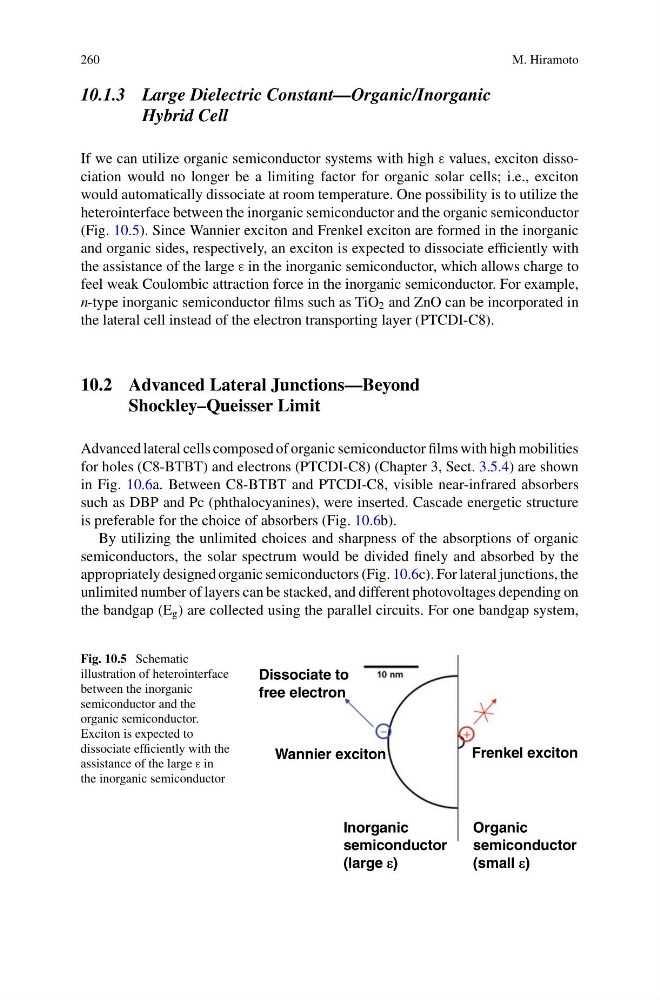
If we can utilize organic semiconductor systems with high ε values, exciton dissociation would no longer be a limiting factor for organic solar cells; i.e., exciton
would automatically dissociate at room temperature. One possibility is to utilize the
heterointerface between the inorganic semiconductor and the organic semiconductor
(Fig. 10.5). Since Wannier exciton and Frenkel exciton are formed in the inorganic
and organic sides, respectively, an exciton is expected to dissociate efficiently with
the assistance of the large ε in the inorganic semiconductor, which allows charge to
feel weak Coulombic attraction force in the inorganic semiconductor. For example,
n-type inorganic semiconductor films such as TiO 2 and ZnO can be incorporated in
the lateral cell instead of the electron transporting layer (PTCDI-C8).
10.2 Advanced Lateral Junctions—Beyond
Shockley–Queisser Limit
Advanced lateral cells composed of organic semiconductor films with high mobilities
for holes (C8-BTBT) and electrons (PTCDI-C8) (Chapter 3, Sect. 3.5.4) are shown
in Fig. 10.6a. Between C8-BTBT and PTCDI-C8, visible near-infrared absorbers
such as DBP and Pc (phthalocyanines), were inserted. Cascade energetic structure
is preferable for the choice of absorbers (Fig. 10.6b).
By utilizing the unlimited choices and sharpness of the absorptions of organic
semiconductors, the solar spectrum would be divided finely and absorbed by the
appropriately designed organic semiconductors (Fig. 10.6c). For lateral junctions, the
unlimited number of layers can be stacked, and different photovoltages depending on
the bandgap (E g ) are collected using the parallel circuits. For one bandgap system,
Fig. 10.5 Schematic
illustration of heterointerface
between the inorganic
semiconductor and the
organic semiconductor.
Exciton is expected to
dissociate efficiently with the
assistance of the large ε in
the inorganic semiconductor
Frenkel exciton
Wannier exciton
Dissociate to
free electron
Inorganic
semiconductor
(large )
Organic
semiconductor
(small )
M. Hiramoto
10.1.3 Large Dielectric Constant—Organic/Inorganic
Hybrid Cell
If we can utilize organic semiconductor systems with high ε values, exciton dissociation would no longer be a limiting factor for organic solar cells; i.e., exciton
would automatically dissociate at room temperature. One possibility is to utilize the
heterointerface between the inorganic semiconductor and the organic semiconductor
(Fig. 10.5). Since Wannier exciton and Frenkel exciton are formed in the inorganic
and organic sides, respectively, an exciton is expected to dissociate efficiently with
the assistance of the large ε in the inorganic semiconductor, which allows charge to
feel weak Coulombic attraction force in the inorganic semiconductor. For example,
n-type inorganic semiconductor films such as TiO 2 and ZnO can be incorporated in
the lateral cell instead of the electron transporting layer (PTCDI-C8).
10.2 Advanced Lateral Junctions—Beyond
Shockley–Queisser Limit
Advanced lateral cells composed of organic semiconductor films with high mobilities
for holes (C8-BTBT) and electrons (PTCDI-C8) (Chapter 3, Sect. 3.5.4) are shown
in Fig. 10.6a. Between C8-BTBT and PTCDI-C8, visible near-infrared absorbers
such as DBP and Pc (phthalocyanines), were inserted. Cascade energetic structure
is preferable for the choice of absorbers (Fig. 10.6b).
By utilizing the unlimited choices and sharpness of the absorptions of organic
semiconductors, the solar spectrum would be divided finely and absorbed by the
appropriately designed organic semiconductors (Fig. 10.6c). For lateral junctions, the
unlimited number of layers can be stacked, and different photovoltages depending on
the bandgap (E g ) are collected using the parallel circuits. For one bandgap system,
Fig. 10.5 Schematic
illustration of heterointerface
between the inorganic
semiconductor and the
organic semiconductor.
Exciton is expected to
dissociate efficiently with the
assistance of the large ε in
the inorganic semiconductor
Frenkel exciton
Wannier exciton
Dissociate to
free electron
Inorganic
semiconductor
(large )
Organic
semiconductor
(small )