

10 Proposal for Future Organic Solar Cells
259
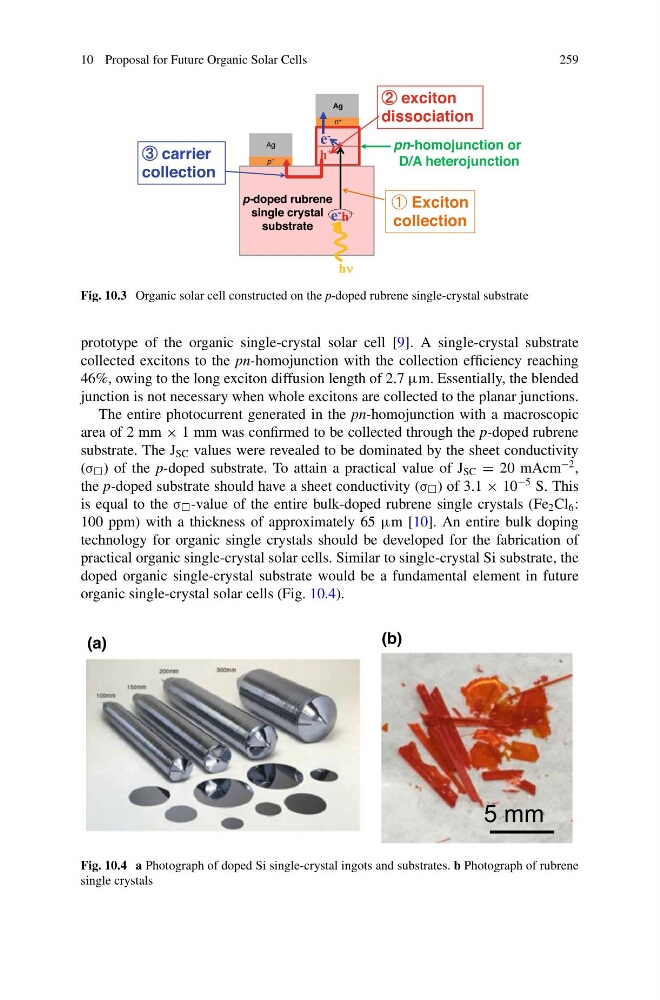
Fig. 10.3 Organic solar cell constructed on the p-doped rubrene single-crystal substrate
prototype of the organic single-crystal solar cell [9]. A single-crystal substrate
collected excitons to the pn-homojunction with the collection efficiency reaching
46%, owing to the long exciton diffusion length of 2.7 μm. Essentially, the blended
junction is not necessary when whole excitons are collected to the planar junctions.
The entire photocurrent generated in the pn-homojunction with a macroscopic
area of 2 mm × 1 mm was confirmed to be collected through the p-doped rubrene
substrate. The J SC values were revealed to be dominated by the sheet conductivity
(σ ) of the p-doped substrate. To attain a practical value of J SC = 20 mAcm
−2 ,
the p-doped substrate should have a sheet conductivity (σ ) of 3.1 × 10
−5 S. This
is equal to the σ -value of the entire bulk-doped rubrene single crystals (Fe 2 Cl 6 :
100 ppm) with a thickness of approximately 65 μm [10]. An entire bulk doping
technology for organic single crystals should be developed for the fabrication of
practical organic single-crystal solar cells. Similar to single-crystal Si substrate, the
doped organic single-crystal substrate would be a fundamental element in future
organic single-crystal solar cells (Fig. 10.4).
Fig. 10.4 a Photograph of doped Si single-crystal ingots and substrates. b Photograph of rubrene
single crystals
259
Fig. 10.3 Organic solar cell constructed on the p-doped rubrene single-crystal substrate
prototype of the organic single-crystal solar cell [9]. A single-crystal substrate
collected excitons to the pn-homojunction with the collection efficiency reaching
46%, owing to the long exciton diffusion length of 2.7 μm. Essentially, the blended
junction is not necessary when whole excitons are collected to the planar junctions.
The entire photocurrent generated in the pn-homojunction with a macroscopic
area of 2 mm × 1 mm was confirmed to be collected through the p-doped rubrene
substrate. The J SC values were revealed to be dominated by the sheet conductivity
(σ ) of the p-doped substrate. To attain a practical value of J SC = 20 mAcm
−2 ,
the p-doped substrate should have a sheet conductivity (σ ) of 3.1 × 10
−5 S. This
is equal to the σ -value of the entire bulk-doped rubrene single crystals (Fe 2 Cl 6 :
100 ppm) with a thickness of approximately 65 μm [10]. An entire bulk doping
technology for organic single crystals should be developed for the fabrication of
practical organic single-crystal solar cells. Similar to single-crystal Si substrate, the
doped organic single-crystal substrate would be a fundamental element in future
organic single-crystal solar cells (Fig. 10.4).
Fig. 10.4 a Photograph of doped Si single-crystal ingots and substrates. b Photograph of rubrene
single crystals