

258
M. Hiramoto
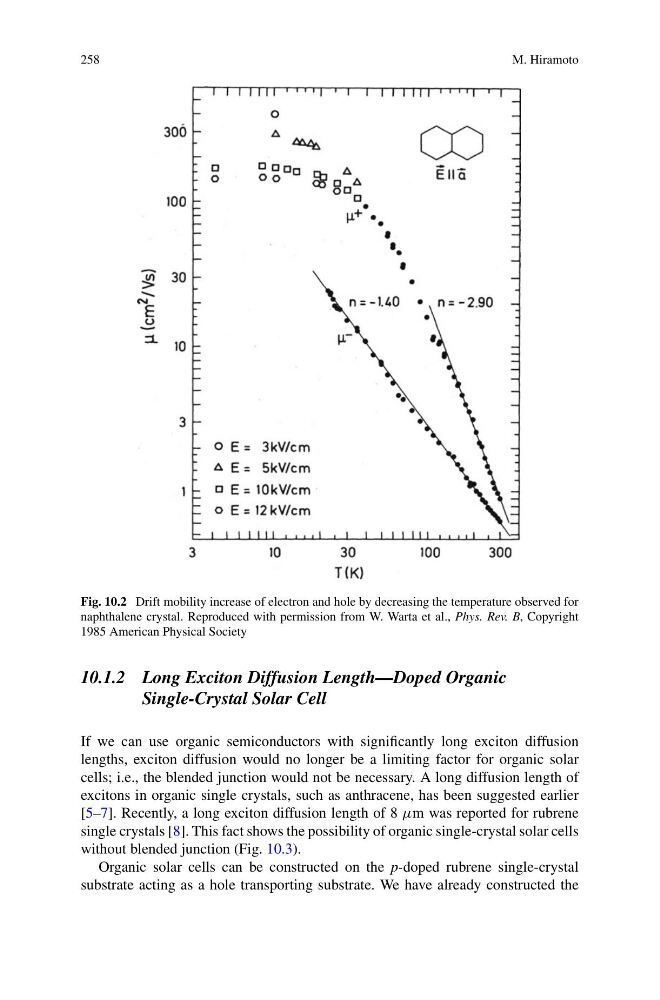
Fig. 10.2 Drift mobility increase of electron and hole by decreasing the temperature observed for
naphthalene crystal. Reproduced with permission from W. Warta et al., Phys. Rev. B, Copyright
1985 American Physical Society
10.1.2 Long Exciton Diffusion Length—Doped Organic
Single-Crystal Solar Cell
If we can use organic semiconductors with significantly long exciton diffusion
lengths, exciton diffusion would no longer be a limiting factor for organic solar
cells; i.e., the blended junction would not be necessary. A long diffusion length of
excitons in organic single crystals, such as anthracene, has been suggested earlier
[5–7]. Recently, a long exciton diffusion length of 8 μm was reported for rubrene
single crystals [8]. This fact shows the possibility of organic single-crystal solar cells
without blended junction (Fig. 10.3).
Organic solar cells can be constructed on the p-doped rubrene single-crystal
substrate acting as a hole transporting substrate. We have already constructed the
M. Hiramoto
Fig. 10.2 Drift mobility increase of electron and hole by decreasing the temperature observed for
naphthalene crystal. Reproduced with permission from W. Warta et al., Phys. Rev. B, Copyright
1985 American Physical Society
10.1.2 Long Exciton Diffusion Length—Doped Organic
Single-Crystal Solar Cell
If we can use organic semiconductors with significantly long exciton diffusion
lengths, exciton diffusion would no longer be a limiting factor for organic solar
cells; i.e., the blended junction would not be necessary. A long diffusion length of
excitons in organic single crystals, such as anthracene, has been suggested earlier
[5–7]. Recently, a long exciton diffusion length of 8 μm was reported for rubrene
single crystals [8]. This fact shows the possibility of organic single-crystal solar cells
without blended junction (Fig. 10.3).
Organic solar cells can be constructed on the p-doped rubrene single-crystal
substrate acting as a hole transporting substrate. We have already constructed the