

10 Proposal for Future Organic Solar Cells
261
Visible-NIR
Absorber
(b)
DBP
Substrate
C8-BTBT
PTCDI-C8
(a)
blue
NIR
red
orange
yellow
green
(c)
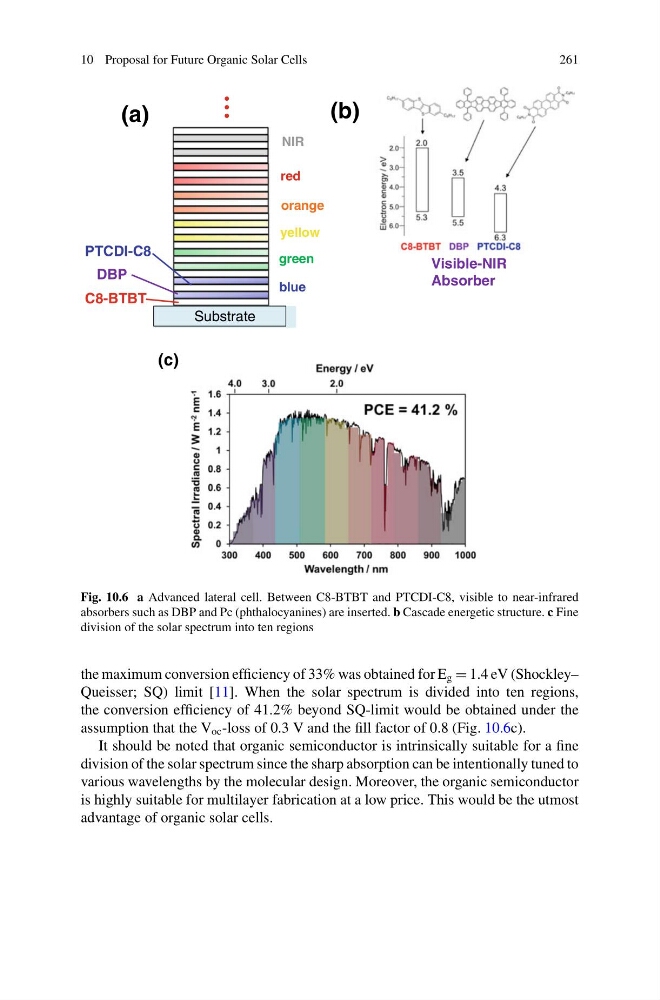
Fig. 10.6 a Advanced lateral cell. Between C8-BTBT and PTCDI-C8, visible to near-infrared
absorbers such as DBP and Pc (phthalocyanines) are inserted. b Cascade energetic structure. c Fine
division of the solar spectrum into ten regions
the maximum conversion efficiency of 33% was obtained for E g = 1.4 eV (Shockley–
Queisser; SQ) limit [11]. When the solar spectrum is divided into ten regions,
the conversion efficiency of 41.2% beyond SQ-limit would be obtained under the
assumption that the V oc -loss of 0.3 V and the fill factor of 0.8 (Fig. 10.6c).
It should be noted that organic semiconductor is intrinsically suitable for a fine
division of the solar spectrum since the sharp absorption can be intentionally tuned to
various wavelengths by the molecular design. Moreover, the organic semiconductor
is highly suitable for multilayer fabrication at a low price. This would be the utmost
advantage of organic solar cells.
261
Visible-NIR
Absorber
(b)
DBP
Substrate
C8-BTBT
PTCDI-C8
(a)
blue
NIR
red
orange
yellow
green
(c)
Fig. 10.6 a Advanced lateral cell. Between C8-BTBT and PTCDI-C8, visible to near-infrared
absorbers such as DBP and Pc (phthalocyanines) are inserted. b Cascade energetic structure. c Fine
division of the solar spectrum into ten regions
the maximum conversion efficiency of 33% was obtained for E g = 1.4 eV (Shockley–
Queisser; SQ) limit [11]. When the solar spectrum is divided into ten regions,
the conversion efficiency of 41.2% beyond SQ-limit would be obtained under the
assumption that the V oc -loss of 0.3 V and the fill factor of 0.8 (Fig. 10.6c).
It should be noted that organic semiconductor is intrinsically suitable for a fine
division of the solar spectrum since the sharp absorption can be intentionally tuned to
various wavelengths by the molecular design. Moreover, the organic semiconductor
is highly suitable for multilayer fabrication at a low price. This would be the utmost
advantage of organic solar cells.