

202
S. Izawa
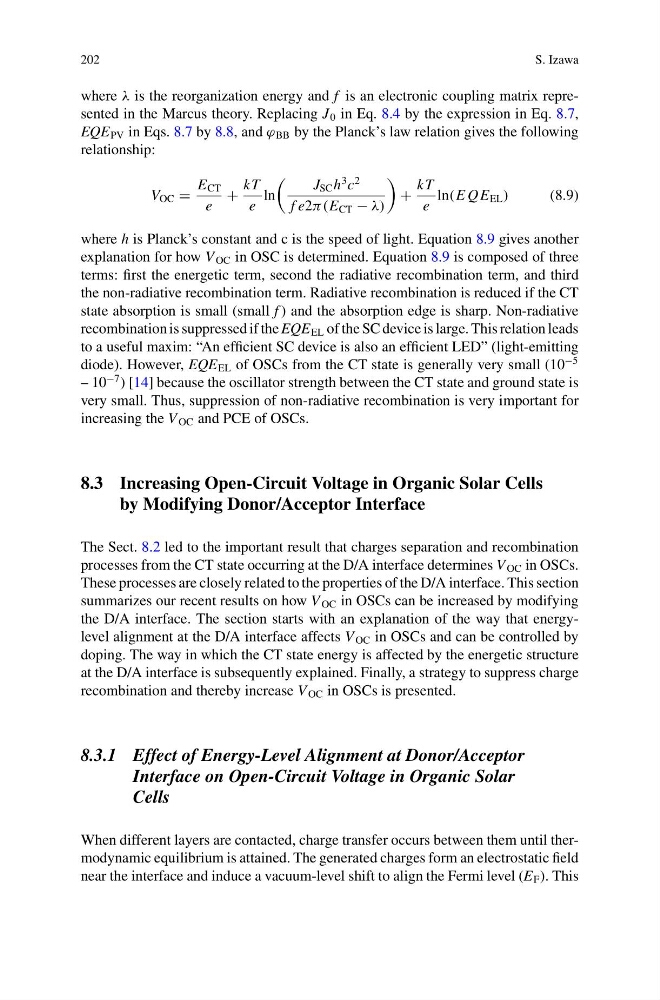
where λ is the reorganization energy and f is an electronic coupling matrix represented in the Marcus theory. Replacing J 0 in Eq. 8.4 by the expression in Eq. 8.7,
EQE PV in Eqs. 8.7 by 8.8, and ϕ BB by the Planck’s law relation gives the following
relationship:
V OC =
E CT
e
+
kT
e
ln
J SC h
3 c
2
f e2π(E CT − λ)
+
kT
e
ln(E Q E EL )
(8.9)
where h is Planck’s constant and c is the speed of light. Equation 8.9 gives another
explanation for how V OC in OSC is determined. Equation 8.9 is composed of three
terms: first the energetic term, second the radiative recombination term, and third
the non-radiative recombination term. Radiative recombination is reduced if the CT
state absorption is small (small f ) and the absorption edge is sharp. Non-radiative
recombination is suppressed if the EQE EL of the SC device is large. This relation leads
to a useful maxim: “An efficient SC device is also an efficient LED” (light-emitting
diode). However, EQE EL of OSCs from the CT state is generally very small (10
−5
– 10
−7 ) [14] because the oscillator strength between the CT state and ground state is
very small. Thus, suppression of non-radiative recombination is very important for
increasing the V OC and PCE of OSCs.
8.3 Increasing Open-Circuit Voltage in Organic Solar Cells
by Modifying Donor/Acceptor Interface
The Sect. 8.2 led to the important result that charges separation and recombination
processes from the CT state occurring at the D/A interface determines V OC in OSCs.
These processes are closely related to the properties of the D/A interface. This section
summarizes our recent results on how V OC in OSCs can be increased by modifying
the D/A interface. The section starts with an explanation of the way that energylevel alignment at the D/A interface affects V OC in OSCs and can be controlled by
doping. The way in which the CT state energy is affected by the energetic structure
at the D/A interface is subsequently explained. Finally, a strategy to suppress charge
recombination and thereby increase V OC in OSCs is presented.
8.3.1 Effect of Energy-Level Alignment at Donor/Acceptor
Interface on Open-Circuit Voltage in Organic Solar
Cells
When different layers are contacted, charge transfer occurs between them until thermodynamic equilibrium is attained. The generated charges form an electrostatic field
near the interface and induce a vacuum-level shift to align the Fermi level (E F ). This
S. Izawa
where λ is the reorganization energy and f is an electronic coupling matrix represented in the Marcus theory. Replacing J 0 in Eq. 8.4 by the expression in Eq. 8.7,
EQE PV in Eqs. 8.7 by 8.8, and ϕ BB by the Planck’s law relation gives the following
relationship:
V OC =
E CT
e
+
kT
e
ln
J SC h
3 c
2
f e2π(E CT − λ)
+
kT
e
ln(E Q E EL )
(8.9)
where h is Planck’s constant and c is the speed of light. Equation 8.9 gives another
explanation for how V OC in OSC is determined. Equation 8.9 is composed of three
terms: first the energetic term, second the radiative recombination term, and third
the non-radiative recombination term. Radiative recombination is reduced if the CT
state absorption is small (small f ) and the absorption edge is sharp. Non-radiative
recombination is suppressed if the EQE EL of the SC device is large. This relation leads
to a useful maxim: “An efficient SC device is also an efficient LED” (light-emitting
diode). However, EQE EL of OSCs from the CT state is generally very small (10
−5
– 10
−7 ) [14] because the oscillator strength between the CT state and ground state is
very small. Thus, suppression of non-radiative recombination is very important for
increasing the V OC and PCE of OSCs.
8.3 Increasing Open-Circuit Voltage in Organic Solar Cells
by Modifying Donor/Acceptor Interface
The Sect. 8.2 led to the important result that charges separation and recombination
processes from the CT state occurring at the D/A interface determines V OC in OSCs.
These processes are closely related to the properties of the D/A interface. This section
summarizes our recent results on how V OC in OSCs can be increased by modifying
the D/A interface. The section starts with an explanation of the way that energylevel alignment at the D/A interface affects V OC in OSCs and can be controlled by
doping. The way in which the CT state energy is affected by the energetic structure
at the D/A interface is subsequently explained. Finally, a strategy to suppress charge
recombination and thereby increase V OC in OSCs is presented.
8.3.1 Effect of Energy-Level Alignment at Donor/Acceptor
Interface on Open-Circuit Voltage in Organic Solar
Cells
When different layers are contacted, charge transfer occurs between them until thermodynamic equilibrium is attained. The generated charges form an electrostatic field
near the interface and induce a vacuum-level shift to align the Fermi level (E F ). This