

8 Open-Circuit Voltage in Organic Solar Cells
201
J 0 = J 00 exp
−
ϕ
nkT
(8.5)
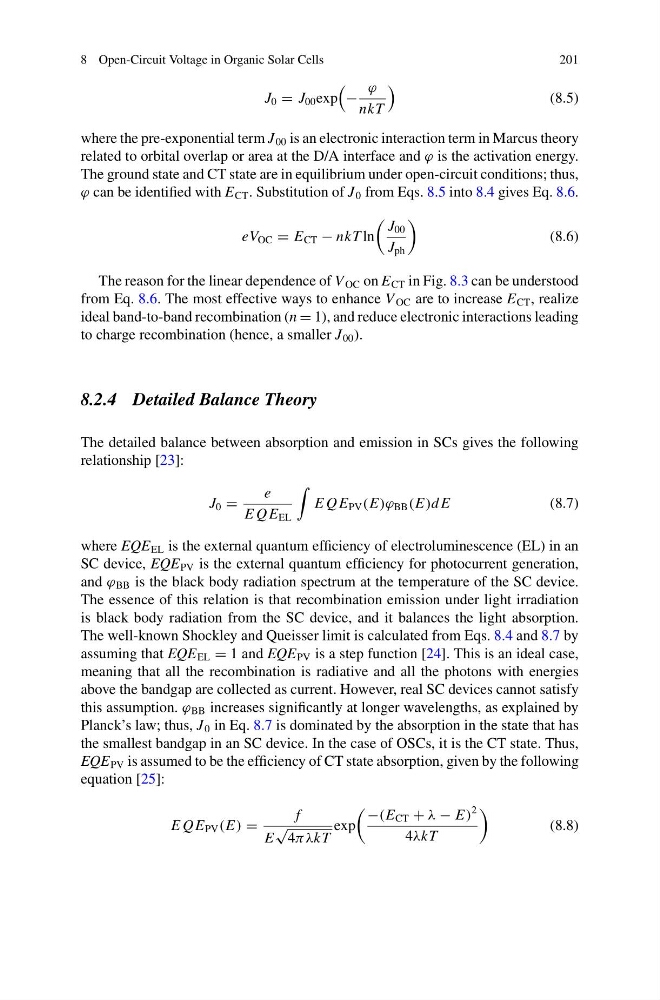
where the pre-exponential term J 00 is an electronic interaction term in Marcus theory
related to orbital overlap or area at the D/A interface and ϕ is the activation energy.
The ground state and CT state are in equilibrium under open-circuit conditions; thus,
ϕ can be identified with E CT . Substitution of J 0 from Eqs. 8.5 into 8.4 gives Eq. 8.6.
eV OC = E CT − nkT ln
J 00
J ph
(8.6)
The reason for the linear dependence of V OC on E CT in Fig. 8.3 can be understood
from Eq. 8.6. The most effective ways to enhance V OC are to increase E CT , realize
ideal band-to-band recombination (n = 1), and reduce electronic interactions leading
to charge recombination (hence, a smaller J 00 ).
8.2.4 Detailed Balance Theory
The detailed balance between absorption and emission in SCs gives the following
relationship [23]:
J 0 =
e
E Q E EL
E Q E PV (E)ϕ BB (E)d E
(8.7)
where EQE EL is the external quantum efficiency of electroluminescence (EL) in an
SC device, EQE PV is the external quantum efficiency for photocurrent generation,
and ϕ BB is the black body radiation spectrum at the temperature of the SC device.
The essence of this relation is that recombination emission under light irradiation
is black body radiation from the SC device, and it balances the light absorption.
The well-known Shockley and Queisser limit is calculated from Eqs. 8.4 and 8.7 by
assuming that EQE EL = 1 and EQE PV is a step function [24]. This is an ideal case,
meaning that all the recombination is radiative and all the photons with energies
above the bandgap are collected as current. However, real SC devices cannot satisfy
this assumption. ϕ BB increases significantly at longer wavelengths, as explained by
Planck’s law; thus, J 0 in Eq. 8.7 is dominated by the absorption in the state that has
the smallest bandgap in an SC device. In the case of OSCs, it is the CT state. Thus,
EQE PV is assumed to be the efficiency of CT state absorption, given by the following
equation [25]:
E Q E PV (E) =
f
E
√
4πλkT
exp
−(E CT + λ − E)
2
4λkT
(8.8)
201
J 0 = J 00 exp
−
ϕ
nkT
(8.5)
where the pre-exponential term J 00 is an electronic interaction term in Marcus theory
related to orbital overlap or area at the D/A interface and ϕ is the activation energy.
The ground state and CT state are in equilibrium under open-circuit conditions; thus,
ϕ can be identified with E CT . Substitution of J 0 from Eqs. 8.5 into 8.4 gives Eq. 8.6.
eV OC = E CT − nkT ln
J 00
J ph
(8.6)
The reason for the linear dependence of V OC on E CT in Fig. 8.3 can be understood
from Eq. 8.6. The most effective ways to enhance V OC are to increase E CT , realize
ideal band-to-band recombination (n = 1), and reduce electronic interactions leading
to charge recombination (hence, a smaller J 00 ).
8.2.4 Detailed Balance Theory
The detailed balance between absorption and emission in SCs gives the following
relationship [23]:
J 0 =
e
E Q E EL
E Q E PV (E)ϕ BB (E)d E
(8.7)
where EQE EL is the external quantum efficiency of electroluminescence (EL) in an
SC device, EQE PV is the external quantum efficiency for photocurrent generation,
and ϕ BB is the black body radiation spectrum at the temperature of the SC device.
The essence of this relation is that recombination emission under light irradiation
is black body radiation from the SC device, and it balances the light absorption.
The well-known Shockley and Queisser limit is calculated from Eqs. 8.4 and 8.7 by
assuming that EQE EL = 1 and EQE PV is a step function [24]. This is an ideal case,
meaning that all the recombination is radiative and all the photons with energies
above the bandgap are collected as current. However, real SC devices cannot satisfy
this assumption. ϕ BB increases significantly at longer wavelengths, as explained by
Planck’s law; thus, J 0 in Eq. 8.7 is dominated by the absorption in the state that has
the smallest bandgap in an SC device. In the case of OSCs, it is the CT state. Thus,
EQE PV is assumed to be the efficiency of CT state absorption, given by the following
equation [25]:
E Q E PV (E) =
f
E
√
4πλkT
exp
−(E CT + λ − E)
2
4λkT
(8.8)