

180
T. Fujita
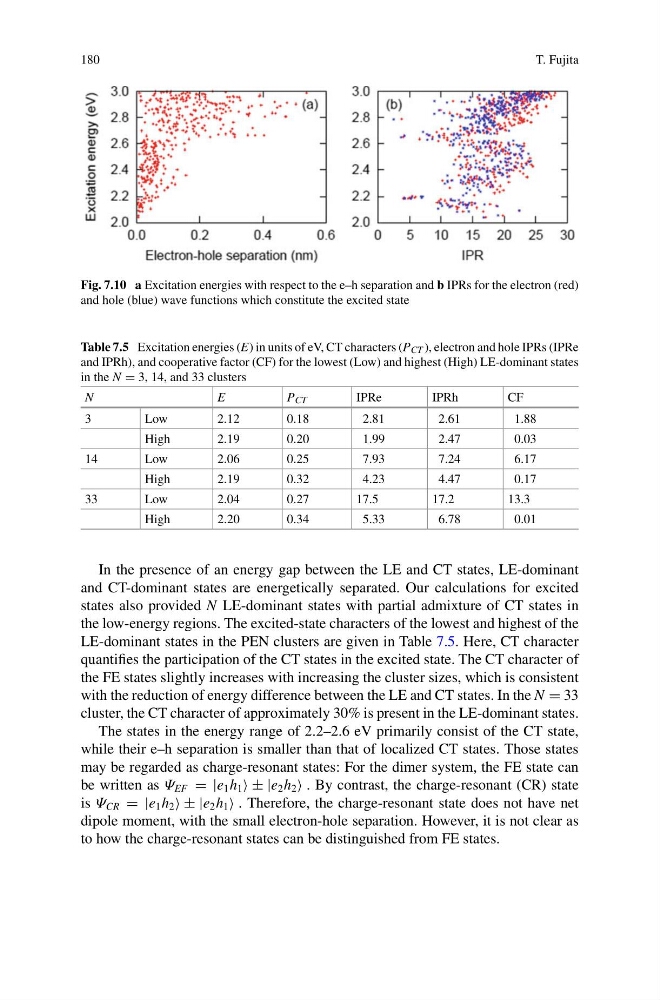
Fig. 7.10 a Excitation energies with respect to the e–h separation and b IPRs for the electron (red)
and hole (blue) wave functions which constitute the excited state
Table 7.5 Excitation energies (E) in units of eV, CT characters (P CT ), electron and hole IPRs (IPRe
and IPRh), and cooperative factor (CF) for the lowest (Low) and highest (High) LE-dominant states
in the N = 3, 14, and 33 clusters
N
E
P CT
IPRe
IPRh
CF
3
Low
2.12
0.18
2.81
2.61
1.88
High
2.19
0.20
1.99
2.47
0.03
14
Low
2.06
0.25
7.93
7.24
6.17
High
2.19
0.32
4.23
4.47
0.17
33
Low
2.04
0.27
17.5
17.2
13.3
High
2.20
0.34
5.33
6.78
0.01
In the presence of an energy gap between the LE and CT states, LE-dominant
and CT-dominant states are energetically separated. Our calculations for excited
states also provided N LE-dominant states with partial admixture of CT states in
the low-energy regions. The excited-state characters of the lowest and highest of the
LE-dominant states in the PEN clusters are given in Table 7.5. Here, CT character
quantifies the participation of the CT states in the excited state. The CT character of
the FE states slightly increases with increasing the cluster sizes, which is consistent
with the reduction of energy difference between the LE and CT states. In the N = 33
cluster, the CT character of approximately 30% is present in the LE-dominant states.
The states in the energy range of 2.2–2.6 eV primarily consist of the CT state,
while their e–h separation is smaller than that of localized CT states. Those states
may be regarded as charge-resonant states: For the dimer system, the FE state can
be written as Ψ EF = |e 1 h 1 ± |e 2 h 2 . By contrast, the charge-resonant (CR) state
is Ψ CR = |e 1 h 2 ± |e 2 h 1 . Therefore, the charge-resonant state does not have net
dipole moment, with the small electron-hole separation. However, it is not clear as
to how the charge-resonant states can be distinguished from FE states.
T. Fujita
Fig. 7.10 a Excitation energies with respect to the e–h separation and b IPRs for the electron (red)
and hole (blue) wave functions which constitute the excited state
Table 7.5 Excitation energies (E) in units of eV, CT characters (P CT ), electron and hole IPRs (IPRe
and IPRh), and cooperative factor (CF) for the lowest (Low) and highest (High) LE-dominant states
in the N = 3, 14, and 33 clusters
N
E
P CT
IPRe
IPRh
CF
3
Low
2.12
0.18
2.81
2.61
1.88
High
2.19
0.20
1.99
2.47
0.03
14
Low
2.06
0.25
7.93
7.24
6.17
High
2.19
0.32
4.23
4.47
0.17
33
Low
2.04
0.27
17.5
17.2
13.3
High
2.20
0.34
5.33
6.78
0.01
In the presence of an energy gap between the LE and CT states, LE-dominant
and CT-dominant states are energetically separated. Our calculations for excited
states also provided N LE-dominant states with partial admixture of CT states in
the low-energy regions. The excited-state characters of the lowest and highest of the
LE-dominant states in the PEN clusters are given in Table 7.5. Here, CT character
quantifies the participation of the CT states in the excited state. The CT character of
the FE states slightly increases with increasing the cluster sizes, which is consistent
with the reduction of energy difference between the LE and CT states. In the N = 33
cluster, the CT character of approximately 30% is present in the LE-dominant states.
The states in the energy range of 2.2–2.6 eV primarily consist of the CT state,
while their e–h separation is smaller than that of localized CT states. Those states
may be regarded as charge-resonant states: For the dimer system, the FE state can
be written as Ψ EF = |e 1 h 1 ± |e 2 h 2 . By contrast, the charge-resonant (CR) state
is Ψ CR = |e 1 h 2 ± |e 2 h 1 . Therefore, the charge-resonant state does not have net
dipole moment, with the small electron-hole separation. However, it is not clear as
to how the charge-resonant states can be distinguished from FE states.