

7 First-Principles Investigations of Electronically …
181
The spatial extent characterized by the IPRs should be carefully interpreted
because the large electron (hole) IPR does not indicate the existence of the delocalized LUMO (HOMO)-derived state. In other words, an electron or hole IPR cannot
distinguish the WM state, which is direct product of delocalized orbitals, from the
FE state comprising many e–h configurations. In our calculations, the FE states were
confirmed by the small e–h separation and minor participation of the CT states. The
distinction between the FE and WM exciton states may be clarified by introducing
the natural transition orbital analysis [73, 87], which is warranted in future studies.
It is interesting to compare the IPRs to other measures for characterizing the
excited states. In particular, several measures have been introduced to quantify the
delocalization length of the FE state [22, 102, 108]. Here, we introduce the exciton
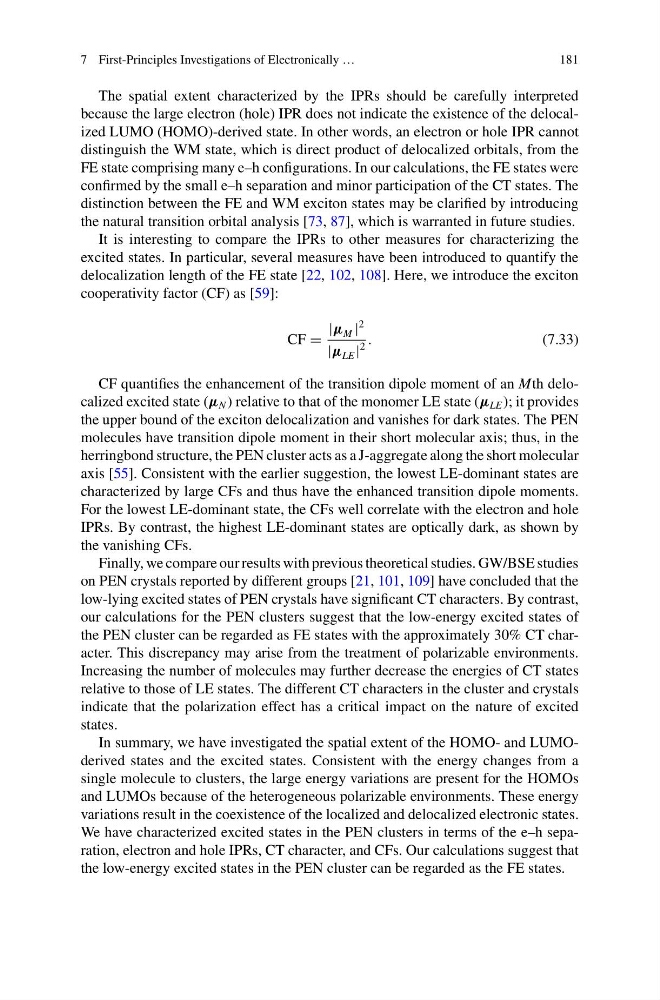
cooperativity factor (CF) as [59]:
CF =
|µ M |
2
|µ LE |
2
.
(7.33)
CF quantifies the enhancement of the transition dipole moment of an Mth delocalized excited state (µ N ) relative to that of the monomer LE state (µ LE ); it provides
the upper bound of the exciton delocalization and vanishes for dark states. The PEN
molecules have transition dipole moment in their short molecular axis; thus, in the
herringbond structure, the PEN cluster acts as a J-aggregate along the short molecular
axis [55]. Consistent with the earlier suggestion, the lowest LE-dominant states are
characterized by large CFs and thus have the enhanced transition dipole moments.
For the lowest LE-dominant state, the CFs well correlate with the electron and hole
IPRs. By contrast, the highest LE-dominant states are optically dark, as shown by
the vanishing CFs.
Finally, we compare our results with previous theoretical studies. GW/BSE studies
on PEN crystals reported by different groups [21, 101, 109] have concluded that the
low-lying excited states of PEN crystals have significant CT characters. By contrast,
our calculations for the PEN clusters suggest that the low-energy excited states of
the PEN cluster can be regarded as FE states with the approximately 30% CT character. This discrepancy may arise from the treatment of polarizable environments.
Increasing the number of molecules may further decrease the energies of CT states
relative to those of LE states. The different CT characters in the cluster and crystals
indicate that the polarization effect has a critical impact on the nature of excited
states.
In summary, we have investigated the spatial extent of the HOMO- and LUMOderived states and the excited states. Consistent with the energy changes from a
single molecule to clusters, the large energy variations are present for the HOMOs
and LUMOs because of the heterogeneous polarizable environments. These energy
variations result in the coexistence of the localized and delocalized electronic states.
We have characterized excited states in the PEN clusters in terms of the e–h separation, electron and hole IPRs, CT character, and CFs. Our calculations suggest that
the low-energy excited states in the PEN cluster can be regarded as the FE states.
181
The spatial extent characterized by the IPRs should be carefully interpreted
because the large electron (hole) IPR does not indicate the existence of the delocalized LUMO (HOMO)-derived state. In other words, an electron or hole IPR cannot
distinguish the WM state, which is direct product of delocalized orbitals, from the
FE state comprising many e–h configurations. In our calculations, the FE states were
confirmed by the small e–h separation and minor participation of the CT states. The
distinction between the FE and WM exciton states may be clarified by introducing
the natural transition orbital analysis [73, 87], which is warranted in future studies.
It is interesting to compare the IPRs to other measures for characterizing the
excited states. In particular, several measures have been introduced to quantify the
delocalization length of the FE state [22, 102, 108]. Here, we introduce the exciton
cooperativity factor (CF) as [59]:
CF =
|µ M |
2
|µ LE |
2
.
(7.33)
CF quantifies the enhancement of the transition dipole moment of an Mth delocalized excited state (µ N ) relative to that of the monomer LE state (µ LE ); it provides
the upper bound of the exciton delocalization and vanishes for dark states. The PEN
molecules have transition dipole moment in their short molecular axis; thus, in the
herringbond structure, the PEN cluster acts as a J-aggregate along the short molecular
axis [55]. Consistent with the earlier suggestion, the lowest LE-dominant states are
characterized by large CFs and thus have the enhanced transition dipole moments.
For the lowest LE-dominant state, the CFs well correlate with the electron and hole
IPRs. By contrast, the highest LE-dominant states are optically dark, as shown by
the vanishing CFs.
Finally, we compare our results with previous theoretical studies. GW/BSE studies
on PEN crystals reported by different groups [21, 101, 109] have concluded that the
low-lying excited states of PEN crystals have significant CT characters. By contrast,
our calculations for the PEN clusters suggest that the low-energy excited states of
the PEN cluster can be regarded as FE states with the approximately 30% CT character. This discrepancy may arise from the treatment of polarizable environments.
Increasing the number of molecules may further decrease the energies of CT states
relative to those of LE states. The different CT characters in the cluster and crystals
indicate that the polarization effect has a critical impact on the nature of excited
states.
In summary, we have investigated the spatial extent of the HOMO- and LUMOderived states and the excited states. Consistent with the energy changes from a
single molecule to clusters, the large energy variations are present for the HOMOs
and LUMOs because of the heterogeneous polarizable environments. These energy
variations result in the coexistence of the localized and delocalized electronic states.
We have characterized excited states in the PEN clusters in terms of the e–h separation, electron and hole IPRs, CT character, and CFs. Our calculations suggest that
the low-energy excited states in the PEN cluster can be regarded as the FE states.