

7 First-Principles Investigations of Electronically …
179
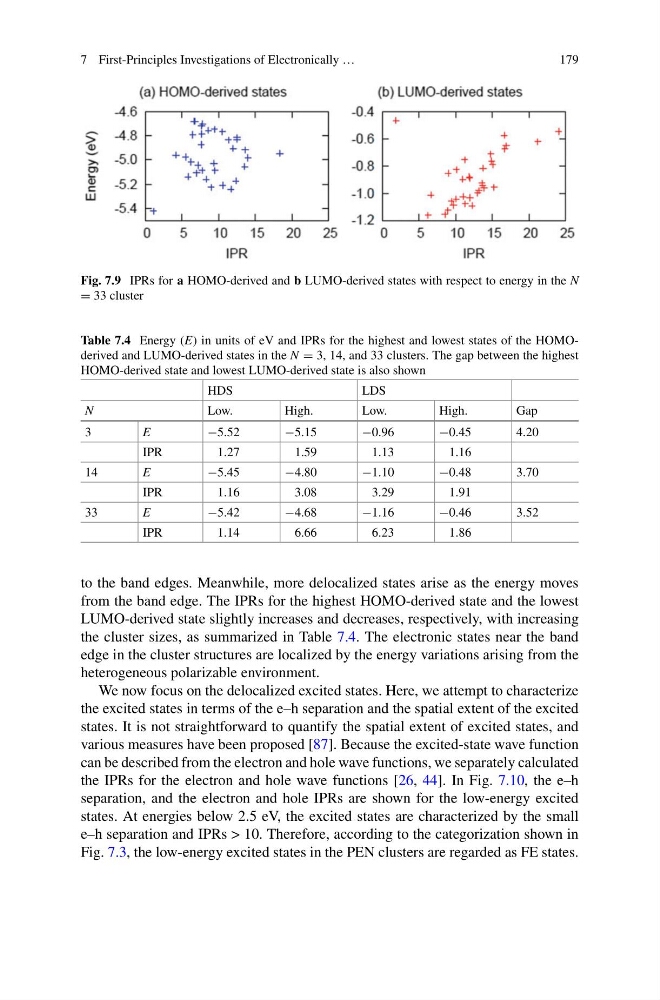
Fig. 7.9 IPRs for a HOMO-derived and b LUMO-derived states with respect to energy in the N
= 33 cluster
Table 7.4 Energy (E) in units of eV and IPRs for the highest and lowest states of the HOMOderived and LUMO-derived states in the N = 3, 14, and 33 clusters. The gap between the highest
HOMO-derived state and lowest LUMO-derived state is also shown
HDS
LDS
N
Low.
High.
Low.
High.
Gap
3
E
−5.52
−5.15
−0.96
−0.45
4.20
IPR
1.27
1.59
1.13
1.16
14
E
−5.45
−4.80
−1.10
−0.48
3.70
IPR
1.16
3.08
3.29
1.91
33
E
−5.42
−4.68
−1.16
−0.46
3.52
IPR
1.14
6.66
6.23
1.86
to the band edges. Meanwhile, more delocalized states arise as the energy moves
from the band edge. The IPRs for the highest HOMO-derived state and the lowest
LUMO-derived state slightly increases and decreases, respectively, with increasing
the cluster sizes, as summarized in Table 7.4. The electronic states near the band
edge in the cluster structures are localized by the energy variations arising from the
heterogeneous polarizable environment.
We now focus on the delocalized excited states. Here, we attempt to characterize
the excited states in terms of the e–h separation and the spatial extent of the excited
states. It is not straightforward to quantify the spatial extent of excited states, and
various measures have been proposed [87]. Because the excited-state wave function
can be described from the electron and hole wave functions, we separately calculated
the IPRs for the electron and hole wave functions [26, 44]. In Fig. 7.10, the e–h
separation, and the electron and hole IPRs are shown for the low-energy excited
states. At energies below 2.5 eV, the excited states are characterized by the small
e–h separation and IPRs > 10. Therefore, according to the categorization shown in
Fig. 7.3, the low-energy excited states in the PEN clusters are regarded as FE states.
179
Fig. 7.9 IPRs for a HOMO-derived and b LUMO-derived states with respect to energy in the N
= 33 cluster
Table 7.4 Energy (E) in units of eV and IPRs for the highest and lowest states of the HOMOderived and LUMO-derived states in the N = 3, 14, and 33 clusters. The gap between the highest
HOMO-derived state and lowest LUMO-derived state is also shown
HDS
LDS
N
Low.
High.
Low.
High.
Gap
3
E
−5.52
−5.15
−0.96
−0.45
4.20
IPR
1.27
1.59
1.13
1.16
14
E
−5.45
−4.80
−1.10
−0.48
3.70
IPR
1.16
3.08
3.29
1.91
33
E
−5.42
−4.68
−1.16
−0.46
3.52
IPR
1.14
6.66
6.23
1.86
to the band edges. Meanwhile, more delocalized states arise as the energy moves
from the band edge. The IPRs for the highest HOMO-derived state and the lowest
LUMO-derived state slightly increases and decreases, respectively, with increasing
the cluster sizes, as summarized in Table 7.4. The electronic states near the band
edge in the cluster structures are localized by the energy variations arising from the
heterogeneous polarizable environment.
We now focus on the delocalized excited states. Here, we attempt to characterize
the excited states in terms of the e–h separation and the spatial extent of the excited
states. It is not straightforward to quantify the spatial extent of excited states, and
various measures have been proposed [87]. Because the excited-state wave function
can be described from the electron and hole wave functions, we separately calculated
the IPRs for the electron and hole wave functions [26, 44]. In Fig. 7.10, the e–h
separation, and the electron and hole IPRs are shown for the low-energy excited
states. At energies below 2.5 eV, the excited states are characterized by the small
e–h separation and IPRs > 10. Therefore, according to the categorization shown in
Fig. 7.3, the low-energy excited states in the PEN clusters are regarded as FE states.