

178
T. Fujita
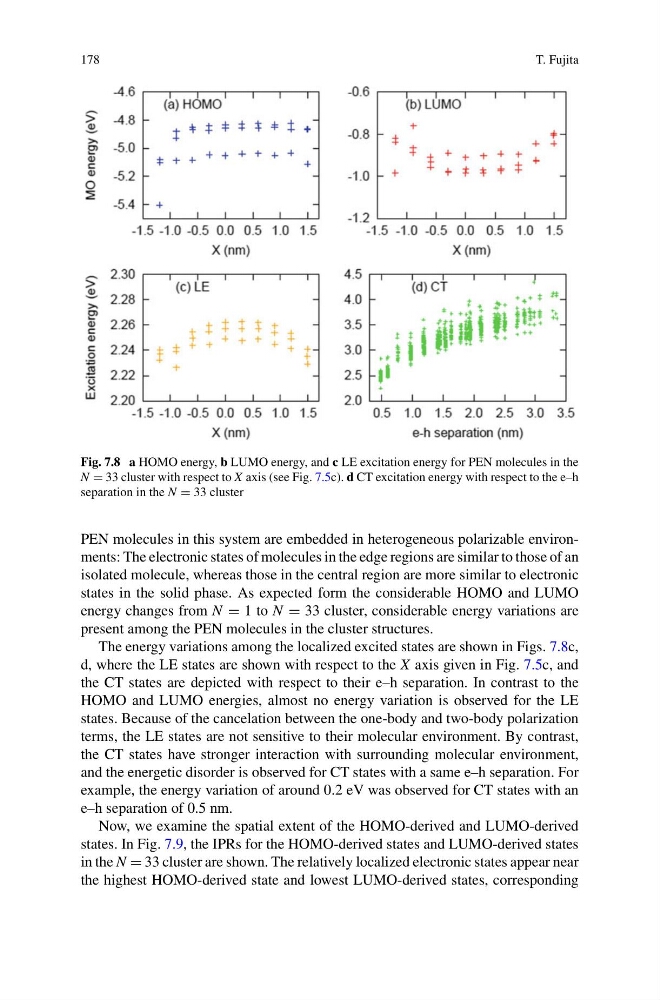
Fig. 7.8 a HOMO energy, b LUMO energy, and c LE excitation energy for PEN molecules in the
N = 33 cluster with respect to X axis (see Fig. 7.5c). d CT excitation energy with respect to the e–h
separation in the N = 33 cluster
PEN molecules in this system are embedded in heterogeneous polarizable environments: The electronic states of molecules in the edge regions are similar to those of an
isolated molecule, whereas those in the central region are more similar to electronic
states in the solid phase. As expected form the considerable HOMO and LUMO
energy changes from N = 1 to N = 33 cluster, considerable energy variations are
present among the PEN molecules in the cluster structures.
The energy variations among the localized excited states are shown in Figs. 7.8c,
d, where the LE states are shown with respect to the X axis given in Fig. 7.5c, and
the CT states are depicted with respect to their e–h separation. In contrast to the
HOMO and LUMO energies, almost no energy variation is observed for the LE
states. Because of the cancelation between the one-body and two-body polarization
terms, the LE states are not sensitive to their molecular environment. By contrast,
the CT states have stronger interaction with surrounding molecular environment,
and the energetic disorder is observed for CT states with a same e–h separation. For
example, the energy variation of around 0.2 eV was observed for CT states with an
e–h separation of 0.5 nm.
Now, we examine the spatial extent of the HOMO-derived and LUMO-derived
states. In Fig. 7.9, the IPRs for the HOMO-derived states and LUMO-derived states
in the N = 33 cluster are shown. The relatively localized electronic states appear near
the highest HOMO-derived state and lowest LUMO-derived states, corresponding
T. Fujita
Fig. 7.8 a HOMO energy, b LUMO energy, and c LE excitation energy for PEN molecules in the
N = 33 cluster with respect to X axis (see Fig. 7.5c). d CT excitation energy with respect to the e–h
separation in the N = 33 cluster
PEN molecules in this system are embedded in heterogeneous polarizable environments: The electronic states of molecules in the edge regions are similar to those of an
isolated molecule, whereas those in the central region are more similar to electronic
states in the solid phase. As expected form the considerable HOMO and LUMO
energy changes from N = 1 to N = 33 cluster, considerable energy variations are
present among the PEN molecules in the cluster structures.
The energy variations among the localized excited states are shown in Figs. 7.8c,
d, where the LE states are shown with respect to the X axis given in Fig. 7.5c, and
the CT states are depicted with respect to their e–h separation. In contrast to the
HOMO and LUMO energies, almost no energy variation is observed for the LE
states. Because of the cancelation between the one-body and two-body polarization
terms, the LE states are not sensitive to their molecular environment. By contrast,
the CT states have stronger interaction with surrounding molecular environment,
and the energetic disorder is observed for CT states with a same e–h separation. For
example, the energy variation of around 0.2 eV was observed for CT states with an
e–h separation of 0.5 nm.
Now, we examine the spatial extent of the HOMO-derived and LUMO-derived
states. In Fig. 7.9, the IPRs for the HOMO-derived states and LUMO-derived states
in the N = 33 cluster are shown. The relatively localized electronic states appear near
the highest HOMO-derived state and lowest LUMO-derived states, corresponding