

7 First-Principles Investigations of Electronically …
177
In summary, we have investigated the polarization energies of the HOMO, LUMO,
and localized excited states. Our calculations confirmed the previous suggestion that
the IP effects are predominantly responsible for the HOMO–LUMO gap reduction.
In contrast to the previous assumption that the anion and cation polarization energies
are same, we have found the unequal polarization between the cation and anion
states. We also examined the polarization energies of excited states, highlighting the
cancelation between the one-body and two-body polarization energies in the LE and
CT states.
7.4.2 Delocalized Electronic States
Having investigated the polarization energies of the localized states, we next turn
to the delocalized electronic states in the PEN clusters. The HOMO-derived and
LUMO-derived states were described as the superposition of HOMOs and LUMOs
of all the constituent PEN molecules in the cluster structures, as given by Eqs. 7.3
and 7.4. As well as the single-electron states, the delocalized excited states were
calculated as the superposition of the LE and CT states (Eq. 7.29).
Here, we briefly discuss factors governing the spatial extent of the electronic states.
One factor contributing the spatial extent of the electronic states is an electronic
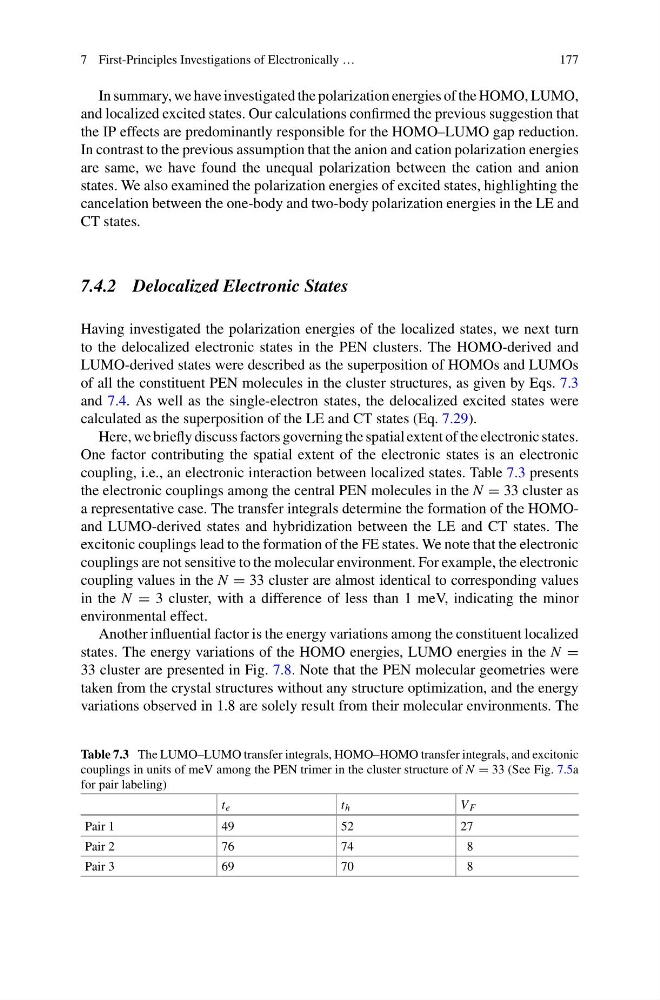
coupling, i.e., an electronic interaction between localized states. Table 7.3 presents
the electronic couplings among the central PEN molecules in the N = 33 cluster as
a representative case. The transfer integrals determine the formation of the HOMOand LUMO-derived states and hybridization between the LE and CT states. The
excitonic couplings lead to the formation of the FE states. We note that the electronic
couplings are not sensitive to the molecular environment. For example, the electronic
coupling values in the N = 33 cluster are almost identical to corresponding values
in the N = 3 cluster, with a difference of less than 1 meV, indicating the minor
environmental effect.
Another influential factor is the energy variations among the constituent localized
states. The energy variations of the HOMO energies, LUMO energies in the N =
33 cluster are presented in Fig. 7.8. Note that the PEN molecular geometries were
taken from the crystal structures without any structure optimization, and the energy
variations observed in 1.8 are solely result from their molecular environments. The
Table 7.3 The LUMO–LUMO transfer integrals, HOMO–HOMO transfer integrals, and excitonic
couplings in units of meV among the PEN trimer in the cluster structure of N = 33 (See Fig. 7.5a
for pair labeling)
t e
t h
V F
Pair 1
49
52
27
Pair 2
76
74
8
Pair 3
69
70
8
177
In summary, we have investigated the polarization energies of the HOMO, LUMO,
and localized excited states. Our calculations confirmed the previous suggestion that
the IP effects are predominantly responsible for the HOMO–LUMO gap reduction.
In contrast to the previous assumption that the anion and cation polarization energies
are same, we have found the unequal polarization between the cation and anion
states. We also examined the polarization energies of excited states, highlighting the
cancelation between the one-body and two-body polarization energies in the LE and
CT states.
7.4.2 Delocalized Electronic States
Having investigated the polarization energies of the localized states, we next turn
to the delocalized electronic states in the PEN clusters. The HOMO-derived and
LUMO-derived states were described as the superposition of HOMOs and LUMOs
of all the constituent PEN molecules in the cluster structures, as given by Eqs. 7.3
and 7.4. As well as the single-electron states, the delocalized excited states were
calculated as the superposition of the LE and CT states (Eq. 7.29).
Here, we briefly discuss factors governing the spatial extent of the electronic states.
One factor contributing the spatial extent of the electronic states is an electronic
coupling, i.e., an electronic interaction between localized states. Table 7.3 presents
the electronic couplings among the central PEN molecules in the N = 33 cluster as
a representative case. The transfer integrals determine the formation of the HOMOand LUMO-derived states and hybridization between the LE and CT states. The
excitonic couplings lead to the formation of the FE states. We note that the electronic
couplings are not sensitive to the molecular environment. For example, the electronic
coupling values in the N = 33 cluster are almost identical to corresponding values
in the N = 3 cluster, with a difference of less than 1 meV, indicating the minor
environmental effect.
Another influential factor is the energy variations among the constituent localized
states. The energy variations of the HOMO energies, LUMO energies in the N =
33 cluster are presented in Fig. 7.8. Note that the PEN molecular geometries were
taken from the crystal structures without any structure optimization, and the energy
variations observed in 1.8 are solely result from their molecular environments. The
Table 7.3 The LUMO–LUMO transfer integrals, HOMO–HOMO transfer integrals, and excitonic
couplings in units of meV among the PEN trimer in the cluster structure of N = 33 (See Fig. 7.5a
for pair labeling)
t e
t h
V F
Pair 1
49
52
27
Pair 2
76
74
8
Pair 3
69
70
8