

7 First-Principles Investigations of Electronically …
169
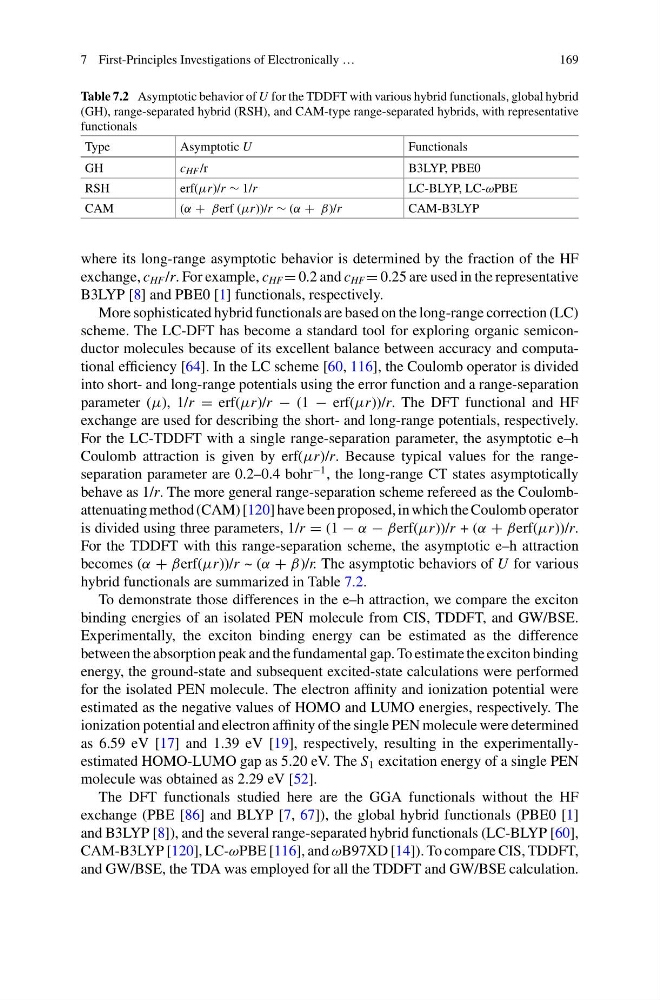
Table 7.2 Asymptotic behavior of U for the TDDFT with various hybrid functionals, global hybrid
(GH), range-separated hybrid (RSH), and CAM-type range-separated hybrids, with representative
functionals
Type
Asymptotic U
Functionals
GH
c HF /r
B3LYP, PBE0
RSH
erf(μr)/r ∼ 1/r
LC-BLYP, LC-ωPBE
CAM
(α + βerf (μr))/r ∼ (α + β)/r
CAM-B3LYP
where its long-range asymptotic behavior is determined by the fraction of the HF
exchange, c HF /r. For example, c HF = 0.2 and c HF = 0.25 are used in the representative
B3LYP [8] and PBE0 [1] functionals, respectively.
More sophisticated hybrid functionals are based on the long-range correction (LC)
scheme. The LC-DFT has become a standard tool for exploring organic semiconductor molecules because of its excellent balance between accuracy and computational efficiency [64]. In the LC scheme [60, 116], the Coulomb operator is divided
into short- and long-range potentials using the error function and a range-separation
parameter (μ), 1/r = erf(μr)/r − (1 − erf(μr))/r. The DFT functional and HF
exchange are used for describing the short- and long-range potentials, respectively.
For the LC-TDDFT with a single range-separation parameter, the asymptotic e–h
Coulomb attraction is given by erf(μr)/r. Because typical values for the rangeseparation parameter are 0.2–0.4 bohr
−1 , the long-range CT states asymptotically
behave as 1/r. The more general range-separation scheme refereed as the Coulombattenuating method (CAM) [120] have been proposed, in which the Coulomb operator
is divided using three parameters, 1/r = (1 − α − βerf(μr))/r + (α + βerf(μr))/r.
For the TDDFT with this range-separation scheme, the asymptotic e–h attraction
becomes (α + βerf(μr))/r ~ (α + β)/r. The asymptotic behaviors of U for various
hybrid functionals are summarized in Table 7.2.
To demonstrate those differences in the e–h attraction, we compare the exciton
binding energies of an isolated PEN molecule from CIS, TDDFT, and GW/BSE.
Experimentally, the exciton binding energy can be estimated as the difference
between the absorption peak and the fundamental gap. To estimate the exciton binding
energy, the ground-state and subsequent excited-state calculations were performed
for the isolated PEN molecule. The electron affinity and ionization potential were
estimated as the negative values of HOMO and LUMO energies, respectively. The
ionization potential and electron affinity of the single PEN molecule were determined
as 6.59 eV [17] and 1.39 eV [19], respectively, resulting in the experimentallyestimated HOMO-LUMO gap as 5.20 eV. The S 1 excitation energy of a single PEN
molecule was obtained as 2.29 eV [52].
The DFT functionals studied here are the GGA functionals without the HF
exchange (PBE [86] and BLYP [7, 67]), the global hybrid functionals (PBE0 [1]
and B3LYP [8]), and the several range-separated hybrid functionals (LC-BLYP [60],
CAM-B3LYP [120], LC-ωPBE [116], and ωB97XD [14]). To compare CIS, TDDFT,
and GW/BSE, the TDA was employed for all the TDDFT and GW/BSE calculation.
169
Table 7.2 Asymptotic behavior of U for the TDDFT with various hybrid functionals, global hybrid
(GH), range-separated hybrid (RSH), and CAM-type range-separated hybrids, with representative
functionals
Type
Asymptotic U
Functionals
GH
c HF /r
B3LYP, PBE0
RSH
erf(μr)/r ∼ 1/r
LC-BLYP, LC-ωPBE
CAM
(α + βerf (μr))/r ∼ (α + β)/r
CAM-B3LYP
where its long-range asymptotic behavior is determined by the fraction of the HF
exchange, c HF /r. For example, c HF = 0.2 and c HF = 0.25 are used in the representative
B3LYP [8] and PBE0 [1] functionals, respectively.
More sophisticated hybrid functionals are based on the long-range correction (LC)
scheme. The LC-DFT has become a standard tool for exploring organic semiconductor molecules because of its excellent balance between accuracy and computational efficiency [64]. In the LC scheme [60, 116], the Coulomb operator is divided
into short- and long-range potentials using the error function and a range-separation
parameter (μ), 1/r = erf(μr)/r − (1 − erf(μr))/r. The DFT functional and HF
exchange are used for describing the short- and long-range potentials, respectively.
For the LC-TDDFT with a single range-separation parameter, the asymptotic e–h
Coulomb attraction is given by erf(μr)/r. Because typical values for the rangeseparation parameter are 0.2–0.4 bohr
−1 , the long-range CT states asymptotically
behave as 1/r. The more general range-separation scheme refereed as the Coulombattenuating method (CAM) [120] have been proposed, in which the Coulomb operator
is divided using three parameters, 1/r = (1 − α − βerf(μr))/r + (α + βerf(μr))/r.
For the TDDFT with this range-separation scheme, the asymptotic e–h attraction
becomes (α + βerf(μr))/r ~ (α + β)/r. The asymptotic behaviors of U for various
hybrid functionals are summarized in Table 7.2.
To demonstrate those differences in the e–h attraction, we compare the exciton
binding energies of an isolated PEN molecule from CIS, TDDFT, and GW/BSE.
Experimentally, the exciton binding energy can be estimated as the difference
between the absorption peak and the fundamental gap. To estimate the exciton binding
energy, the ground-state and subsequent excited-state calculations were performed
for the isolated PEN molecule. The electron affinity and ionization potential were
estimated as the negative values of HOMO and LUMO energies, respectively. The
ionization potential and electron affinity of the single PEN molecule were determined
as 6.59 eV [17] and 1.39 eV [19], respectively, resulting in the experimentallyestimated HOMO-LUMO gap as 5.20 eV. The S 1 excitation energy of a single PEN
molecule was obtained as 2.29 eV [52].
The DFT functionals studied here are the GGA functionals without the HF
exchange (PBE [86] and BLYP [7, 67]), the global hybrid functionals (PBE0 [1]
and B3LYP [8]), and the several range-separated hybrid functionals (LC-BLYP [60],
CAM-B3LYP [120], LC-ωPBE [116], and ωB97XD [14]). To compare CIS, TDDFT,
and GW/BSE, the TDA was employed for all the TDDFT and GW/BSE calculation.