

170
T. Fujita
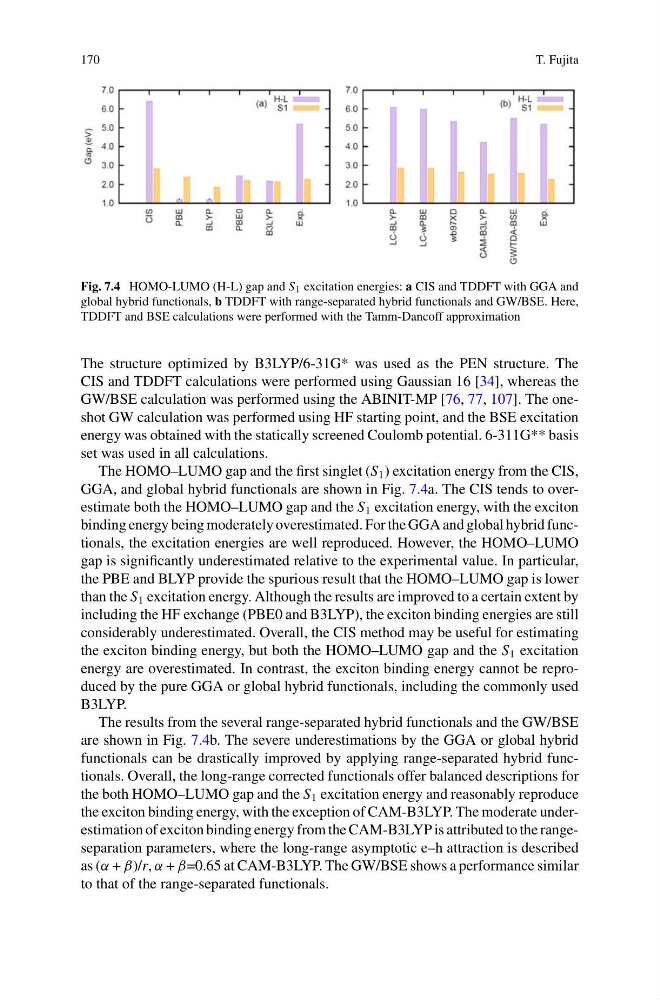
Fig. 7.4 HOMO-LUMO (H-L) gap and S 1 excitation energies: a CIS and TDDFT with GGA and
global hybrid functionals, b TDDFT with range-separated hybrid functionals and GW/BSE. Here,
TDDFT and BSE calculations were performed with the Tamm-Dancoff approximation
The structure optimized by B3LYP/6-31G* was used as the PEN structure. The
CIS and TDDFT calculations were performed using Gaussian 16 [34], whereas the
GW/BSE calculation was performed using the ABINIT-MP [76, 77, 107]. The oneshot GW calculation was performed using HF starting point, and the BSE excitation
energy was obtained with the statically screened Coulomb potential. 6-311G** basis
set was used in all calculations.
The HOMO–LUMO gap and the first singlet (S 1 ) excitation energy from the CIS,
GGA, and global hybrid functionals are shown in Fig. 7.4a. The CIS tends to overestimate both the HOMO–LUMO gap and the S 1 excitation energy, with the exciton
binding energy being moderately overestimated. For the GGA and global hybrid functionals, the excitation energies are well reproduced. However, the HOMO–LUMO
gap is significantly underestimated relative to the experimental value. In particular,
the PBE and BLYP provide the spurious result that the HOMO–LUMO gap is lower
than the S 1 excitation energy. Although the results are improved to a certain extent by
including the HF exchange (PBE0 and B3LYP), the exciton binding energies are still
considerably underestimated. Overall, the CIS method may be useful for estimating
the exciton binding energy, but both the HOMO–LUMO gap and the S 1 excitation
energy are overestimated. In contrast, the exciton binding energy cannot be reproduced by the pure GGA or global hybrid functionals, including the commonly used
B3LYP.
The results from the several range-separated hybrid functionals and the GW/BSE
are shown in Fig. 7.4b. The severe underestimations by the GGA or global hybrid
functionals can be drastically improved by applying range-separated hybrid functionals. Overall, the long-range corrected functionals offer balanced descriptions for
the both HOMO–LUMO gap and the S 1 excitation energy and reasonably reproduce
the exciton binding energy, with the exception of CAM-B3LYP. The moderate underestimation of exciton binding energy from the CAM-B3LYP is attributed to the rangeseparation parameters, where the long-range asymptotic e–h attraction is described
as (α + β)/r, α + β=0.65 at CAM-B3LYP. The GW/BSE shows a performance similar
to that of the range-separated functionals.
T. Fujita
Fig. 7.4 HOMO-LUMO (H-L) gap and S 1 excitation energies: a CIS and TDDFT with GGA and
global hybrid functionals, b TDDFT with range-separated hybrid functionals and GW/BSE. Here,
TDDFT and BSE calculations were performed with the Tamm-Dancoff approximation
The structure optimized by B3LYP/6-31G* was used as the PEN structure. The
CIS and TDDFT calculations were performed using Gaussian 16 [34], whereas the
GW/BSE calculation was performed using the ABINIT-MP [76, 77, 107]. The oneshot GW calculation was performed using HF starting point, and the BSE excitation
energy was obtained with the statically screened Coulomb potential. 6-311G** basis
set was used in all calculations.
The HOMO–LUMO gap and the first singlet (S 1 ) excitation energy from the CIS,
GGA, and global hybrid functionals are shown in Fig. 7.4a. The CIS tends to overestimate both the HOMO–LUMO gap and the S 1 excitation energy, with the exciton
binding energy being moderately overestimated. For the GGA and global hybrid functionals, the excitation energies are well reproduced. However, the HOMO–LUMO
gap is significantly underestimated relative to the experimental value. In particular,
the PBE and BLYP provide the spurious result that the HOMO–LUMO gap is lower
than the S 1 excitation energy. Although the results are improved to a certain extent by
including the HF exchange (PBE0 and B3LYP), the exciton binding energies are still
considerably underestimated. Overall, the CIS method may be useful for estimating
the exciton binding energy, but both the HOMO–LUMO gap and the S 1 excitation
energy are overestimated. In contrast, the exciton binding energy cannot be reproduced by the pure GGA or global hybrid functionals, including the commonly used
B3LYP.
The results from the several range-separated hybrid functionals and the GW/BSE
are shown in Fig. 7.4b. The severe underestimations by the GGA or global hybrid
functionals can be drastically improved by applying range-separated hybrid functionals. Overall, the long-range corrected functionals offer balanced descriptions for
the both HOMO–LUMO gap and the S 1 excitation energy and reasonably reproduce
the exciton binding energy, with the exception of CAM-B3LYP. The moderate underestimation of exciton binding energy from the CAM-B3LYP is attributed to the rangeseparation parameters, where the long-range asymptotic e–h attraction is described
as (α + β)/r, α + β=0.65 at CAM-B3LYP. The GW/BSE shows a performance similar
to that of the range-separated functionals.